 Emily Anderson Stern
As controversy grows around celebrity investor Kevin O’Leary’s proposed hyperscale data center in Box Elder County, Utah Gov. Spencer Cox has lambasted its rollout as “not good,” saying both his office and lawmakers should have been involved in the decision to “make sure people understand what’s actually happening out there.”
And on Friday, Cox signed an executive order “establishing higher standards for data center development in Utah.”
But records obtained by The Salt Lake Tribune show the governor’s office knew O’Leary was pursuing building a data center in the Beehive State as early as mid-December — more than five months before Friday’s order, and four months before a governmental authority voted, with little public awareness, to help facilitate the massive project.
“Utahns have raised important questions about the impact large data centers could have on water, air quality, utility rates and quality of life,” Cox said in a statement on the order. “Those concerns deserve to be taken seriously.”
(Chris Samuels | The Salt Lake Tribune) People protest the Stratos data center project at the Utah Capitol in Salt Lake City on Thursday, May 14, 2026.
Alexander Tarbet, a Utah-based government strategist representing O’Leary, sent his first email about the project to Cox’s office on Dec. 16, 2025, records show.
“It was fun to see you the other day,” Tarbet wrote to scheduling director Tiffeni Wall. “I hope you’re doing well and ready for Christmas! Kevin O’Leary is in town Jan 7-9 and would like to meet with the Governor. Is there a time we can jump on the schedule?”
Wall responded a couple days later, on Dec. 18, asking for more context on the purpose of the meeting, saying the governor had a “full schedule” following the holidays.
“KO from Shark Tank would like to meet with the Gov on Jan 8 to discuss data centers in UT. He has a data center facility in Alberta and would like to talk about doing one in UT,” Tarbet replied within minutes.
Cox agreed to the meeting, emails show, and it appeared on his public schedule in January.
As initially described by the agency that gave the first green light to the project — the Military Installation Development Authority, or MIDA — the data center campus would be built on a 40,000-acre site and would generate and use 9 gigawatts of energy at full buildout, powered solely by natural gas. Cox has since said only its first phase will be powered exclusively by natural gas, “but the other phases should not be.”
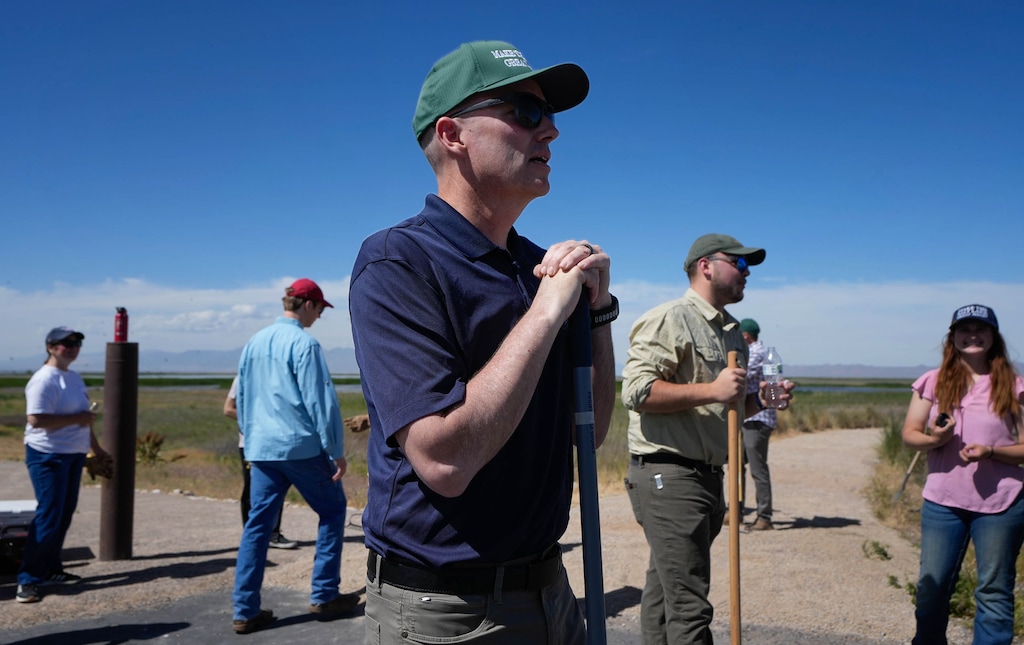
(Francisco Kjolseth | The Salt Lake Tribune) Gov. Spencer Cox concludes a meeting on the Great Salt Lake with federal, philanthropic, scientific, business and conservation leaders on Friday, May 29, 2026. The governor had just signed an executive order establishing a statewide framework to guide the evaluation and development of large data center projects in Utah.
The governor’s office did not respond to a series of questions on how much he learned about the data center proposal in his interactions with O’Leary, and what limited him from ensuring it was discussed more publicly before MIDA passed a handful of resolutions that give the project tax breaks and help it move forward.
A planning document named “Meet w/ Kevin O’Leary” and shared through emails ahead of the governor’s meeting was not included in records his office provided under a Government Records Access and Management Act request.
It was one of the records the office classified as “protected,” because “they would reveal the governor’s contemplated policies or courses of action before the governor has implemented or rejected those policies or made them public.”
Among the “guiding principles” for Cox’s executive order listed in a news release is “Providing transparent, meaningful and thorough opportunities for public comment.”
(Governor's Office of Economic Opportunity) Celebrity investor and "Shark Tank" star Kevin O'Leary sits next to Gov. Spencer Cox (at the head of the table), along with other Utah officials, during a visit to Salt Lake City on Jan. 8, 2026.
Speaking with reporters Friday on the wetlands of the ailing Great Salt Lake, and wearing a green cap that read, “MAKE THE LAKE GREAT AGAIN,” the governor called immense public backlash against the proposed complex “incredibly helpful.”
“Public pressure is important,” Cox said. “I share those concerns, and if I had had any concerns about ... water and the Great Salt Lake ... I would have opposed it from the very beginning.”
(Governor's Office of Economic Opportunity) Celebrity investor and "Shark Tank" star Kevin O'Leary poses for a photo behind the desk of Utah Gov. Spencer Cox, during a visit to Salt Lake City on Jan. 8, 2026.
A photo of the Jan. 8 meeting obtained through a separate public records request to the Governor’s Office of Economic Development shows Cox smiling at the head of a boardroom table, with O’Leary sitting next to him.
In other photos included in the response, O’Leary is seated at the governor’s desk, grinning while a woman takes a picture with a cell phone. And in another, he poses with Tyler Jennings, the director of entrepreneurship and ecosystem development for GOED.
Tarbet requested meetings for O’Leary with other top Utah officials around the same time, records show.
Emails obtained from the Utah House of Representatives indicate Tarbet asked on Jan. 6 that Speaker Mike Schultz, R-Hooper, sit down with O’Leary while he was at the Capitol on Jan. 8.
An executive assistant turned down the meeting, saying “we won’t be able to make it work” because Schultz had an all-day legislative session planning conference with House Republicans, and noted the speaker needed one to two weeks of notice for such appointments.
While critics of the speaker have raised questions about whether his ownership of land in the area could lead to him profiting from the data center, Schultz has said he is concerned about the project. He told The Tribune, “Personally, and for my ranch, this data center is not a good thing.”
It’s unclear at what point Senate President J. Stuart Adams, who chairs MIDA, was introduced to O’Leary. A similar public records request to the Utah Senate did not produce emails seeking to arrange a meeting.
Emily is a statewatch reporter at The Salt Lake Tribune, where she has worked since 2022. She received her master's degree in journalism from Northwestern University. There, she worked on investigative projects for The Washington Post and ProPublica. While writing, she's probably spinning something from her ever-expanding shelf of punk records.