 Robert Gehrke
A tight race for Davis County Commissioner is under dispute even though election officials have counted all the votes and certified Bret Millburn’s victory over Susan Lee.
Lee — the Republican candidate for the seat and mother of former state Rep. Trevor Lee – lost by 412 votes.
But her campaign manager, Jason Sanders, has requested a criminal investigation into whether Millburn, an unaffiliated candidate, violated election law and should be banned from taking office.
Sanders’ complaint accuses Millburn of illegal “electioneering” — campaigning in a building within 150 feet of a ballot box during the time when voters could drop off their ballots – based on Millburn’s comments about his candidacy at two city council meetings.
Former Rep. Suzanne Harrison, who sponsored the last bill that changed this section of Utah election law, said she believes tweaks made in 2020 were intended to accommodate these kinds of presentations. Now on the Salt Lake County Council, she said candidates for office “frequently” appear before the council and introduce themselves and explain why they’re running.
But Sanders, an attorney, wants the attorney general, lieutenant governor or Davis County attorney to investigate whether Millburn’s comments to the councils violated the law, which does not specify an exemption for such comments at public meetings.
“Utah law protects the space where people cast their ballots, and that protection applies to every candidate equally,” Sanders said in a statement. “I’m not asking anyone to prejudge this. I’m asking prosecutors to look at the public notice and the meeting recordings and decide whether the law was followed.”
A violation of the electioneering provision is a class A misdemeanor.
More importantly, however, the law prohibits anyone convicted of the election violation from holding the office he or she was running for.
A spokesperson for the lieutenant governor’s office referred questions about Sanders’ complaint to Davis County Attorney Troy Rawlings, who declined to comment.
‘Last stand of a desperate and disappointed candidate’
On October 20, Millburn spoke during the public comment period at two city council meetings — Woods Cross and Fruit Heights. He introduced himself as a candidate for county commission, explaining that he was running as an unaffiliated candidate because he was tired of partisanship and wanted to represent everyone. He also criticized a proposed property tax increase.
“I firmly believe in fostering and maintaining relationships with all 15 cities,” Millburn said at the Fruit Heights meeting. “And I’ll just quickly end with kind of my mantra, and that’s: People over politics, experience over partisanship and proven results over rhetoric.”
Millburn had spoken to several other city councils — like Bountiful, Sunset and Farmington — before ballots were sent out, as well. But Sanders argues that addressing the two councils while voting was open at drop boxes at city hall violated the electioneering provision.
David Irvine, a lawyer and former legislator representing Millburn, said the complaint is frivolous and that candidates commonly speak to city councils. Sanders’ interpretation would prohibit any candidate from appearing before the city council or at events inside city halls, which raises First Amendment free speech issues.
“It would be shocking if the bogus complaint were taken seriously by the lieutenant governor or the county attorney,” Irvine said in a statement. “This bogus complaint is the last stand of a desperate and disappointed candidate.”
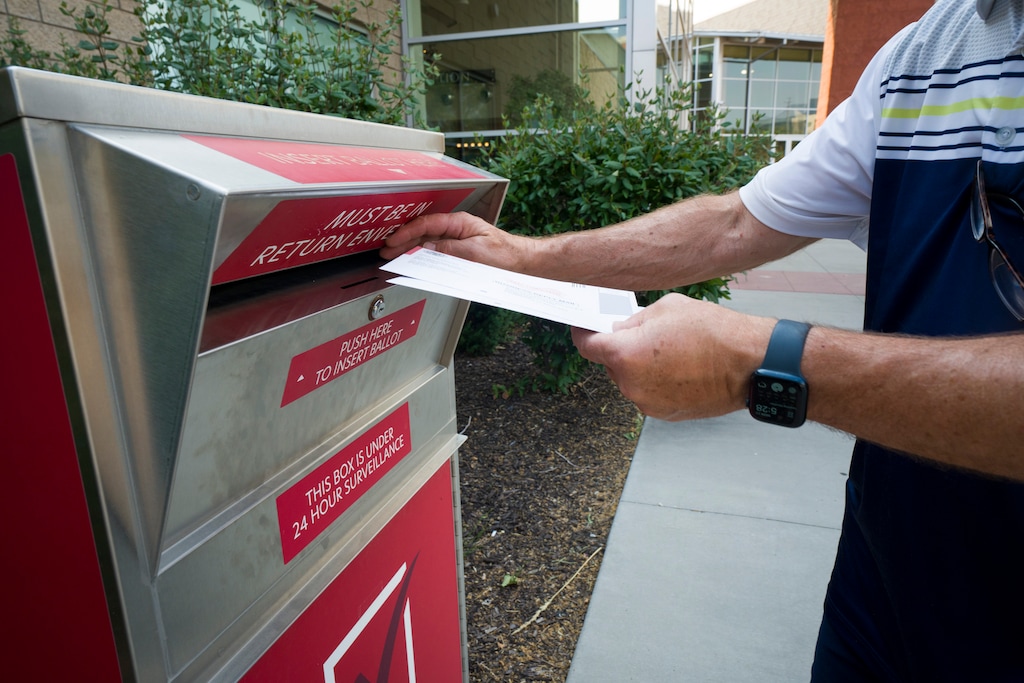
Utah’s law defines a “polling place” as the place where ballots are cast and “includes the physical place where a drop box is located.” But it goes on to say an individual cannot conduct any electioneering “within any polling place or in any public area within 150 feet of a building where a polling place is located.”
According to the lieutenant governor’s guide for candidates, that includes wearing campaign T-shirts or buttons or displaying signs or bumper stickers.
Bountiful Mayor Kate Bradshaw said Friday that her fellow Davis County mayors have had discussions about what the complaint against Millburn might mean.
She said that, during the primary election, candidates for sheriff spoke during the city council’s public comment portion and other mayors have said they have had candidates introducing themselves during public comment periods.
If the drop boxes mean the city halls are off limits to election discussions three weeks before every primary and general election or municipal elections, she said, “that can influence how people can use public comment time or how we serve as community hubs for debates.”
Opportunity to clarify the law
Up until 2020, the law specifically said that the polling place “includes the county clerk’s office or city hall during the period in which absentee ballots may be cast there.” But the law was changed that year to delete the reference to the city or county offices and the time period in which the ban on electioneering applies.
Harrison said she doesn’t recall discussions on the particular change, but it was likely done so candidates could speak during the public comment period at council meetings, if they are held in the same building where the clerk’s office is located or if there are drop boxes nearby.
“I believe it was meant to address that type of subtlety,” she said, “where public comment [and] public meetings happen near other government functions.”
Strictly interpreted, anyone with a campaign bumper sticker who uses the drive-through ballot drop boxes would violate the law.
Irvine said a potential bright spot may come from the complaint — that the Legislature can amend the law to clarify the intent of the statute.