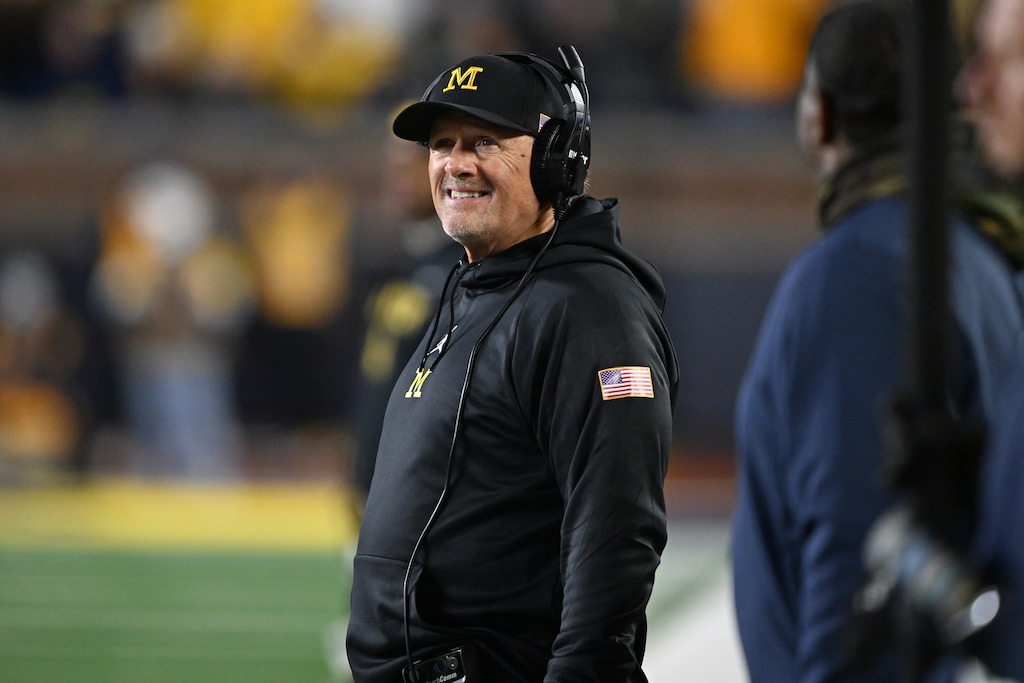
College football pundits, a group of people who will disagree about almost anything, achieved a rare moment of unanimity last December when Michigan hired Kyle Whittingham.
“Kyle Whittingham! Yes!” gushed Barstool Sports founder and Michigan fan Dave Portnoy.
“This is an incredible fit,” said Fox analyst Joel Klatt.
“He’s said all the right things, in my opinion,” said former Michigan offensive lineman Taylor Lewan.
“He’s exactly what Michigan needs right now,” said ESPN analyst and Michigan alum Desmond Howard.
Whittingham’s rock-solid reputation and his commitment to winning in the trenches seemed to make him the ideal coach to restore Michigan’s values and identity after Sherrone Moore’s tenure ended in disgrace.
Ten games into Whittingham’s first season at Michigan, the perfect fit has instead turned into a nightmare.
The Wolverines are 5-5 and have one of the worst offenses in program history. Jason Beck, the highest-paid offensive coordinator in the country, was already fired after nine games. Michigan fans heckled Whittingham with shouts of “Go back to Utah!” outside of his postgame news conference after a 31-7 loss to Oregon and hung a bedsheet painted with the message “Fire Whitt” across the street from Schembechler Hall. The coach who said all the right things seems to have a weekly gaffe that goes viral, adding to the outrage of a disgruntled fanbase.
With games still to play against undefeated UCLA and archrival Ohio State, Michigan’s 2026 season has been a stunning failure for a coach who won 177 games in 21 seasons at Utah. To explain how it happened, people close to Michigan point to several themes: a scheme that wasn’t built for the Big Ten, a CEO-style head coach who insulated himself from Michigan’s offensive struggles, a disconnect between Whittingham and the players he inherited and a stubborn attempt to replicate Utah’s culture in Ann Arbor.
This week’s news that Michigan is on the verge of hiring Texas A&M’s Trev Alberts as its next athletic director suggests Michigan feels urgency to address a faltering football program. As recently as a few weeks ago, some at Michigan doubted that a new athletic director would arrive in time to make a decision about Whittingham’s status for next season.
“Michigan is a different breed,” said the parent of a Michigan player, who spoke on the condition of anonymity, like others in this story, to speak candidly and protect relationships with coaches. “You’ve got to embrace their culture. You embrace Michigan. If you don’t, No. 1, the fans will rip you apart.”
Moore’s abrupt firing nearly a year ago left Michigan scrambling to find a new coach.
Whittingham, who stepped down at Utah after the two sides failed to reach an agreement for his return, landed in Michigan’s lap after the search pivoted away from Arizona State’s Kenny Dillingham and Alabama’s Kalen DeBoer. Under different circumstances, Whittingham’s lack of Michigan ties might have prompted comparisons to Rich Rodriguez, the last Michigan coach with no previous connection to Ann Arbor. The scandals that rocked the program under Moore and Jim Harbaugh made an outsider more appealing.
Following a whirlwind hiring process, Michigan introduced Whittingham in late December at a hastily arranged news conference in Orlando, Fla., where the Wolverines were preparing to face Texas in the Citrus Bowl. Asked about the challenges of building a program’s culture in the era of the transfer portal, Whittingham said the following:
“Another thing that I believe strongly in is that you will become us. We will not become you, as far as the players that are coming in. You will become us and do things the way that we do things.”
The implication was clear: Michigan’s locker room would adapt to Whittingham, not the other way around. That uncompromising approach served Whittingham well over two decades at Utah, where the culture had been fashioned in his image. It was a jarring message for Michigan players recruited by a different staff and fans who venerated Michigan’s rivalries and traditions.
“That’s a great press conference quote that shows that you’re going to bring the hammer,” said a former Michigan staff member. “You’re not walking into a nameless, faceless place. It doesn’t seem like he’s attempting to buy into what the place is about.”
Though a few assistants and staffers stayed — including running backs coach Tony Alford, former Michigan wideout Ron Bellamy and longtime assistant Fred Jackson — most of Michigan’s coaching staff came from Utah or BYU. Whittingham brought his Utah strength coach, Doug Elisaia, and introduced the Wolverines to “Bloody Tuesday,” a term used by former Utah and Ohio State coach Urban Meyer, a longstanding Michigan nemesis, to describe the team’s most physical practice of the week.
A second former staff member described Whittingham’s weight room philosophy as “push weight fast,” with emphasis on maximizing players’ bench press and squat numbers. When Whittingham found the team’s strength to be subpar, it was because the previous staff was training players to hit different goals, the former staff member said. An agent who works with several Michigan players said players have started looking outside the program for training and recovery.
“There is a growing frustration about the program and the services that these players have access to, or lack thereof,” the agent said. “Something is clearly missing there.”
Whittingham even cut ties with Robby Emery, a pastor who had been Michigan’s spiritual adviser since Harbaugh’s time as head coach. The first parent said players and families were upset to learn that after Michigan initially pledged to retain Emery, it eliminated his position and decided to fly in a pastor affiliated with the Fellowship of Christian Athletes from Utah instead.
Cleaning house is a new coach’s prerogative, and Whittingham had ample reason to do so after the past few years at Michigan. Moore, the coach Whittingham replaced, engaged in a romantic relationship with a staff member, lost his job and was arrested after confronting the staffer at her apartment, the last in a string of scandals that led interim coach Biff Poggi to describe Michigan as a “malfunctioning organization.”
Still, some close to the program wondered if Whittingham should have hired more people with Michigan ties to ease the transition.
“I’ve heard from parents who are calling saying this isn’t the program they came to,” said the second former Michigan staff member. “There’s essentially no more Michigan people in the building anymore.”
Though Moore’s firing, arrest and subsequent pleading of no contest to two misdemeanor charges sullied the entire program, some at Michigan believed the culture didn’t need to be ripped out root and branch. Michigan is three years removed from a national championship and had a locker room full of four- and five-star recruits — including quarterback Bryce Underwood, the No. 1 player in his class — who won nine games in 2025. Whittingham didn’t need to gut the program and rebuild it, those people believed. He just needed to be the steady hand that was missing during Moore’s two-year tenure.
“This isn’t a rebuild at all,” Poggi said after coaching Michigan in the loss to Texas. “That would be short-changing the kids and where they are. I think coach Whittingham is going to do a fantastic job here. … He is going to find a very, very full cupboard, a bunch of very willing kids that are just great kids.”
Whittingham seemed to agree with that assessment, at least initially.
He spoke highly of Michigan’s returning talent and noted that Michigan’s problems came from the adults, not the players. It was only after Michigan’s season went south that he began talking about missing out on last year’s recruiting cycle and the transfer portal.
“We had no opportunity to recruit a class this year,” Whittingham said Monday. “We inherited the team. I’m not complaining about the team, but if there (were) deficiencies, we didn’t have a chance to fill any of those needs.”
Whittingham was hired Dec. 26, almost three weeks after most of the other Power 4 jobs were filled. He and his staff arrived in Ann Arbor in early January, just as the portal window was opening. Amid the chaotic transition, the focus was on retaining players from last year’s team, not flipping the roster. Aside from Utah transfers John Henry Daley, Smith Snowden and JJ Buchanan, most of Michigan’s key contributors were holdovers.
It went against the new model in college football of hiring a coach who can flip a roster with transfers from his previous school.
Curt Cignetti provided the blueprint by winning a national championship at Indiana with players who followed him from James Madison. Oklahoma State (91 new players under coach Eric Morris), UCLA (11 players, including seven starters, and more than a dozen coaches who followed Bob Chesney from James Madison) and Penn State (24 transfers who followed Matt Campbell from Iowa State) are among the programs trying to replicate the formula.
Whittingham’s recent comments about Oregon’s roster spending struck some as out of touch, as if Whittingham didn’t realize his own roster was earning between $35 million and $40 million, making it one of the most expensive in the Big Ten. The view of some former staff members is that Whittingham was handed a College Football Playoff-caliber roster and may end up with a losing record.
“I don’t care what anybody says. That roster is loaded,” said a third former staff member. “Those kids have checked out, and can you really blame ’em?”
There have been signs, though, that Michigan’s locker room culture wasn’t as healthy as some in the program wanted to believe.
Michigan suspended defensive end Nate Marshall, a top-50 prospect from the Class of 2025, in November for an unspecified violation of team rules. Wide receiver Andrew Marsh, another highly touted player from the 2025 class, faces a misdemeanor charge of indecent exposure for a February incident that came to light this week involving a female delivery driver.
A person close to the program said Year 1 was an opportunity to see who fit with Michigan’s new staff and who didn’t.
“The core, the ones that are going to be back next year, they get it,” the person said. “They have the great discipline. They have the great work ethic. You can’t take those one-offs and act like that’s the whole team.”
Whittingham’s history of building tough, hard-nosed teams was part of the “perfect fit” narrative. While his Utah defenses were consistently among the best in the nation, the Utes had 10 offensive coordinators in his 21 years as head coach and didn’t have a quarterback drafted. Whittingham’s program was on shaky footing after a 5-7 season in 2024 until he hired Beck, a coach from the BYU tree, to revitalize the offense.
Michigan made Beck the highest-paid offensive coordinator in college football on the basis of his one-year turnaround at Utah. At Michigan, his offense was a disaster from the start. Michigan fired Beck following a 15-6 loss to Michigan State, nine games into a three-year contract that guaranteed him nearly $14 million.
One of the most glaring failures was Beck’s inability to develop Underwood, Michigan’s $3 million-per-year sophomore quarterback and a prospect unlike any Whittingham coached at Utah. Underwood threw five touchdowns and six interceptions before he was benched for freshman Tommy Carr at halftime of Michigan’s sixth game. The two quarterbacks have combined to average 163.6 passing yards per game, last among Power 4 teams.
One of Beck’s calling cards was his use of a sixth offensive lineman known as the rhino. At the time of Beck’s firing, Michigan had played 252 snaps with six or more linemen, more than double the next closest FBS team, according to TruMedia.
The reliance on the rhino meant Michigan was blocking Big Ten edge rushers with a converted defensive tackle or a backup guard, not the tackles recruited for that purpose. A stockpile of versatile tight ends recruited by Harbaugh and Moore went largely unused. If Buchanan and Marsh couldn’t get open, Beck’s offense didn’t provide many other options for Michigan’s quarterbacks.
In a meeting with players during Michigan’s off week, Beck defended his scheme by noting that Michigan’s most productive personnel grouping was a rhino and three wide receivers. He also cited Pro Football Focus grades to defend the rhino’s blocking. But players could see the results on the field, and the offense wasn’t working.
Opposing coaches saw it, too.
“Those guys are underachieving,” said a defensive coach in the Big Ten. “I’ve seen those backs running better than they are now. The O-line has underachieved. I’m hoping they give (Whittingham) another year to make up some ground on them.”
Amid Michigan’s on-field struggles, Whittingham’s sideline demeanor and his performance in news conferences have been heavily scrutinized.
A coach who exuded intensity at Utah has often appeared aloof and detached, rarely interacting with players and standing at a distance from the team huddle — something he’s done throughout his career, the person close to the program said. Whittingham’s subdued comments about Michigan’s trophy games and the Michigan State and Ohio State rivalries rubbed some fans the wrong way too.
Whittingham contended that no one would care about his sideline demeanor if the Wolverines were 8-2. Even that comment earned him some grief from fans who think Michigan should be aiming higher than two- or three-loss seasons. The common theme in many conversations is that Whittingham wasn’t prepared for how much bigger everything would be at Michigan: the expectations, the attention, the pressure and the backlash when things go wrong.
“Michigan’s a difficult beast, just to put it lightly,” said a Michigan source. “When you’re winning, it’s great. When you’re not, it’s a very difficult place to operate.”
Alberts, a College Football Hall of Fame linebacker at Nebraska, was described by the person close to the program as a “football guy” who will evaluate the substance of Whittingham’s program, not the news conference quotes and clips of Whittingham wandering away from the team huddle.
Whittingham, who turns 67 on Saturday, affirmed this week that he wants to continue as Michigan’s coach beyond this season amid speculation that he might be looking for a way out of his five-year, $41 million contract. Michigan would owe him a buyout of about $25 million if it fires him without cause.
“I’m competitive, and I love the competitive arena and the challenge. To me, that’s enough right there,” Whittingham said. “It’s just the challenge and the competitive aspect of coaching and the challenge of getting this turned around.”
A second Michigan parent expressed confidence that Whittingham will get the program on track if given enough time. The parent compared Whittingham to a stock that earns a steady 8 percent return every year and noted that Whittingham had some of his best seasons at Utah when his back was against the wall. The parent also cautioned not to mistake Whittingham’s even-keeled demeanor for a lack of drive.
“I promise you, coach Whitt is probably the most competitive person I know, and it’s killing him,” the second parent said. “He’s frickin’ pissed, but he’ll always keep his poise. He won’t yell at a reporter, won’t cuss anybody out. He’ll wake up, hit the treadmill for 45 minutes and keep his routine going. He’ll do what he does.”
Whittingham has been touting Michigan’s 2027 recruiting class and pointing to the transfer portal as reasons for hope. Many around the industry expect Michigan to have substantial roster turnover and question whether players and donors will stick with Michigan given the negativity surrounding Whittingham.
Two Michigan parents described a grim scene before Michigan’s game against Michigan State as players counted down the days until the season ended and they could enter the portal. The next day, Michigan stumbled through a listless loss to a bitter rival that had been winless in the Big Ten under its own first-year coach.
Many of the same voices that were unanimous in their praise have reached a new consensus: Whittingham, once seen as the perfect fit, was the wrong coach at the wrong time.
“He’s just not a match,” the first Michigan parent said.
— Christopher Kamrani contributed to this report.
This article originally appeared in The Athletic.