 Emily R. Anderson
If Utah wants to win a massive federal nuclear campus, it will have to rely on funding from private companies.
But elected officials’ financial disclosures show the corporations expected to support and profit from such a project were investing in the possibility of state-backed nuclear initiatives years before Utah submitted its proposal to the U.S. Department of Energy last week.
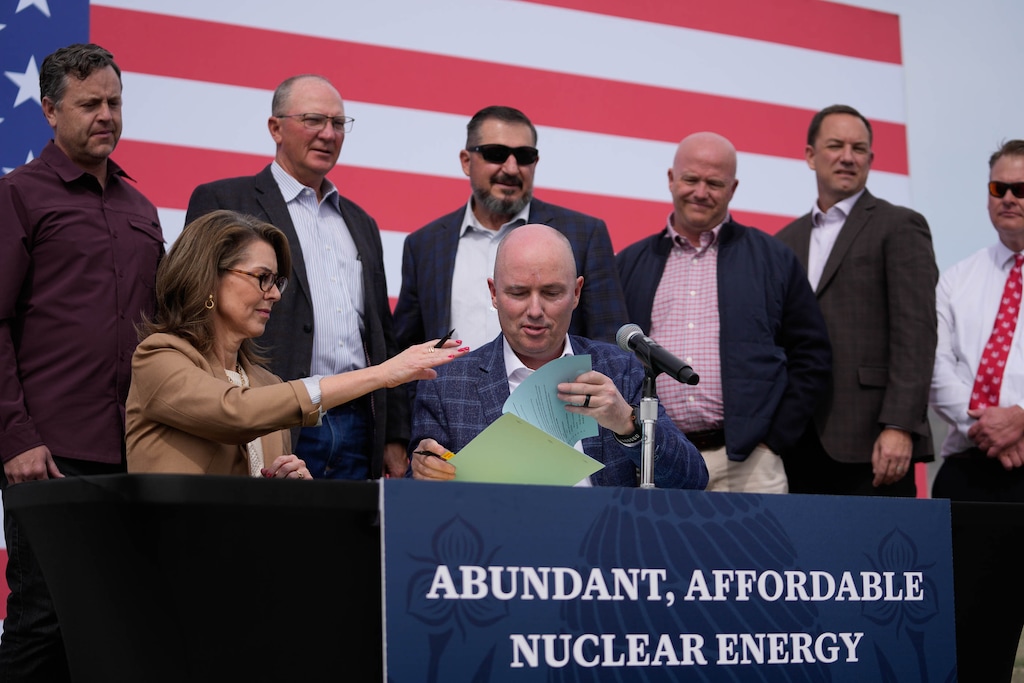
As Gov. Spencer Cox took the podium in the state’s remote West Desert last month to announce Utah was entering the competition for a DOE “nuclear lifecycle innovation campus,” he thanked partners “from the private sector, who are doing incredible work here in our state, and will be doing even more soon.”
In its response last week to DOE’s January call for states to submit their visions for hosting a nuclear campus and outline how they are equipped to welcome one, nearly two dozen private companies were listed as possible partners or wrote letters of support for the effort.
Cox has been aggressively pursuing nuclear energy development as part of his “Operation Gigawatt” plan, which he launched in October 2024 prior to his reelection. Since the beginning of that year, a half dozen of the companies — and their owners — listed in the proposal have given over $360,000 to Utah officials and political influence groups, The Salt Lake Tribune found in an analysis of campaign finance documents.
Approximately $57,500 of that has gone directly to Cox’s campaign.
The governor’s office referred questions to Cox’s campaign, which said the donations do not influence the governor’s decision-making.
A shift toward nuclear energy — which, when operating safely, more cleanly generates energy than that derived from fossil fuels — has bipartisan support, although Democratic Utah lawmakers would rather see more investment in renewable technologies and are cautious about whether state and national regulations will adequately protect residents from contamination.
Utah is one of only five states without political contribution limits for corporations and one of eleven states without a ceiling for individual donors, according to the National Conference of State Legislatures.
(Bethany Baker | The Salt Lake Tribune) Gov. Spencer Cox walks beside U.S. Secretary of Energy Chris Wright to speak with the media after three USAF C-17s transported components of a micro nuclear reactor to Hill Air Force Base near Layton on Sunday, Feb. 15, 2026.
EnergySolutions
The most frequent donor among the bunch is Salt Lake City-based EnergySolutions, which operates a low-level nuclear waste facility in Tooele County and has been pushing the state to adopt nuclear power for two decades.
It has given over $215,000 to Utah elected officials since the beginning of 2024. And earlier, in 2023, The Tribune previously reported, the company began buying Republican state lawmakers’ memberships to the conservative American Legislative Exchange Council, which has pushed energy policy in nuclear’s direction.
One month after EnergySolutions signed an April 2025 memorandum of understanding with Intermountain Power Agency to study the possibility of putting a small nuclear reactor at its coal-fired Intermountain Power Project site in Delta, the company gave $7,500 to Cox.
EnergySolutions’ largest donations to lawmakers have coincided with those legislators proposing nuclear-related policies that directly benefit the company.
Late last year, a compact of states approved a first-ever plan to ship nuclear waste from a foreign country — Canada — to Utah to be stored at EnergySolutions’ Clive facility 75 miles west of Salt Lake City.
That decision, according to Utah’s pitch to DOE, “provoked very limited response from both the legislature and the general public,” which was cited as evidence that nuclear-related legislation in Utah “has received strong support overall.”
The lawmakers who sponsored the bill enabling that move were Sen. Mike McKell, R-Spanish Fork, and Rep. Bridger Bolinder, R-Grantsville. They also introduced HB254, which repealed Utah’s definition for the type of nuclear waste EnergySolutions can accept in its Clive facility, located in Bolinder’s district, instead relying on a less specific federal definition.
As Bolinder faced reelection in 2024, EnergySolutions gave $11,000 to his campaign, becoming his biggest financial backer. And after The Tribune first reported those contributions, both lawmakers received additional money from the company, according to campaign disclosures.
EnergySolutions donated $6,500 to Bolinder last year, in addition to buying his $200 membership to the conservative American Legislative Exchange Council. It also gave $3,000 to McKell.
When asked about the purpose of the company’s donations and how it envisions its role in a possible nuclear campus, a spokesperson said, “EnergySolutions is encouraged by Utah’s efforts to explore opportunities related to a potential federal nuclear lifecycle campus.”
The statement continued, “We are proud to be headquartered in Utah with decades of experience supporting the safe management, decommissioning, and disposal of nuclear materials.
EnergySolutions added that they “recognize the value that a nuclear lifecycle campus could bring in advancing innovation, workforce development, and domestic nuclear capabilities to support the growing need for nuclear energy advancement across the nation.”
(Trent Nelson | The Salt Lake Tribune) House Majority Assistant Whip Bridger Bolinder, R-Grantsville, meets with reporters at the Utah Capitol in Salt Lake City on Wednesday, June 18, 2025.
Hi Tech Solutions
The name of this Washington-based company has not appeared in Utah campaign finance disclosures. But its owner’s has.
Hi Tech Solutions CEO Chris Hayter, who lives in Utah, has given $17,200 to Utah politicians in the past few years. After his company secured an agreement alongside Holtec International last April to build a nuclear training facility in Utah, Hayter gave $3,500 to the House Speaker Leadership PAC and $10,000 to Cox.
Within a week of that memorandum of understanding being announced, Hayter co-wrote an op-ed for Deseret News with former Economic Development Corporation of Utah CEO Scott Cuthbertson, calling the agreement “a bold step toward [Utah] leading the nation in energy innovation.”
“The landmark memorandum of understanding lays the groundwork for the Beehive State to become the Western hub for advanced nuclear technology development, manufacturing and deployment,” the piece read.
Cuthbertson had unsuccessfully challenged state Sen. Kathleen Riebe, D-Cottonwood Heights, for her seat in the 2024 election. Hayter donated $3,700 toward his race.
Hayter did not respond to emails asking about the purpose behind his contributions.
Last July, Cuthbertson’s consulting firm Alpen Associates announced it was partnering with Hi Tech Solutions for “a comprehensive stakeholder engagement effort — including community outreach, public affairs, and investor relations — to build alignment, foster support, and drive sustained momentum for Utah’s first full stack nuclear energy ecosystem."
“My support for nuclear energy isn’t new, nor is it tied to any single partnership. It is a long-standing professional conviction that predates my relationship with Chris Hayter or the founding of Alpen Associates by more than a decade,” Cuthbertson told The Tribune in an email.
Cuthbertson pointed out that Hayter was one of many individual donors to his campaign, adding, “I believe he, like many other local business leaders, supported my campaign because of my platform focused on economic growth and energy abundance.”
(Chris Samuels | The Salt Lake Tribune) Hi Tech Solutions CEO Chris Hayter makes remarks at an event in Brigham City, Monday, Nov. 17, 2025. Gov. Spencer Cox announced plans to build a training center and nuclear manufacturing plant in Brigham City.
Energy Fuels
Uranium mining and processing in Utah has long been primarily overseen by Energy Fuels. And with the possibility of Utah increasing the demand for its products, the company put $5,500 in state lawmakers’ campaign accounts last year.
“Utah is uniquely positioned to operationalize and scale uranium mining and milling as part of a domestic nuclear fuel supply chain, anchored by Energy Fuels’ White Mesa Mill, the only operating conventional uranium mill in the U.S.,” the state wrote in its DOE response, adding, “While the Innovation Campus may not share a fenceline with these assets, its proximity to established mining and milling operations can reduce first-mover risk.”
The nuclear energy boom buoyed San Juan County’s previously struggling White Mesa Mill, Energy Fuels’ CEO Mark Chalmers told The Tribune in 2021. Tribal nations surrounding the mill have fiercely opposed its operations, raising concerns about air and water contamination risks.
Rocky Mountain Power and PacifiCorp
Utah’s largest electric utility company serves about three-quarters of the state’s geographic area “and a larger percentage of the state’s population,” according to the Utah Office of Consumer Services.
Rocky Mountain Power and parent-company PacifiCorp consequently have wide-ranging policy interests in Utah, so the $117,000 that they gave to lawmakers since the beginning of 2024 likely was not entirely focused on the outcome of nuclear energy legislation.
But a potential nuclear campus in the state would rely on the utility’s electricity, and Rocky Mountain Power sees nuclear power development as a way to make Utah’s energy supply more reliable.
The company did not respond to a voicemail left on its media hotline.
“As the largest investor-owned utility within the State of Utah, serving more than one million customers, we recognize the critical national importance of co-locating the entire nuclear value chain,” it wrote in a letter supporting Utah’s bid for a federal nuclear campus, adding, “We stand ready to work with the Department of Energy and the State of Utah to make the Nuclear Lifecycle Innovation Campus a landmark success for American energy independence.”