 Leia Larsen
Note to readers • This story is made possible through a partnership between The Salt Lake Tribune and Grist, a nonprofit environmental media organization.
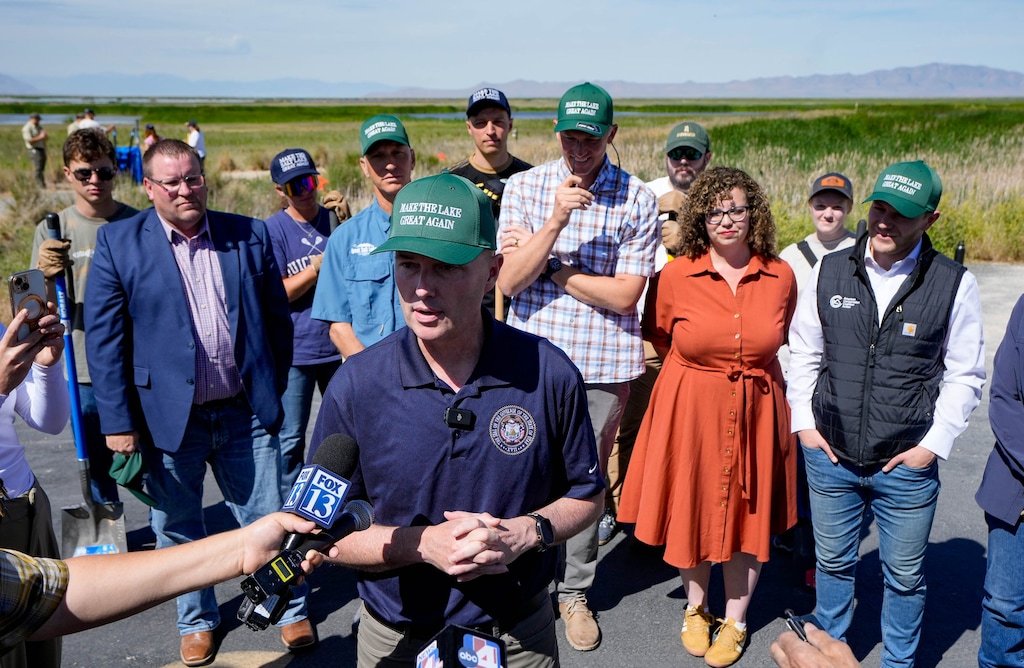
Farmington • Flanked by Utah politicians, a crowd of conservation volunteers and flocks of shorebirds, Gov. Spencer Cox announced Friday he has issued an executive order to ensure the state properly evaluates large data center proposals like the controversial Stratos Project in Box Elder County.
Cox issued the order while sitting at a roundtable event in Farmington Bay to discuss the plight of the Great Salt Lake with Utah business leaders, state officials and members of the state’s congressional delegation.
The Stratos Project, backed by celebrity investor Kevin O’Leary, has received widespread backlash over concerns about air quality and water depletion. The 40,000-acre campus would be built in Hansel Valley and neighbor the northernmost tip of the Great Salt Lake.
“The feedback has been incredibly helpful,” Cox said at a news conference following his roundtable. “People are concerned about about data centers, they’re concerned about the lake, they’re concerned about resources, and they should be concerned.”
In just a few weeks, thousands of people filed formal protests against two requests to transfer water rights in Hansel Valley from agriculture to industrial uses for the data center; the requests have since been rescinded. Utahns also showed up in droves to protest the project ahead of the Box Elder County Commission’s vote earlier this month; others later protested at the Capitol, where organizers delivered a letter of concern to Cox’s office.
“Public pressure is important,” the governor said Friday. “I share those concerns, and if I had had any concerns about ... water and the Great Salt Lake ... I would have opposed it from the very beginning.”
In late April, the governor called frustrations over the perceived rushed process to green light the data center project “the dumbest thing ever.”
Cox’s new order guides agencies like the Department of Environmental Quality and Department of Natural Resources to protect air quality, water quality and utility ratepayers. It calls for transparent public comment opportunities.
It protects the Great Salt Lake by “ensuring” water consumption does not increase as data centers look to buy up water rights. And it calls for protections for Utah ratepayers, so they’re not impacted by energy and associated infrastructure costs as large data centers get built across the state.
In many ways, however, the order seems to reiterate the status quo. The Department of Environmental Quality already enforces standards established by federal laws like the Clean Air Act and Clean Water Act. Those laws require public comment processes.
“It doesn’t give them additional authority,” the governor acknowledged when asked, “but it does give them the opportunity to look at other issues ... like getting water to the Great Salt Lake.”
(Francisco Kjolseth | The Salt Lake Tribune) Gov. Spencer Cox concludes a meeting with, federal, philanthropic, scientific, business and conservation leaders for a Great Salt Lake Roundtable on Friday, May 29, 2026. The governor signed an Executive Order regarding large data center projects.
Cox also already closed much of the Great Salt Lake basin in 2022 to new water rights and consumptive uses of water.
“It’s making sure that it’s a doubling down on the executive order I issued before,” Cox said, “which means no new water rights in northern Utah.”
Hansel Valley and the Stratos Project, however, appear to fall within a large swath of the West Desert that is carved out from the governor’s 2022 water rights order. Cox did not explain Friday why he created that carve-out.
“That was like three years ago,” Cox said. “I’m going to have to go back and look.”
Lawmakers also passed a bill in 2025 that allows large data centers to build their own power plants, partly in an effort to shield ratepayers from their impact on the grid.
But that legislation also opened the door for several data complexes across the state to build their own massive natural gas power-generating stations. Comprised almost entirely of methane, a potent natural gas, the surge in fossil fuel demand has some clean air and clean energy advocates concerned.
The Stratos Project first came to light when officials with the quasi-governmental Military Industrial Development Authority, or MIDA, promoted the proposal to Box Elder County officials. MIDA is now the land-use authority over the Stratos Project, which provides tax incentives to the developers. Its role has many Utahns scrutinizing the agency and its leadership.
“We’re already having discussions with the with the Stratos group about the footprint, the size, the water usage, all of those things,” Cox said. MIDA has no authority over air quality, they have no authority over over water."
(Francisco Kjolseth | The Salt Lake Tribune) U.S. Representatives Celeste Maloy, Blake Moore and Gov. Spencer Cox, conclude a meeting with, federal, philanthropic, scientific, business and conservation leaders for a Great Salt Lake Roundtable on Friday, May 29, 2026.
While Cox initially supported Stratos and parroted some of MIDA’s talking points cheerleading the project, all the fallout has apparently prompted a change of heart.
The governor said during a news conference last week that the project’s rollout was “not good” and needed more input from elected leaders.
Senate President Stuart Adams chairs the MIDA board. Adams did not appear to be present at the governor’s Great Salt Lake roundtable, which was closed to media, but Cox said he spoke with Adams and had his full support.
“Usually legislators don’t like executive orders,” Cox said. “This is the exact opposite.”
Neither O’Leary nor the other Stratos Project developers have provided specific details on the water demands for both the proposed computing complex as well as the technology planned for its associated natural gas plant. At full build, the campus will use up to 9 gigawatts of power, state officials have said, more than double Utah’s current consumption.
Local scientists have calculated the massive campus may create a sweltering heat island that significantly raises nighttime temperatures, increases evaporation and wipes out wildlife in Hansel Valley. Pollution released from the natural gas plant could raise Utah’s carbon emissions by as much as 64%, although the governor has asserted Stratos may incorporate some renewables or nuclear power.
The governor further announced Friday that 500,000 acre-feet of water were secured in leases and donations for the Great Salt Lake this season, with another 300,000 acre-feet in the works. Combined, that’s about enough combined water to meet the basic needs of 1.6 million Utah households.
“That’s already getting close to our goals for the lake,” Cox said, “well ahead of schedule.”
(Francisco Kjolseth | The Salt Lake Tribune) Gov. Spencer Cox and U.S. Rep. Celeste Maloy jump in for a brief service project focused on trail improvements and invasive weed removal at Farmington Bay on Friday, May 28, 2026. State representatives had just convened with, federal, philanthropic, scientific, business and conservation leaders for a Great Salt Lake Roundtable focused on the next phase of coordinated action and partnership.
The Great Salt Lake will need around 1 million acre-feet of additional inflows each year to refill to a minimum healthy elevation over the next 30 years, according to the latest Great Salt Lake Strike Team report.
The governor wore a green cap calling to “MAKE THE LAKE GREAT AGAIN,” in an apparent nod to the $1 billion in federal funding Utah is seeking to help the Great Salt Lake recover. President Donald Trump and his administration have voiced support for the request, with Environmental Protection Agency Administrator Lee Zeldin visiting the lake last weekend.
Ultimately, the appropriation will have to be approved by Congress. Both U.S. Rep. Celeste Malloy and U.S. Rep. Blake Moore, who participated in Friday’s roundtable, said in interviews they were working with their colleagues in Washington to make it happen. But, they conceded, Utah was unlikely to receive the full amount in a single year.
Leia Larsen is a sixth generation Utahn and a water and land use reporter reporter for The Salt Lake Tribune. She has covered environment, energy and political issues throughout the West. When she’s not chasing the news, Leia can be found exploring the Wasatch Mountains, sleeping in the desert or rooting around her garden.