 Leia Larsen
Note to readers • This story is made possible through a partnership between The Salt Lake Tribune and Grist, a nonprofit environmental media organization.
Utah Gov. Spencer Cox acknowledged Wednesday that the rollout of the controversial Stratos data center project in Box Elder County “was not good,” saying future decisions like it should involve his office and the Legislature.
“There’s no question, the process was not good,” Cox told reporters Wednesday during a news conference.
“It’s something I’ve worried about for a long time with that entity that made that decision,” the governor continued.
Cox appeared to refer to the Military Installation Development Authority, or MIDA, the quasi-governmental agency that approved the Stratos data center project area in Box Elder County last month.
(O'Leary Digital) Renderings of a proposed data center to be constructed in Box Elder County. The project is backed by celebrity investor Kevin O'Leary.
“That was not a decision that was made by me or the Legislature,” Cox said. “In the future those are decisions that should be made by us, so that we can do these types of things ahead of time to make sure people understand what’s actually happening out there. That did not happen, and it should happen.”
The proposed data center project backed by celebrity investor Kevin O’Leary would include a 9-gigawatt data center campus and cover roughly 40,000 acres once fully built out, according to project backers. Scientists, environmental advocates and some residents have raised alarms about the impact the project — and the possibility of a massive natural gas plant to power it — could have on air quality, greenhouse gas emissions and water supplies near the Great Salt Lake.
While discussing plans for the data center complex last month, a MIDA official said the 9-gigawatt data center campus would be powered “100% off the Ruby Pipeline,” a natural gas line that crosses the proposed project area north of the Great Salt Lake.
Cox said Wednesday, however, that the project would “never” be solely powered by natural gas.
“That’s never going to happen,” Cox told The Salt Lake Tribune. “The very first phase will be natural gas, but the other phases should not be. They should be nuclear, and they should be geothermal, and solar and other technology.”
A 9-gigawatt power plant entirely powered by natural gas could raise Utah’s carbon emissions by 64%, according to some estimates.
The full water demands of the project remain unknown, although its developers have said they’re working to secure 13,000 acre-feet in Hansel Valley and the surrounding area, which is mostly agricultural. That’s enough water to meet the needs of more than 20,000 Utah households.
(Trent Nelson | The Salt Lake Tribune) The north end of the Great Salt Lake and Hansel Valley on Friday, May 1, 2026.
Opposition to the proposal has been intense. A water right filed to support the data center and power plant received nearly 4,000 protests this month. Opponents of the project held a rally at Utah’s Capitol last week and delivered a letter to Cox with more than 6,000 signatures urging him to take “binding action” to preserve the Great Salt Lake instead of issuing platitudes over social media.
The controversy comes as state leaders and energy developers across the West scramble to meet rapidly growing electricity demand driven in part by artificial intelligence computing and large-scale data centers.
Cox on Wednesday hosted the final workshop in his “Energy Superabundance” initiative as chair of the Western Governors Association, part of a broader push that complements his “Operation Gigawatt” goal to more than double Utah’s energy production over the next decade.
Electricity demands across the nation have held relatively steady for decades, but a surge in demand for artificial intelligence computing and data centers is putting a strain on the grid. That’s left Western states scrambling to build new energy supplies.
At the same time, public skepticism toward large data center developments appears to be growing, particularly over concerns involving water use, noise, energy costs and pollution.
“It feels like the future is here,” Cox said during opening remarks at the workshop Wednesday. “It’s coming quicker than people asked for, and there are so many amazing things that can come from that future, and some pretty awful ones as well.”
Cox has also pushed for faster permitting timelines for large energy and infrastructure projects, arguing that environmental review processes often take too long.
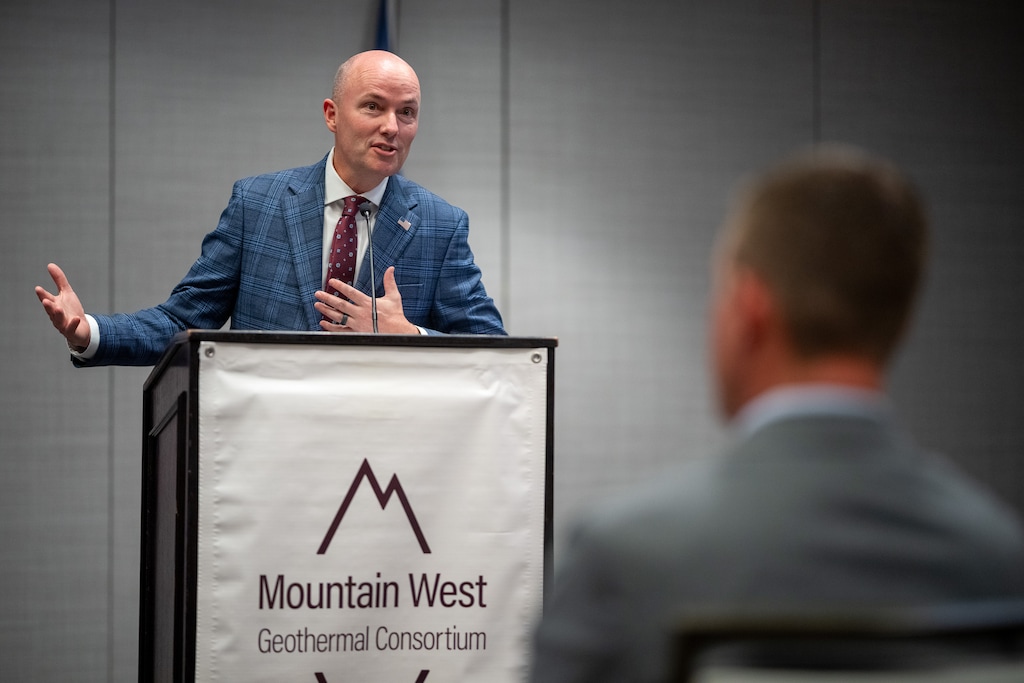
(Francisco Kjolseth | The Salt Lake Tribune) Utah Gov. Spencer Cox hosts a Western Governor's Association event on energy as he is joined by Wyoming Governor Mark Gordon in downtown Salt Lake City on Wednesday, May 20, 2026.
“This whole idea of being rushed — I’m so tired of our country taking years to get stuff done,” he said at a news conference about the Stratos project last month. “It’s the dumbest thing ever. We think that taking time makes things better or safer. It absolutely does not.”
But the governor struck a more measured tone Wednesday as criticism of the project continues to mount.
“One of the things people are worried about, and rightfully so, is air quality,” Cox said in a brief interview as he left the workshop Wednesday. “That’s a yearlong [permitting] process. ... We’re not speeding those up. Those are really important, and we want to make sure that things are done the right way.”