 Samantha Moilanen
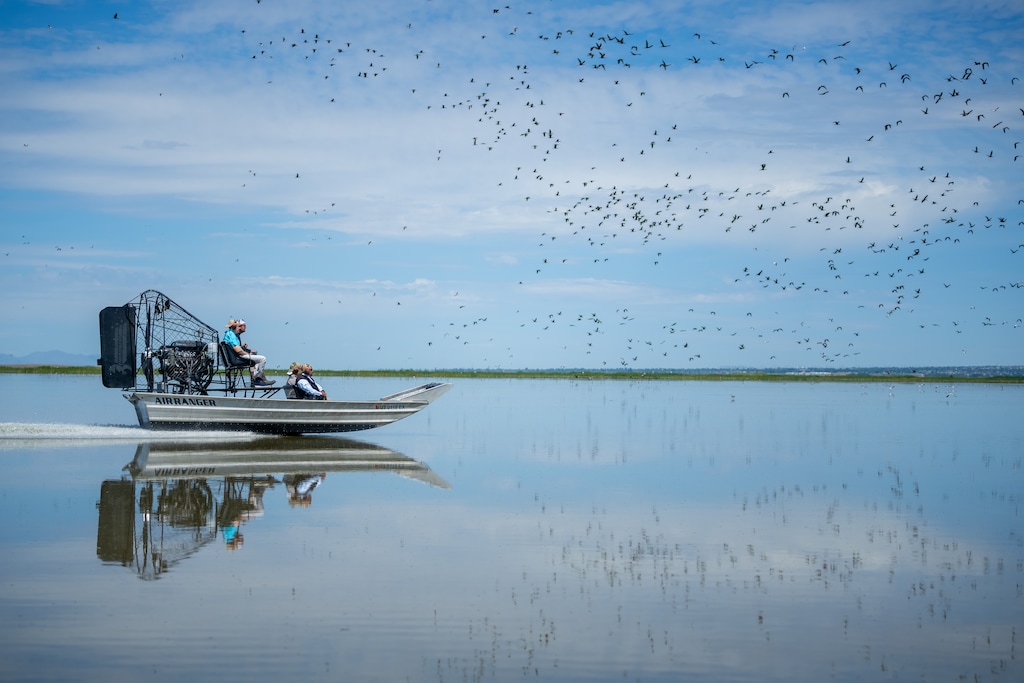
Farmington • After coasting across the receding waters of the Great Salt Lake on Saturday morning, the nation’s top environmental official announced that President Donald Trump has asked Congress for $1 billion to help save the landmark lake.
At Farmington Bay’s Eccles Wildlife Education Center after the nearly hourlong tour of the shrinking lake, Environmental Protection Agency Administrator Lee Zeldin said he is confident the funding could put “far more than a dent” in addressing the drying lake.
“We must tackle this very important issue of the local community, the region, the state and the country,” Zeldin told reporters, adding that it requires a “new and urgent solution.”
Zeldin was joined by other Utah leaders, including Republican U.S. Rep. Mike Kennedy, who quipped that Utahns do not want to see the Great Salt Lake turn into the Bonneville Salt Flats.
“We’ll have to call Salt Lake City Salt Flat City, and I’m not invested in that,” Kennedy said. “That name change would be very expensive and not worth it. We need this lake.”
(Trent Nelson | The Salt Lake Tribune) People pose for a photo during a tour of the Great Salt Lake at Farmington Bay on Saturday, May 23, 2026.
In February, Trump pledged to help save the shriveling Great Salt Lake but had not said what that aid might look like. After that vow, Utah Gov. Spencer Cox said he was working on a $1 billion funding proposal for the president.
The funding request, which Zeldin said is now awaiting congressional approval, calls for:
• $300 million to pay farmers and other water users to lease or sell water rights so more water can flow to the lake.
• $100 million for ecosystem restoration and removal of invasive plant species.
• $244 million to support water conservation projects in cities and towns.
• $66 million to resolve a land dispute with the Bear River Migratory Bird Refuge.
• $100 million for habitat management to protect migratory birds and other vulnerable species.
• $190 million to invest in major engineering solutions to improve lake levels and the overall health of the system.
Touring the lake was the third of Zeldin’s stops during his trip to Utah, he said. At an energy summit Friday, Zeldin largely sidestepped questions about a controversial proposed data center campus and energy project in Box Elder County near the lake’s northern edge.
On Saturday, Zeldin reiterated that the data center project is not an “EPA responsibility” but rather a matter for state and local leaders.
“The EPA isn’t stepping all over the toes of that process that is state and locally driven,” Zeldin said. “We’re here to support.”
(Trent Nelson | The Salt Lake Tribune) Environmental Protection Agency Administrator Lee Zeldin tours the Great Salt Lake at Farmington Bay on Saturday, May 23, 2026.
Tim Davis, executive director of the Utah Department of Environmental Quality, said the agency has not yet received an air quality permit from the project developers and has not sat down for a meeting ahead of filing the application.
“We welcome sitting down and going through figuring out how the data center can move forward in a way that doesn’t undermine our air quality, and then complies with Clean Air Act,” Davis said. “Same thing is true for the Clean Water Act.”
The project has quickly drawn widespread opposition across the Beehive State, fueled by concerns over what the project could mean for air quality, water resources and the already stressed ecosystem around the Great Salt Lake.
Zeldin’s visit also came just days after Cox issued an emergency drought declaration amid worsening dry conditions across much of Utah in the wake of a winter of low snowpack.