 Leia Larsen
Note to readers • This story is made possible through a partnership between The Salt Lake Tribune and Grist, a nonprofit environmental media organization.
Following Utah’s winter of “no-pack,” Gov. Spencer Cox has declared a state of emergency over drought conditions.
The governor and Utah water managers stood near the shores of Little Dell Reservoir in Salt Lake County to outline how dire conditions have become: the worst snowfall seen in generations. Record-breaking spring heat. Rural towns that will have practically no irrigation season this summer. Forestry managers bracing for a rough fire season. And the continued decline of the Great Salt Lake and Colorado River.
“We can’t bank on what Mother Nature might deliver next winter,” Cox said at a news conference Thursday. “Precipitation isn’t promised, and conservation is a choice that we can all make, and must make at this time.”
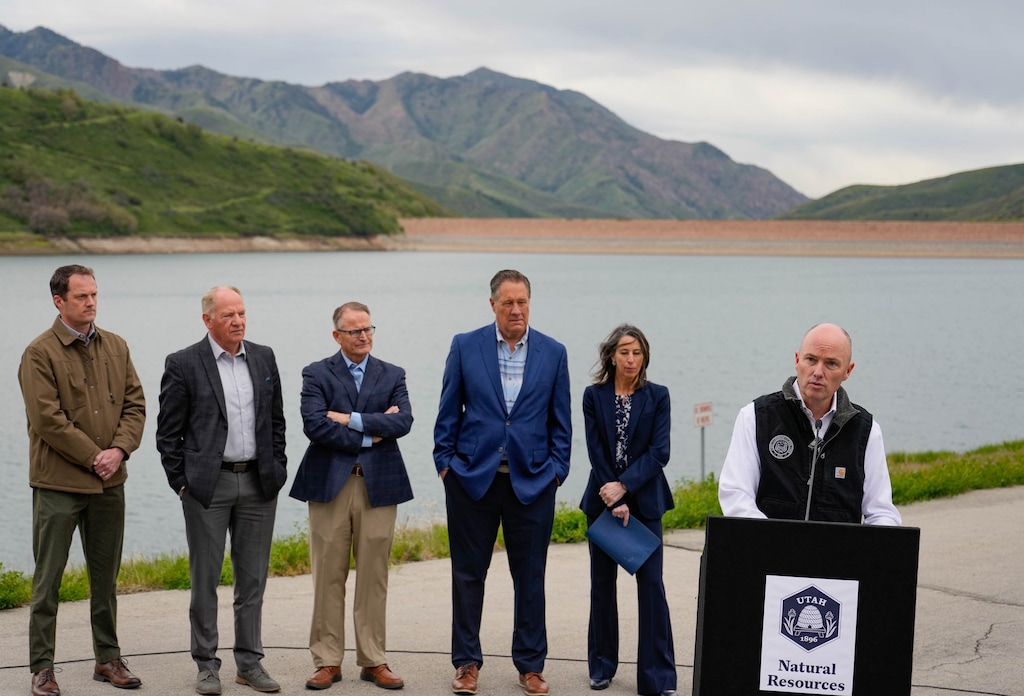
(Francisco Kjolseth | The Salt Lake Tribune) Little Dell Reservoir, one of the primary supplies of water for the city of Salt Lake, sits well below capacity following a news event providing an update on Utah’s drought conditions and water supply outlook heading into the summer months on Thursday, May 21, 2026. The reservoir is expected to be a little above 50% capacity by the end of the runoff season.
Utah’s April 1 snowpack averaged 2.7 inches of snow water equivalent, the amount of water the snow releases when it melts. That’s the lowest since 1930, the governor said. The normal snow water equivalent is around 14 inches at the start of April. In 2023, which saw record snowfall, the state had an average of 28 inches in April. Snowmelt provides almost all of the water supplies across the state, and runoff is what helps the Great Salt Lake and reservoirs rise each spring.
“We are relying on our savings account in our reservoirs” Cox said, noting reservoirs statewide sit at roughly 70% capacity. “Our savings is being spent a little faster than we like, since the checking account is empty.”
The governor’s emergency declaration does not contain any mandatory actions, though.
It calls on Utahns to voluntarily take water-saving measures like fixing irrigation leaks, installing low-flow toilets and replacing unused grass with water-wise plants.
“If the only time you walk on your grass is to mow it,” Cox said, “it’s probably not that necessary.”
The state will leave water policing and penalties up to individual water districts and cities, Cox said, since they have their own unique storage and distribution systems. Weber Basin Water Conservancy District, for example, has reservoir capacity to meet the needs of two years’ worth of demands during dry spells. Central Utah Water Conservancy District, by comparison, has around seven years’ worth of storage thanks to massive reservoirs like Strawberry and Jordanelle.
“There will be enhanced enforcement,” Cox said, “because the situation is so dire, and that will take place at the local level.”
The governor’s emergency declaration creates funding opportunities for farmers and municipalities to cope with the drought.
“You’re going to see farms and ranches throughout the state, they’re going to get one cutting ... [and] they’ve got livestock that can’t eat just once,” said Joel Ferry, the commissioner of the Department of Natural Resources who also operates a farm along the Bear River. “We may have communities that need to re-drill wells to have access to drinking water.”
(Francisco Kjolseth | The Salt Lake Tribune) Joel Ferry, executive director of the Department of Natural Resources, joins speaks during an update on Utah’s drought conditions and water supply outlook heading into the summer months at Little Dell Reservoir on Thursday, May 21, 2026. Also pictured are Laura Briefer, Director of Salt Lake City Department of Public Utilities and Gov. Spencer Cox.
The Utah Department of Agriculture and Food said the declaration opens up the Emergency Disaster Relief Loan program for farmers and ranchers across the state. The program offers seven-year loans of up to $100,000 at 0% interest for the first 2 years, and 2.75% interest thereafter. Those funds can only be used for declared disaster-related losses not covered by insurance, the department said.
“We’ve been preparing to open these programs since it became clear what kind of year we’re looking at,” UDAF Commissioner Kelly Pehrson said in a statement. “Many of our producers are going to need supplies and supplemental resources to a degree that puts many people’s livelihoods at risk, so this program will be instrumental in helping them make it through the season.”
Around 65% of residential water in the state is used outdoors. Water managers like Tage Flint, executive director of Utah Waterways, said that’s “simply too high,” and called on Utahns across the state to pivot to less water-intensive landscaping.
“I’m also here to tell you that this is not our last drought,” Flint said. “This is going to happen again and again and again.”
Laura Briefer, director of Salt Lake City Public Utilities, said she’s already seen residents watering their yards as if it’s June rather than a water-strapped May. She expects Little Dell, with its bathtub ring visible during the news conference, to only fill to about half its capacity this season.
“This year’s extremely low snowpack, reduced runoff, and the dire condition of Great Salt Lake make it extremely clear that we must do more,” Briefer said.
Salt Lake City is currently under its stage-two drought contingency plan, which mandates cuts from government properties and calls on other businesses and residents to voluntarily conserve.
“Water has always connected our communities, our economy, and our environment,” Briefer said, “and the choices that we make today will shape Utah’s futures for decades to come.”
The governor lauded Utahns for stepping up their water conservation during rough droughts in 2021 and 2022 which saw the Great Salt Lake hit two record-low elevations in a row.
“We can’t control the weather, but we can control the tap,” Cox said. “So, let’s make 2026 the year we prove once again Utah’s resilience is deeper than any drought.”
Update, 2 p.m. • This story has been updated to include additional details about financial relief available for agriculture producers.