 Megan Banta
Most people in Box Elder County “don’t want me to put down my shovels,” Kevin O’Leary said of plans for a 40,000-acre data center campus in the rural northern Utah county.
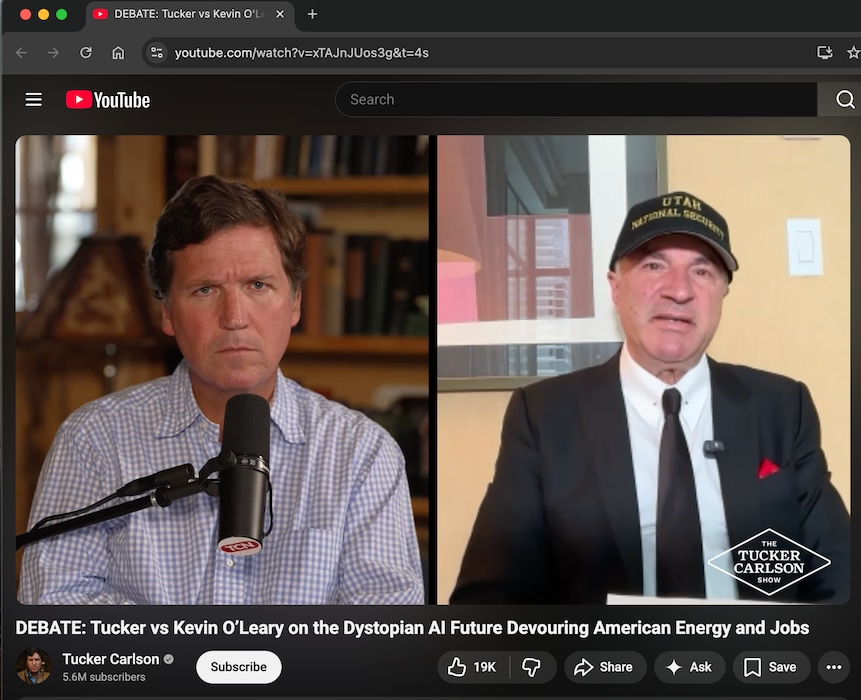
“They asked us to come. They asked us to bring $50 billion,” O’Leary said during a nearly hourlong conversation with Tucker Carlson on posted on the conservative political commentator’s website and social media pages.
O’Leary didn’t specify who “they” are — but said “they” voted for the data center.
When pressed by Carlson, who asked whether he’d missed a referendum approved by Utah voters, O’Leary referred to the 3-0 decision of the Box Elder County Commission to approve the massive energy and data campus plan.
But commissioners have said they were handed details of a massive data center and energy proposal at the “last hour,” and brought in outside attorneys to help navigate the high-stakes deal. Their vote came about a week after Utah’s Military Installation Development Authority board voted to create a project area to allow the data center development under that body’s oversight.
The project has faced criticism for being rushed, as well as concerns about the environmental impact, but O’Leary said the reason behind expediting it is so it doesn’t go to Mississippi or elsewhere.
O’Leary and Carlson’s conversation on “The Tucker Carlson Show” — the episode titled, “DEBATE: Tucker vs Kevin O’Leary on the Dystopian AI Future Devouring American Energy and Jobs” — followed a 32-minute monologue from Carlson.
The popular host aired concerns about AI and the data center plan, including criticism of Gov. Spencer Cox’s initial reaction to questions about the plan. Cox has since said his comments during a news conference — where he said Utah has an “obligation” to allow the building of massive data centers — fell short.
One of Carlson’s biggest concerns centered around “normal, middling IQ autocrats” using AI to control people and an assertion that no one involved in the data center project has taken the time to get people to like it.
“They don’t care what you think about it — possibly, because pretty soon, they won’t have to,” Carlson said.
O’Leary, arguing for more data centers, said he was motivated to start developing them because of “this narrative in North America about how negative data centers are” and China’s rapid building of data centers with gigawatt or higher capacity.
While the U.S. has thousands of data centers, he said, those have enough capacity for storing files in the cloud – not the gigawatt or more needed for training AI tools like Anthropic’s Claude or Google’s Gemini.
“We have to keep all our tech ahead of theirs, including data centers and everything else,” he said of the Chinese.
O’Leary also alleged again that China was behind organizing the protesters who have organized against the Box Elder data center plan.
If he were China, he said, he would “want to shut down every proposal for a data center,” rile up environmentalists and pay protestors.
He’s previously said protestors were “bused in” from out of state and that opponents include “professional protesters.”
The Salt Lake Tribune analyzed hundreds of comments from Box Elder County residents and found overwhelming local opposition. Locals are trying for a referendum to stop it. A group of Utahns gathered on the Capitol steps Thursday to deliver a letter signed by roughly 6,000 people opposing the project.
O’Leary doubled down on his assertion that China has strings manipulating the attacks on his data centers proposed for Utah and Alberta, Canada. Four hours after the county commissioners voted, he said, his team noticed a spike of “a bunch of IP addresses that we don’t know spewing out a tremendous amount of information” on social media.
There’s “misinformation being spewed everywhere,” he said, including that it will be the biggest in the world.
While the project is on 40,000 acres, O’Leary said, it won’t use the entirety of the Stratos Project Area.
“There’s plenty of land, we don’t need it all,” he said, adding they might lease some back to grazers or use some for manufacturing.
O’Leary also addressed concerns Carlson raised about water usage, tax subsidies and AI taking people’s jobs.
Overall, he said, he’s never faced a controversy or attacks as he has in the days since MIDA approved the project area plan.
“What’s motivating me now,” he told Carlson, “with all of this barrage, this firestorm — which I understand you’ve experienced in the past — is I want to beat them (the Chinese) in AI."