 Courtney Tanner
The University of Utah’s men’s basketball team has started its latest season on a winning streak, but the arena they call home is losing big.
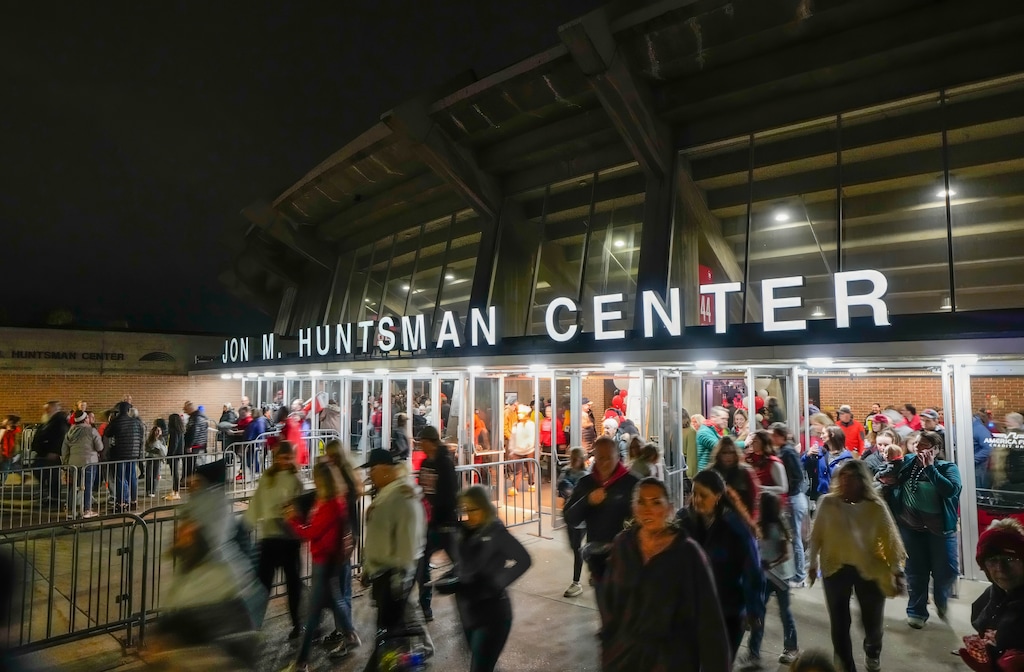
The outdated and much-debated Jon M. Huntsman Center is operating at a significant deficit, according to numbers presented Tuesday to the U.’s board of trustees.
The arena was reported in the red this past fiscal year, with a $765,859 loss. That’s since been paid off. But this fiscal year, it’s projected to grow to a new deficit of over $1 million.
The U. is subsidizing the losses by transferring funds from other operations.
U. Trustee Karen Marriott questioned what was being done to intervene.
Gary McArthur, the university’s chief financial officer, said the school won’t be able to reverse it immediately. But he pointed to the now-finalized private equity partnership the U. formed with Otro Capital to revitalize revenue for Utah Athletics.
Under that deal, the spinoff company Crimson Brand Partners is expected to take over commercial sports events on campus, including ticketing, concessions, licensing and branding, as well as stadium and arena operations.
Part of that includes a planned renovation of the 57-year-old Huntsman Center, which hosts Utah basketball, gymnastics and volleyball events. There had been initial talk of leveling the longstanding arena and relocating it before discussions reversed course earlier this year.
Now, the idea is to shrink its capacity and add more premium suites with higher-priced ticket sales, according an initial study. The plan also calls for more food offerings for fans, who currently have relatively few options.
The arena, which has roughly 15,000 seats, brings in an average of 7,000 fans each men’s basketball game. It also hosts nonathletic events, including the U.’s graduation ceremonies and those for high schools across the Salt Lake Valley.
McArthur, though, said any renovation plans won’t be ready to present for approval this year to the Utah Board of Higher Education.
Under the deal with Crimson Brand Partners, the U. will still own and manage the Huntsman Center as a facility and report those finances as part of its auxiliary budget. In a statement after the meeting, the school added that having a building deficit “is not uncommon for older arenas that have ongoing maintenance needs.”
The statement continued: “Despite the upcoming renovations, we are committed to providing the best environment for all events in the historic Huntsman Center.”
Earlier this year, McArthur presented fiscal 2027 projections that showed the U.’s athletics overall operating at a deficit. That’s the result, he said, of conference changes and the House v. NCAA settlement, which created an eligible $20.5 million salary pool for student-athletes at any school.
McArthur estimates an $11 million-dollar hole, with athletics bringing in $118 million and spending $129 million.
Football continues to be the school’s most profitable sport. But like the Huntsman Center, Rice-Eccles Stadium is also expected to operate at a loss this year.
The stadium came out ahead last fiscal year with $105,913 in income. But McArthur projects a deficit there this fiscal year of $97,310.
The U. is hoping the private equity partnership will infuse up to $500 million into its athletics operations.