 Sean P. Means
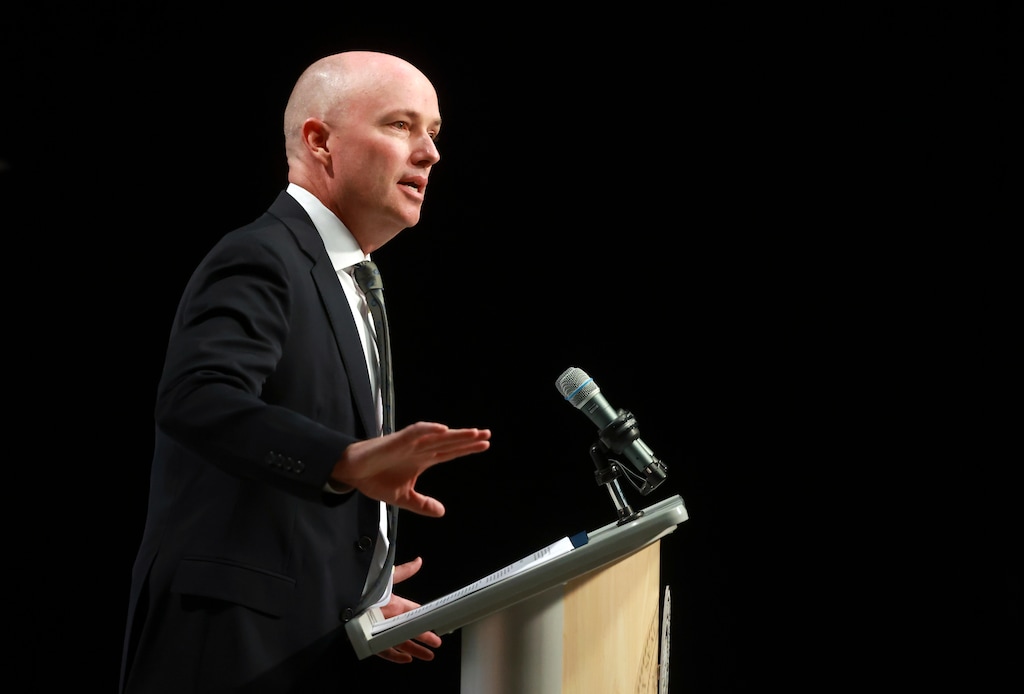
Utah Gov. Spencer Cox said he aims to “do better” about a week after his comments over a proposed data center campus in Box Elder County rankled some critics.
“Strong opinions are welcome. Healthy disagreement is part of good government,” Cox wrote Friday in a long thread posted on X. “But I know my own comments at a recent press conference did not meet the expectations I have for myself. I seek to do better.”
Cox was referring to his latest monthly news conference on April 30, during which he responded sharply to criticism that the data center plan was moving too quickly for public scrutiny.
“This whole idea of being rushed — I’m so tired of our country taking years to get stuff done,” Cox said at the news conference. “It’s the dumbest thing ever. We think that taking time makes things better or safer. It absolutely does not.”
Cox added at the time that he has been “pretty neutral on data centers,” but said every state, including Utah, “has an obligation to allow for these types of data centers to be built.”
Plans for the 40,000-acre data center campus were first made public at a little-noticed April 22 meeting of the Box Elder County Commission.
Two days later, the state’s Military Installation Development Authority, or MIDA, unveiled details while giving its approval to the plan. Then, during a May 4 meeting packed with protesters, the Box Elder County Commission approved an agreement with MIDA, allowing the data center plan to proceed.
In his Friday thread, Cox on X addressed several concerns people have raised about the data center proposal, including the project’s size, the energy needed to run it and the water it would need to function.
Cox noted electrical use on the project’s first phase would not exceed 1.5 gigawatts, while officials have previously cited up to 3 gigawatts. He did not address the discrepancy.
The potential officials have described for it use up to 9 gigawatts — more than twice what the entire state now uses — is “10-15 years down the road,” he said.
He has directed state agencies to review air permits and ensure Utah’s water and the Great Salt Lake are protected, he wrote, adding that “in no event will the developer reduce water going to the Great Salt Lake.”
Cox added that the project’s developer has committed to pursue renewable energy sources in addition to natural gas. He did not specify where the developer made that commitment; on social media, celebrity investor and project developer Kevin O’Leary has said the project “can” use renewables.
MIDA’s plan specifically cited the Box Elder County location’s proximity to the Ruby Pipeline, a natural gas line that crosses the area, and indicated that it would be powered “100%” by natural gas.
Cox concluded that he supported Box Elder County’s agreement with MIDA and decried “threats and personal attacks.”
“We cannot lose sight of our shared humanity,” Cox wrote. “Public officials, community members and project opponents — these people are our neighbors.”