 Samantha Moilanen
With Utah leaders urging speed and local residents protesting that they should slow down, Box Elder County commissioners voted to delay a decision on giving final approval to a “hyperscale” data center campus and energy project.
“The thing that’s so frustrating for us, for commissioners, is all of a sudden, we’re brought this in the last hour, and we’re expected to hurry,” Commission Chair Tyler Vincent said, shortly before the three commissioners decided to table the decision.
The next meeting to vote on the project was scheduled for next Monday, May 4, at 4 p.m. at the Box Elder County Fairgrounds Fine Arts Building to accommodate the crowd. The larger venue was chosen after some 80 people packed the commission chamber Monday, spilling out into the hallway.
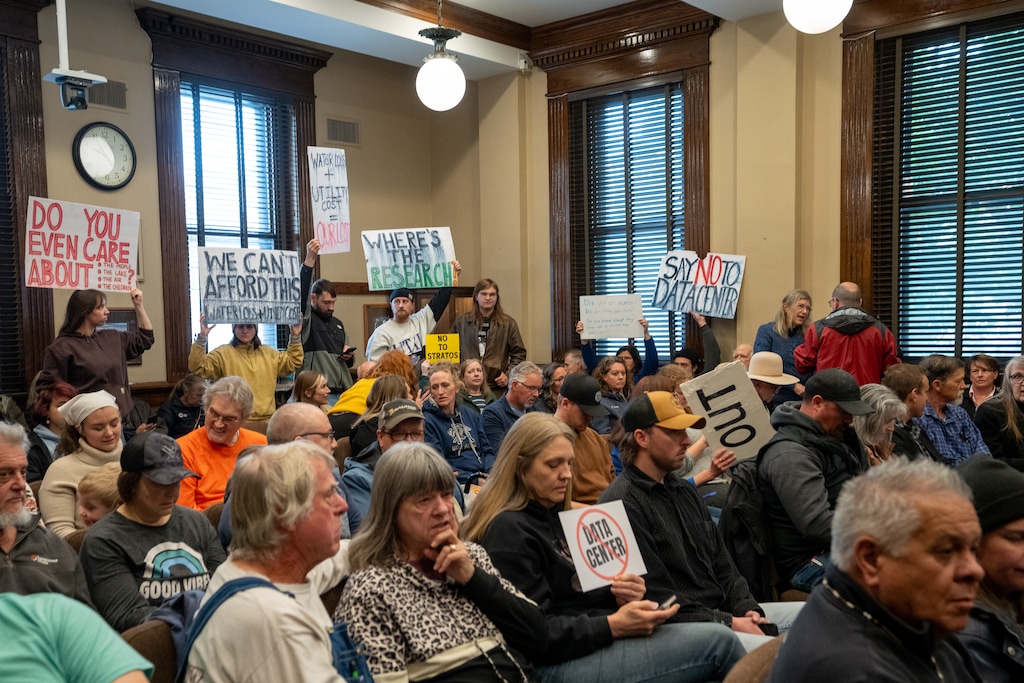
Some of those people carried signs reading “Where’s the research,” “People before profits” and “Say no to data center.”
After the vote to delay, cheers and applause broke out inside the chamber and from those gathered outside the room.
Commissioner Lee Perry said the commission first learned about the project through “rumors” during the last legislative session, before the state’s Military Installation Development Authority (MIDA) presented it to them.
To better understand the proposal, which MIDA has called the Stratos Project, Vincent said the county brought in an outside legal team. He did not say how much that help cost the area’s taxpayers.
(Trent Nelson | The Salt Lake Tribune) Box Elder County commissioners Boyd Bingham, Tyler Vincent and Lee Perry discuss a MIDA and Kevin O'Leary data center project at a special meeting in Brigham City on Monday, April 27, 2026.
Representing MIDA at the meeting, Project Area Director Hilary Venable said MIDA wants “full transparency” and apologized for how late county leaders were brought into discussions.
“We apologize and know that that is not the MIDA way,” Venable said. “Because of the nature of the competitiveness of this project, to come to Utah or to another state, that is the reason why this has been exponentially put into motion.”
‘It affects all of us’
Some protesters arrived at the Box Elder County Historic Courthouse, where commission meetings are held, about an hour early, standing in the rain before filing inside.
Once inside the chamber, they held up their rain-soaked signs throughout much of the meeting, occasionally pointing to them and silently signaling commissioners to address their questions.
At other moments, frustration spilled over into shouted interjections from the crowd, drawing warnings from the commission chair that disruptors could be removed.
(Trent Nelson | The Salt Lake Tribune) People debate the project as the Box Elder County Commission prepared to meet on a MIDA and Kevin O'Leary data center project in Brigham City on Monday, April 27, 2026.
Attendees traveled from across northern Utah — including Cache and Weber counties — to voice opposition to the project, citing concerns about water use and energy demand, as well as frustration that they felt the public had little opportunity to comment before a decision was set to be made.
Mike Sims said he traveled from his South Ogden home to protest “because it affects all of us here in northern Utah.”
Others like Barbara Haggerty, who lives in Logan, said she worries the 2,000 permanent and high-paying jobs MIDA says the project will create won’t pay enough to “put groceries on the table.”
Monday’s turnout was organized through messages shared in the days leading up to the meeting, said Julie Quinlan, a Brigham City resident, describing it as a last-minute effort.
At one point, as Venable was speaking on behalf of MIDA, Quinlan interrupted, saying: “You’ve allowed this woman to come and speak three times, and you’ve allowed the public to speak once.”
In a Thursday Facebook post, the county said the “shortened session” will not include public comment. Commissioners said Monday that the public had been able to comment at the meeting last Wednesday, but many in the room said they had not been aware.
“Such large decisions like this shouldn’t be made without public input and without some serious pressure to make sure that we will be okay,” Haggerty said, “because we’re the ones who live here and call this place home.”
On the Utah Public Notice website, where the county posts meeting notices in compliance with state law, there is a notice for Wednesday’s meeting where public comment was held for the data center project and other agenda items.
There is no separate notice for a formal public hearing on the project — a step typically required under Utah law for certain land-use decisions, including zoning changes and development regulations.
At that Wednesday meeting, some residents told commissioners they felt the project had been handled quietly and they had been left without clear information as the timeline moved forward.
However, some landowners in Hansel Valley — the unincorporated area where the first phase of the project is planned — said they were contacted by MIDA about selling their property and told the commission they support the project.
Tim Munns, who lives in the valley, said he is not “selling out,” as only a small portion of his property is included in the project. He added that he supports the project, for the economic benefits MIDA has said it would bring to the county.
“It was either watch what’s happening or be involved,” he said. “So we chose to be involved.”
MIDA and county commissioners will hold two town halls in the “coming weeks” where the public can weigh in, the Facebook post states.
Later on Monday, the county commissioners said in a news release they delayed the decision to take more time to review the proposal and understand the “potential benefits and impacts” to residents.
“We want Box Elder County residents to know that we are listening and want to hear from you,” Vincent said in the news release. “While we’re excited at the potential investment and job creation Stratos can bring, it’s our responsibility to make sure this project is done the right way — protecting our agricultural heritage, maintaining local control, and addressing concerns from our residents."
In the release, the commission said it created an online form for residents to submit questions about the project.
Tax breaks for the MIDA project
The project is planned for 40,000 acres in unincorporated Box Elder County, where every private landowner has agreed to the use of their land; and on an additional 1,200 acres that include a section of the Utah Test and Training Range (UTTR), which is a Department of Defense site, and property owned by the Utah Trust Lands Administration.
It was approved by the MIDA board at a meeting on Friday, where state boosters said the proceeds will fund modern buildings at Hill Air Force Base while generating all of its own power, cleaning the water it uses so it can be sent to the Great Salt Lake, and creating 2,000 high-paying jobs in the rural area.
Box Elder County commissioners, who said at a Wednesday meeting that they had first heard of the proposal a few weeks ago, had been scheduled to give the project the last approval it needs at a meeting late Friday. But late Friday afternoon, that meeting was rescheduled for 10 a.m. Monday.
The head developer of the project is O’Leary Digital, owned by Kevin O’Leary, a Canadian tycoon and one of the investors on the reality show “Shark Tank,” where his nickname is “Mr. Wonderful.” O’Leary also made his movie debut last year, co-starring with Timothée Chalamet in “Marty Supreme.”
MIDA can offer tax incentives to developers so as they build in a project area, they can claim decades-long rebates of the property taxes assessed on the increased value they are creating. MIDA also can set special tax levies to raise funds and can issue bonds.
At the Friday meeting, Paul Morris, MIDA’s executive director, outlined proposed tax breaks — that the board then approved — for O’Leary’s project. Even with the breaks, the project will generate millions for Utah, he emphasized.
• MIDA usually imposes a 6% energy use tax on its developments. But to stay competitive with others trying to land deals with the same companies, Morris asked board members to approve a sharply reduced rate for the project’s data centers. The board agreed to set it at 0.5%.
• Instead of a standard certificate of occupancy — which would normally trigger property taxes — the project will use a “letter of completion” that sets a flat 1.2% tax on a site’s value. From there, the tax is further reduced. The developer is first credited back enough to bring it in line with Box Elder County’s normal property tax rate, which Morris said is about 0.926%.
Of the tax revenue collected at that rate, 80% will be directed to O’Leary Digital, Morris said.
• Personal property taxes also will be rebated for data centers, he said.