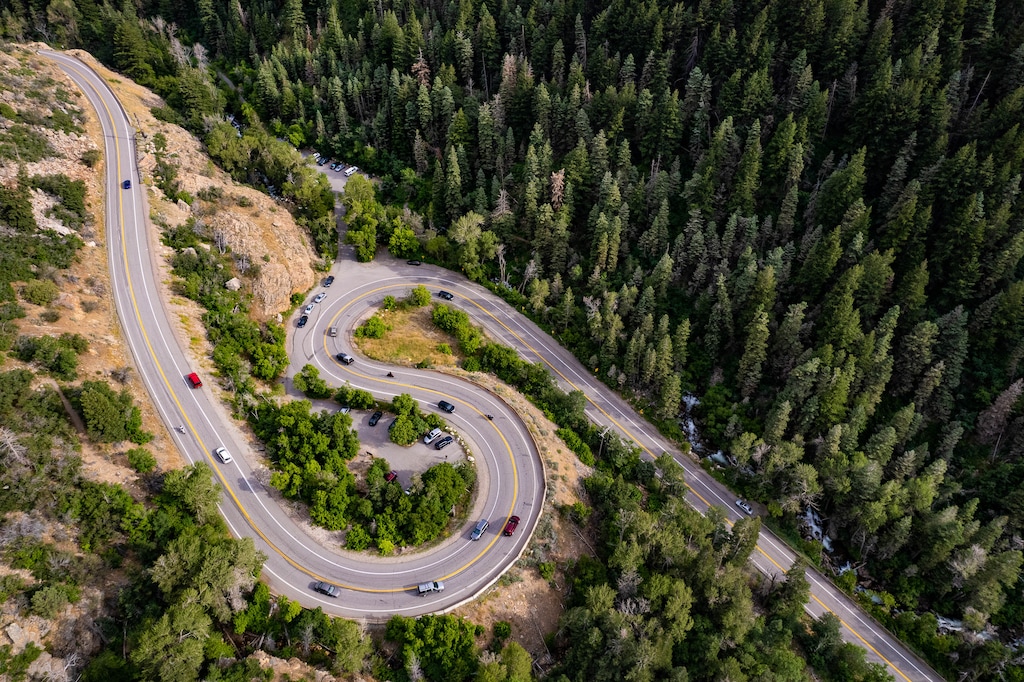
The 2001 Roadless Rule was created “to establish prohibitions on road construction and timber harvesting in inventoried roadless areas” on National Forest System lands. The intent of this rule is to provide lasting protection and leave a legacy of wild forests, clear drinking water and a place to recreate while listening to the wild wind and birds.
It tells the next generation that we care about their future. The legacy of the Roadless Rule gives hope in contrast with the ever-increasing development on our public lands.
We represent residents of Big Cottonwood Canyon who have worked to support a legacy of responsible recreation and conservation over many years. The Big Cottonwood community supports forest protection by dedicating weekends to manual labor on projects such as controlling invasive species, building analog beaver dams, clearing and building trails, and following fire-wise standards for helping protect forest, watershed, and homes from devastating wildfire.
But we also recognize the need for help with national issues. This White House has just rescinded three proven conservation orders.
The 25-year-old Roadless Rule, plus the 50-year old Nixon Executive Orders 11644 and 11989, restrict roadbuilding on all federal land. Recently, the White House rescinded them, calling them outdated. This appears to be a move to allow more oil and gas development and motorized recreation.
Remember when the hillsides above Salt Lake were scarred and eroded from dirt bikes and 4X4s? When the meadow at Silver Lake in Big Cottonwood was a mudhole from trucks “digging” and slinging mud off their knobby tires? Those scars remain 60 years later and could potentially return.
Executive Order 11644 required our federal land management agencies to designate where off-road vehicles could be driven, while prior to EO11644 and now post White House recission, off-road driving is unrestricted until each area is designated as no motor vehicles.
To their credit, our local Forest Service Salt Lake District focuses on watershed, recreation and conservation. Also, the Town of Brighton commits substantial funding to watershed protection. Over $200,000 will be funded this year. This is the vision that triggered the Town of Brighton to incorporate, and it remains our mission to advocate for our watershed, our forest and our people, both residents and visitors.
We absolutely need the Roadless Rule to continue. After all, the Cottonwood Canyons provide over 50% of the water for Salt Lake City residents. Canyon water travels from mountains to downtown taps within about 24 hours, so it’s vital to protect these headwater canyons.
The Wasatch Mountains support a broad range of recreational and conservation activities, drawing upwards of 3.2 million visitors a year, where the daytime population outnumbers all but 53 of Utah’s 326 towns. The Forest Plan delineates specific boundaries to support a variety of conservation and recreation goals.
The roadless prescription protects diverse ecosystems, historic landscapes and public values. In the Central Wasatch, portions of Millcreek, and both Big and Little Cottonwood Canyons are managed under this prescription.
The less segmented by roads the forests are, the more space there is for the wildlife and the fewer wildfires, since most wildfires are caused by activities near roads.
Roads are more expensive in the canyons; we don’t need more.
As canyon residents, we watch the annual road damage caused by snowmelt, avalanches, rockfalls, thunderstorms, artesian springs, frost heave and ephemeral streams, which create potholes, washouts and unstable asphalt.
The Forest Service has 371,000 miles of road in its system, twice as long as the federal highway system. So far, they have been unable to maintain them fully, resulting in a backlog of about $10 billion. Roads also carry invasive weeds into the canyons, like fuzzy mullein, myrtle spurge and Dyer’s woad. You’ll notice these invasives along the roadways, but not so much in the backcountry (yet).
We would be proud if our Sen. John Curtis stood up for the Roadless Rule. Sadly, we know where Mike Lee stands.
America needs a roadless bill similar to the Public Lands Integrity Act that has been proposed to block Mike Lee’s sale of our public lands. Write to your senators, write to your representatives, write to your candidates.
Roadless areas maintain the scenic beauty that people seek to restore their bodies and souls through hiking, snowshoeing, picnicking or just sitting peacefully, leaning up against a tree.
(Barbara Cameron) Barbara Cameron is a resident of Brighton, serving as President of Big Cottonwood Canyon Community Council for 24 years.
Barbara Cameron is a resident of Brighton, serving as President of Big Cottonwood Canyon Community Council for 24 years. She has served on local water and sewer boards, as a stakeholder for the Central Wasatch Commission, and as an appointed representative for the Blue Ribbon Commission for Mountain Zoning, Mountain Accord and Cottonwood Canyons Scenic Byways Study.
(Kirk Nichols) Kirk Nichols is a representative in the Big Cottonwood Community Association.
Kirk Nichols is a representative in the Big Cottonwood Community Association. He has served with the Mountain Accord, the Central Wasatch Commission’s Stakeholders Council, and numerous Utah State Park Planning Teams. He is a former Forest Service ecologist and is currently a professor of parks, recreation and tourism at the University of Utah.
The Salt Lake Tribune is committed to creating a space where Utahns can share ideas, perspectives and solutions that move our state forward. We rely on your insight to do this. Find out how to share your opinion here, and email us at voices@sltrib.com.