 Tamarra Kemsley
Latter-day Saint Bible scholar Dan McClellan read the email inviting him to appear on one of the world’s most influential podcasts — and promptly ignored it.
Even if the invitation to appear on the “Joe Rogan Experience” was legitimate (McClellan wasn’t sure at first), the academic doubted whether he should take part in the controversial show.
“I struggled with it,” McClellan told The Salt Lake Tribune, calling the podcast, which attracts tens of millions of listeners, a “purveyor of misinformation” and “hateful ideologies.”
McClellan is a former scripture translation supervisor for The Church of Jesus Christ of Latter-day Saints, and has made a name for himself in recent years by challenging popular Bible hot takes under the tagline “data over dogma.” He’s also the author of “The Bible Says So: What We Get Right (and Wrong) About Scripture’s Most Controversial Issues.”
McClellan mulled over the question for so long that Rogan’s assistant emailed him a second time, he said, asking if he had received his initial email.
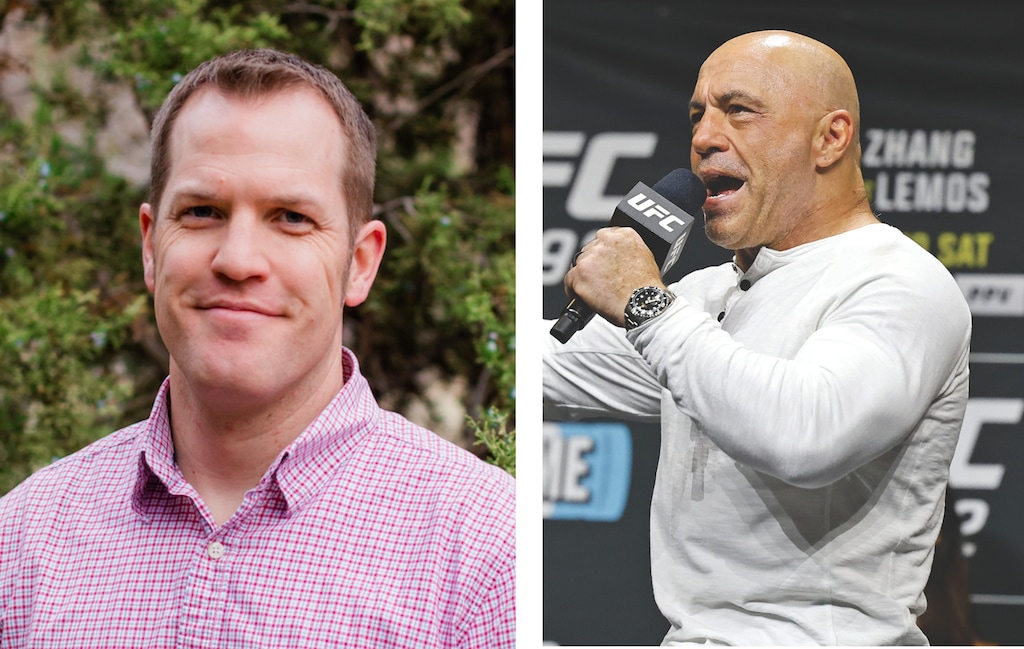
(Francisco Kjolseth | The Salt Lake Tribune) Joe Rogan looks out into the crowd during the UFC 278 mixed martial arts fights at Vivint Arena on Saturday, Aug. 20, 2022. McClellan described the influential podcaster's show a “purveyor of misinformation” and “hateful ideologies.”
Only after consulting “numerous people” with opposing viewpoints did he agree to go on the podcast, hopeful the opportunity to “confront misinformation” among such a large audience would render his appearance a “net positive.”
The resulting two-and-a-half-hour episode, posted Wednesday, represents one of — if not the — biggest media breakthroughs for a Latter-day Saint scholar of religion.
But not all of McClellan’s 1.6 million social media followers are celebrating.
‘I just don’t talk about that’
As is his wont, McClellan neither hides nor focuses on his status as a member of the Utah-based faith in the episode, briefly noting near the beginning of the episode that he converted at age 20 and enlisted as a missionary a year later.
Another two hours pass before he briefly returns to the subject.
“I got a set of scriptures,” he says toward the end of the episode, referring to the time shortly after his baptism. “And the first thing I wrote on the inside cover was a quote that I’ve always loved: ‘A good example is the best preacher.’ I’ve always tried to live by that.”
Rogan, for his part, seems uninterested in the church, never asking directly about it. He inquires only near the very end about McClellan’s own beliefs — or, as he puts it, “your version of this.”
It’s a question McClellan is clearly practiced at sidestepping, conceding that he is a “religious man” and nothing more.
“I just don’t talk about that,” he explains about his personal beliefs, “and in no small part because I do believe that it is as Jesus in the New Testament says: ‘When you pray, go into your closet and pray in secret, and your father will reward you openly.’”
Mushrooms and identity politics
The overall conversation is freewheeling as Rogan, prone to free association, interrupts McClellan to interject ideas and arguments from previous guests or books he’s read.
“There were a couple times when I just remained silent because I didn’t want to become confrontational,” McClellan told The Tribune, “or I didn’t want to invite a more significant departure from what I felt like I was there to talk about.”
McClellan did want to push back, however, against a long-debunked theory that Rogan has helped repopularize — that psychedelic mushrooms, not Jesus of Nazareth, kicked off Christianity.
Sure enough, Rogan gives McClellan his hoped-for opening, asking him during the final third of the interview what he thinks of the 1970s book “The Sacred Mushroom and the Cross,” generally despised by scholars for injecting the hypothesis into the mainstream.
McClellan doesn’t hold back.
“The main argument … has been just torn to shreds,” he informs Rogan before carefully dissecting its pitfalls.
Another win McClellan ticked off in his interview with The Tribune included explaining to Rogan’s millions of listeners that the Bible is a living document that has undergone numerous evolutions through the centuries — and not a static, self-interpreting text.
McClellan, a critic of Christian nationalism, said he was also glad for the opportunity to argue that identity politics play a powerful — and often unrecognized — role in how people approach the Bible.
“If we like a particular interpretation … that serves our interests within the communities that are important to us, we’re going to be loath to accept a different interpretation,” he tells Rogan. “That’s our intuitive cognition trying to protect us socially. It causes all kinds of problems.”
‘This is so disappointing’
So, how does McClellan, who posted an hour-long video response Friday to criticisms of his appearance on the show, feel now that it’s done, posted and racking up hundreds of thousands of views?
“As of now,” he said Thursday, “I still feel like it is a net positive.”
But neither does he begrudge those who disagree.
“For all I know,” he said, “it might have been the wrong decision.”
And amid the flood of congratulatory messages and praise for the performance online, there are more than a few who do, in fact, believe he was wrong. Denunciations on social media were immediate, and often weighted with a sense of betrayal.
“I have followed and supported Dan for years,” wrote one social media commenter, “but this is so disappointing.”
Another wrote: “Dan always says he’s against disinformation, but then goes on the show of one of the greatest purveyor of lies and disinformation in history? Make it make sense!”
A milestone
Not counted among those criticizing the move are two Latter-day Saint historians who have themselves sought to harness social media as a tool of public scholarship.
There’s a huge upside to exposing Rogan’s audience to vetted scholarship about one of the world’s most influential texts, agreed Benjamin Park, with Sam Houston State’s University, and Kalamazoo College’s Taylor Petrey.
“If your true goal is to stop the spread or confront the spread of misinformation,” Park said, it’s hard to pass up an audience “in the millions who you can expose to a rigorous argument concerning the Bible who would otherwise not hear one.”
(Benjamin Park) Historian Benjamin Park described McClellan's appearance on the show a breakthrough for Latter-day Saint scholars of religion.
Petrey said he was especially impressed with McClellan’s ability to “dismantle” in clear terms the widely held notion that the Bible represents “a single book with a single perspective and a single voice.”
Another point both historians agreed on — McClellan’s interview marks a major milestone for Latter-day Saint scholars of religion.
Petrey wagered that not since author Joanna Brooks appeared on “The Daily Show” in 2012 to talk about her memoir “The Book of Mormon Girl” has a member of their ranks broken through like McClellan did this week.
(Taylor Petrey) Latter-day Saint religion scholar Taylor Petrey applauded McClellan's performance, including his representation of scholarship on the Bible.
“Dan isn’t doing Mormon scholarship,” Park stressed. “But I do think it’s telling that the fact that someone with a Mormon background can be seen as a trustworthy source to millions of potential viewers [on the topic of the Bible].”
To the historian of American Christianity, it signifies an important shift toward acceptance of Latter-day Saints as potential authorities on the sacred text — if not by everyone, then at least by a meaningful segment of society.