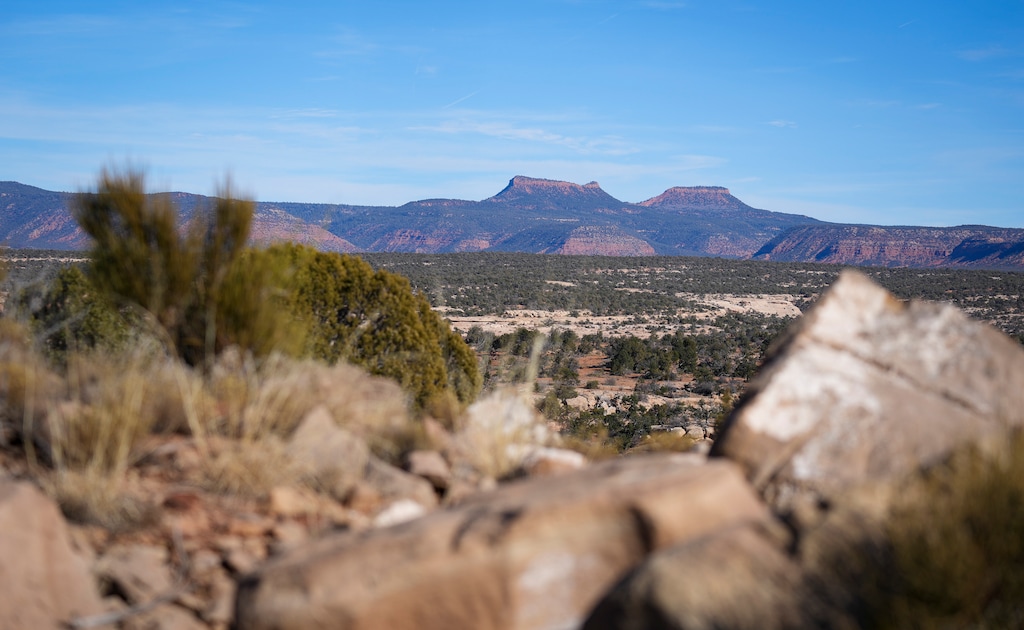
This week, the Tenth Circuit Court of Appeals handed Utah a victory: Our challenge to the size and scope of the Bears Ears and Grand Staircase-Escalante monument designations will move forward. For years, the federal government insisted that no court was even permitted to weigh whether those designations followed the law Congress actually wrote. The appellate court rejected that, and Utah will finally make its case.
To understand why this ruling matters, it helps to start more than a century ago when Congress passed the Antiquities Act in 1906 to address a serious problem.
Across the American West, so-called “pot hunters” were looting archaeological sites, stripping artifacts from ancient pueblos and cliff dwellings, and selling pieces of America’s history to collectors. Congress responded by creating a mechanism to protect those historical treasures before they disappeared forever.
Few would question the wisdom of that decision. But the question today is different: How much land may a president claim with the stroke of a pen?
That question lies at the heart of every debate over monuments like Bears Ears and Grand Staircase-Escalante and the future of public lands in Utah. Yet it is often misrepresented as a choice between those who care about conservation and those who do not.
That’s a false choice.
Utahns treasure our public lands, national parks and national monuments. I have spent considerable time hiking in these lands, including an unforgettable week-long hike in the breathtaking Grand Staircase-Escalante region.
The dispute is whether the Antiquities Act authorizes presidents to place millions of acres under added layers of federal control.
Congress gave presidents authority to identify precious antiquities and protect enough land around them to preserve those antiquities. But Congress did not grant presidents unlimited power. Congress expressly provides that monument designations must be confined to the “smallest area compatible” with protecting the object at issue.
Think of it this way: Congress let presidents draw a small border around a treasure. But some presidents used that authority to claim every acre for miles around it. Many Utahns — myself included — believe that is precisely what has occurred with the Antiquities Act.
In 2016, President Obama designated approximately 1.35 million acres in Utah as Bears Ears National Monument — an area around the size of the entire state of Delaware. Twenty years earlier, President Clinton designated 1.7 million acres as Grand Staircase-Escalante National Monument — now it is 1.87 million acres, roughly the size of Delaware and Rhode Island combined.
Can million-plus acre monuments truly be described as the “smallest area compatible” with protecting an object?
Even the legislative history points in the same direction. During debate on the Antiquities Act, a representative asked how much western land would be withdrawn from use under the bill. The bill’s sponsor responded simply: “Not very much.”
During the debate over Bears Ears, Rebecca Benally — the only Navajo member of the San Juan County Commission at the time — opposed the designation and warned that decisions affecting local communities would increasingly be made by distant federal officials. Her concerns highlight a simple reality: Monuments of this scale do far more than protect objects — they end up governing regions.
The Antiquities Act’s size limitation serves another important purpose that is often overlooked: The act gives presidents the power to designate monuments, but does not give them the power to fund the monuments.
Under our Constitution, only Congress can appropriate money. A president may draw lines on a map, but he cannot appropriate the resources needed to manage what lies inside those lines. When a president designates millions of acres with the stroke of a pen, visitation to the monument often increases dramatically, as it did in Utah. Yet the funding needed for roads, archaeological protection, law enforcement, and search-and-rescue operations does not automatically follow.
Local communities are often left shouldering the costs of these increased responsibilities. The designation becomes an unfunded mandate.
There is a reason many of Utah’s most beloved public lands followed a different path. Zion, Bryce Canyon, Arches and Capitol Reef all began as national monuments. But they became enduring success stories because Congress eventually turned them into parks and gave them the funds and staff to manage increased visitation and protect the resources that drew visitors in the first place.
That process reflects the wise design of our constitutional system. Presidents may identify resources worthy of protection. Congress then determines whether the nation is prepared to commit the resources necessary to preserve them.
This debate is not about whether Utah’s treasures should be protected. They should be. Nor is it about whether presidents have a role in protecting historic and cultural objects. They do.
Conservation and constitutional limits are not opposing values. This week, Utah proved we can defend both — and we intend to finish what we started.
(Derek Brown) Derek Brown pictured in his home in Cottonwood Heights on Wednesday, Oct. 16, 2024.
Derek Brown is the Utah Attorney General. He brings decades of legal and political experience to his role, shaped by his service as legal counsel to two U.S. Senators and as a state lawmaker.
The Salt Lake Tribune is committed to creating a space where Utahns can share ideas, perspectives and solutions that move our state forward. We rely on your insight to do this. Find out how to share your opinion here, and email us at voices@sltrib.com.