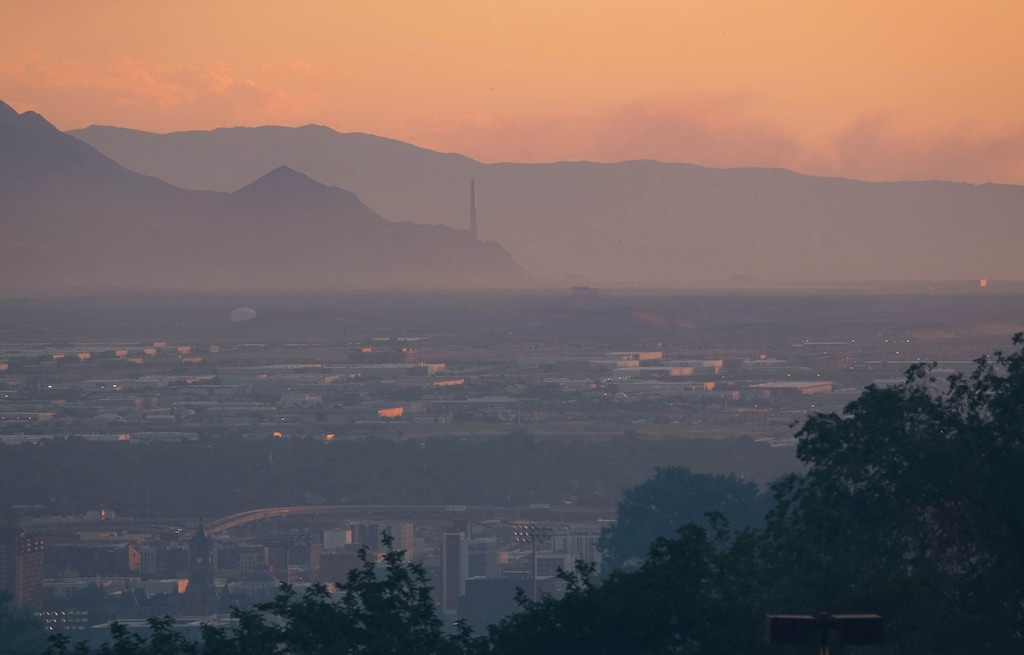
During wildfire season, most of us don’t need to check the Air Quality Index (AQI) in our weather app — when there’s smoke in the air, it’s obvious. The air is thick with that familiar “campfire” smell, and it permeates our indoor spaces as well as our outdoor environment.
If you did happen to check the AQI Tuesday morning, you might have been surprised to see the AQI was “moderate” (between 51 and 100). This means the Environmental Protection Agency (EPA) considers the air quality to be acceptable and safe for outdoor activities — even sensitive groups can exercise outside, as long as they avoid heavy exertion. But there is something fundamentally misleading about the AQI’s public health messaging when wildfire smoke is present.
My day-to-day job is to study the effects of air pollution on our health. I see a broad gap between what we know about pollution and how we communicate these harms to the public. For those who are unfamiliar, the EPA protects our public health through the Clean Air Act, a law which establishes air quality standards. These standards are the concentrations at which pollutants, such as fine particulate matter (PM2.5), are thought to be detrimental to human health.
But PM2.5, the main pollutant in wildfire smoke, is only a measure of the size of the particle (smaller than 2.5 micrometers in diameter, or about 30-times smaller than the width of a human hair). PM2.5 can actually be many things — and in the case of wildfire smoke, PM2.5 is highly toxic, burned material.
PM2.5 from wildfire smoke is up to 10-times more toxic to human health than PM2.5 from other sources (such as traffic). Exposure to moderate-AQI levels of wildfire smoke — like what most of the Wasatch Front experienced Tuesday morning — may be far more harmful than a moderate-AQI day without wildfire smoke.
In a study in California, exposure to even light amounts of smoke was demonstrated to increase risk of death from cardiovascular and respiratory causes. This was true for older adults, but also younger adults.
Another study suggests there is no safe level of exposure to wildfire smoke, meaning even a “healthy” AQI (50 or lower) is unsafe if smoke is present. Specifically, these researchers found that any amount of PM2.5 from smoke was associated with higher rates of death.
Short-term consequences of wildfire smoke exposure may include more emergency room visits and hospitalizations for respiratory conditions. During pregnancy, exposure may increase risk of preterm birth later on, regardless of how far along you are. Exposure can cause inflammation and reduce lung function, and these effects may be long-lasting even in healthy adults. Children, older adults, people with chronic diseases, and pregnant folks are considered particularly sensitive to the health effects of wildfire smoke.
On days like today, we are sending the wrong message — to sensitive groups, as well as the general population.
As we begin the 2026 wildfire season, we should rethink our public health messaging. The AQI is valued for its simplicity, but wildfire smoke days may need to carry an additional warning, such as a flag indicating the presence of smoke.
Regardless of what the AQI says, let’s exercise far greater caution — maybe 10-times more caution — when wildfire smoke is present.
(Brenna Kelly) Brenna Kelly is a postdoctoral fellow with the Responsible-AI Initiative at the University of Utah.
Brenna Kelly is a postdoctoral fellow with the Responsible-AI Initiative at the University of Utah. She holds a Ph.D. in Population Health Sciences from the University of Utah and has expertise in analyzing the health effects of air pollution exposure during pregnancy. The views expressed are her own.
The Salt Lake Tribune is committed to creating a space where Utahns can share ideas, perspectives and solutions that move our state forward. We rely on your insight to do this. Find out how to share your opinion here, and email us at voices@sltrib.com.