I am a registered nurse and a human anatomy instructor.
I spend my days teaching students how the body works and caring for patients whose bodies are not working. This has taught me something simple: People do not make decisions about health in a vacuum. They bring their beliefs, their fears, their past experiences and sometimes a deep distrust of medicine itself. I have tried to meet people in that space.
But Utah’s measles outbreak has pushed me to a place I do not like and cannot ignore.
There are limits to empathy when other people are forced to live with the consequences.
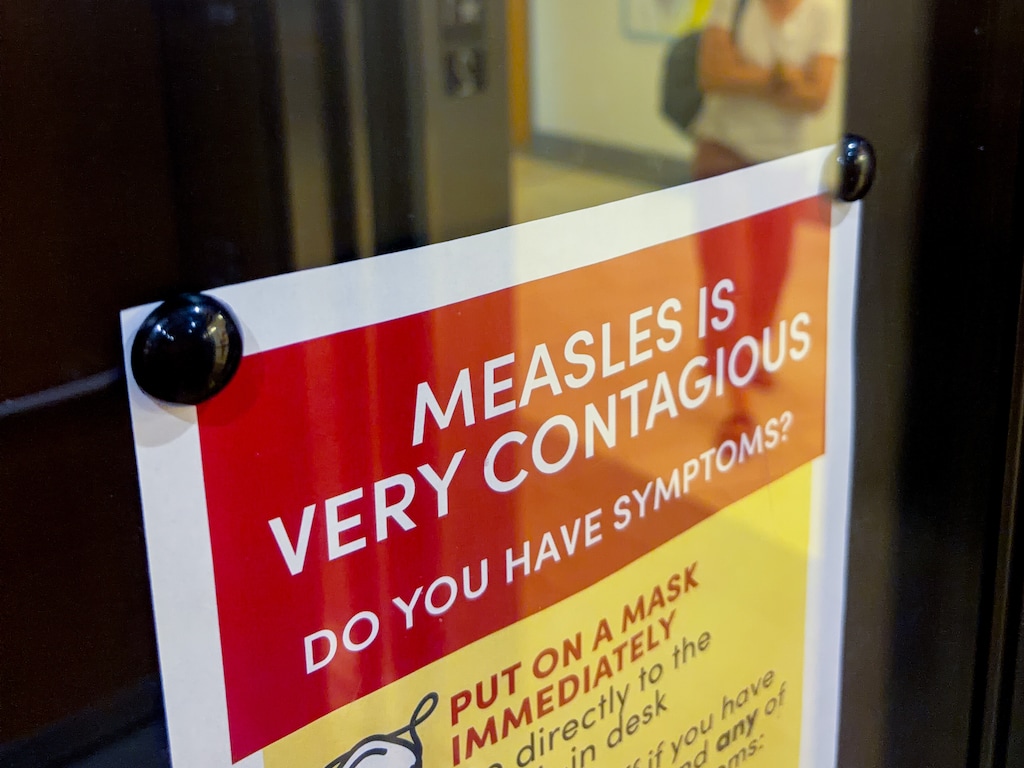
This is no longer theoretical. Utah’s measles outbreak has already sickened hundreds of people. Public health officials warn that the virus can remain in the air for up to two hours after an infected person leaves, which means exposure is not always visible or avoidable. This is what it looks like when a preventable disease starts moving through a community again.
It is also worth saying clearly: No one in Utah has died from measles in this outbreak so far.
That fact will reassure some people, but it can also mislead them. Death is not the only meaningful outcome of this disease.
CDC data show that about 1 in 5 unvaccinated people in the U.S. who get measles is hospitalized, and severe complications can include pneumonia, encephalitis and death.
We are fortunate to live near a world-class children’s hospital system. We can provide the highest standard of care possible.
But those interventions do not make the disease harmless. They mean a child now gets a chance to survive something that should never have happened in the first place. They mean a 4-year-old may spend days or weeks in an ICU fighting for their life. And even then, the outcome is not guaranteed.
That distinction matters. Because when people look at this outbreak and see that no one has died, they may conclude that the risk is not real. What they are not seeing is the full cost of the disease.
My grandfather died several months ago at the age of 93. One of the last conversations I had with him was about polio. He grew up in Price, Utah, in a time when infection was not abstract or political. It was part of daily life. He remembered what it felt like to live with the possibility that a disease could take your strength, your breath or your future. He remembered watching other children get sick, some of them never walking the same again, some of them not coming back at all.
I worry that we are losing that memory, so dearly earned by people who understood exactly what was at stake.
And in its place, we are slowly accepting the return of suffering that earlier generations spent their lives trying to escape.
I do not think most people making these decisions are malicious. Many are trying to make sense of complicated information with imperfect trust in the system. I can understand that.
But there are limits to what we accept when other people are at risk. Most wildfires are not started by people who set out to burn entire landscapes. They start with something small: a cigarette in dry grass, a campfire someone assumed was out. The person who caused it may never have intended the damage that followed. But intention does not contain the fire once it spreads.
Once it starts moving, it stops being yours.
This is completely preventable. The measles, mumps and rubella vaccine has been studied for decades and remains one of the most effective tools in modern medicine. The CDC makes this point plainly: Getting the MMR vaccine is much safer than getting measles, and serious complications from the vaccine are extremely rare. Nearly 1 out of every 3 children under the age of 5 who catches measles ends up in the hospital, according to the AAP. And nearly 1 to 3 of every 1,000 children will die, the CDC reports.
And yet, we are watching a preventable disease move through our communities again.
At some point, this stops being a question of personal preference and starts becoming a question of responsibility. Infectious diseases do not care about the boundaries we draw around our own choices. They move through households, classrooms and communities. The consequences move with them. Public health requires public cooperation and participation.
We need a renewed commitment to the idea that our health decisions affect more than just ourselves. At some point, caring for your neighbor has to show up in what you do, not just what you believe.
Because in a state where measles is spreading again, the cost of getting this wrong will not be measured in opinions.
It will be measured in children.
(Andy Munguia) Andy Munguia is a registered nurse and a human anatomy instructor in Utah.
Andy Munguia is a registered nurse and a human anatomy instructor in Utah. The views expressed here are his and do not necessarily reflect those of his employers.
The Salt Lake Tribune is committed to creating a space where Utahns can share ideas, perspectives and solutions that move our state forward. We rely on your insight to do this. Find out how to share your opinion here, and email us at voices@sltrib.com.