As we transition from June to July, my internal radio station automatically shifts from playing the song “Vogue” by Madonna to playing “God Bless the USA” by Lee Greenwood.
Mindfully, I pause to see if perhaps there is something else — something between those two songs. Up pop the lyrics “Don’t dream it, be it,” sung by Tim Curry, playing Dr. Frank-N-Furter in “The Rocky Horror Picture Show.”
My face changes into a sly smile and my mind plays a nostalgic memory.
I first heard those lyrics when I was in high school, in the great Northwoods at the head of the Mississippi River and in the land of the Ojibwe/Anishinaabe. A charismatic teen was stomping around the small stage of the charter high school I was attending in thick-heeled platform combat boots. He was a riot, and my whole being lit up with excitement. I had no idea that this level of exuberance lived in anyone else. I would come to find out it lives in the hearts of countless others, and that they (we) are called queers.
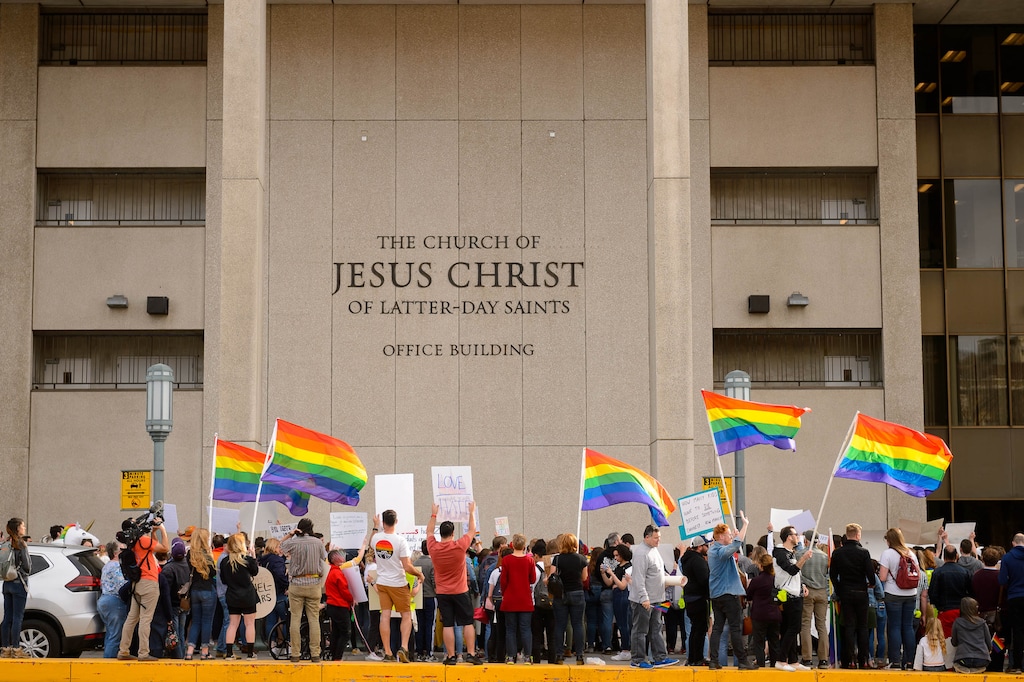
My parents are members of The Church of Jesus Christ of Latter-day Saints. I was “born in the covenant,” raised and lived the principles of the gospel of Jesus Christ until my 35th birthday; my midlife crisis birthday. The gift I gave myself that year was the freedom to live the fullness of my creation — authentically. Within a few months, my bishopric member was at my door with a letter.
You know the rest of the story.
I now find myself in the beautiful era of building a life that fits the reality of my identity: I am a queer Mormon. I always have been, and I always will be.
Where to start, however, in understanding what any of that means? With genealogy, of course.
My mother taught me well: Look to our ancestors to help make meaning of our existence. Connecting with them means connecting with a part of myself that has gone undiscovered for far too long.
From my research, I now know that Ina Mae Murri is one of my queer ancestors. She was a brave Mormon woman who fought for the well-being of women and gay men in California during the AIDS epidemic. She has died, but I wish I could tell her about how her efforts paid off. Not only do we have medical advancements that help manage HIV, but we also have survivors from the epidemic. Survivors like sweet Olin. He lives on the East Coast with his husband, Sidney. They are queer Mormons, too. They have worked hard to build and maintain the organization Affirmation: LGBTQ Mormons, Families & Friends.
The current Affirmation president is Fred Bowers, and — you guessed it — he is also a queer Mormon. I have had the privilege of watching him guide this international nonprofit with tremendous care as I sit on the board of directors.
Who knew queer Mormons were capable of such an endeavor? Certainly not my 15-year old self. All I knew about queer people in the early 2000s was that they were antithetical to my Mormon existence. This became quite the dilemma, however, because I was a queer Mormon. So, I thought, if I exist, perhaps there are others like me, too. How we exist seems quite up for debate in our faith.
For example, Jacki and Tere are two lesbian women who fell in love at the Missionary Training Center in the late 1980s. They served full-time missions and went on to teach Spanish at the same high school in Southern California. They built a home there, integrated with their neighbors — many of whom are also Latter-day Saints — and grew their family from two to four. They have lived a beautiful life as queer Mormons.
I wish their story and other successful stories of queer Mormon families would have been shared more. Because what I learned when I dialed up to the internet as a teenager and searched “queer Mormon” was that my option was silence. If I kept my queerness a secret and didn’t act on it, then I could play the part of a good Mormon girl and everything would be OK.
Well, everything would look OK from the outside, and that’s all that mattered.
In my heart those lyrics played, louder and louder as the years went on — “Don’t dream it, be it!” Dr. Frank-N-Furter was encouraging me to actively live the identity I am.
And so I did.
For the past four years, I have been building a life of authenticity with my loved ones. We are taking the advice to “be it!” I hope my queer Mormon ancestors would be proud, and I especially hope future generations of queer Mormons know they are part of a proud lineage of brave and exuberant souls.
(Dr. Lacey Bagley) Dr. Lacey Bagley is a fierce advocate for LGBTQIA+ and polyamorous communities and provides relationships coaching online.
Dr. Lacey Bagley is a queer Mormon living in Utah County, land of the Timpanogos and Ute tribes, with her husband and kids. She is a fierce advocate for the LGBTQIA+ and polyamorous communities and provides relationships coaching online. The stories shared in this op-ed will be published by Signature Books in an upcoming book called “Eras of Affirmation: A 50-year History of LGBTQ+ Mormons, Families & Friends.” The editors of the book are Dr. Lacey Bagley, Dr. Phoenix Har and Josh Smith.
The Salt Lake Tribune is committed to creating a space where Utahns can share ideas, perspectives and solutions that move our state forward. We rely on your insight to do this. Find out how to share your opinion here, and email us at voices@sltrib.com.