 Megan Banta
Maggie Wells briefly considered renting after her divorce. But she ultimately decided she and her three kids, including two teens living at home, needed the stability of homeownership.
She found one in Plain City. The 1,900-square-foot house with a one-car garage was priced below $450,000, and with help from the state’s down-payment assistance program, she bought it on her single income. It’s made all the difference.
“It’s very empowering,” she said.
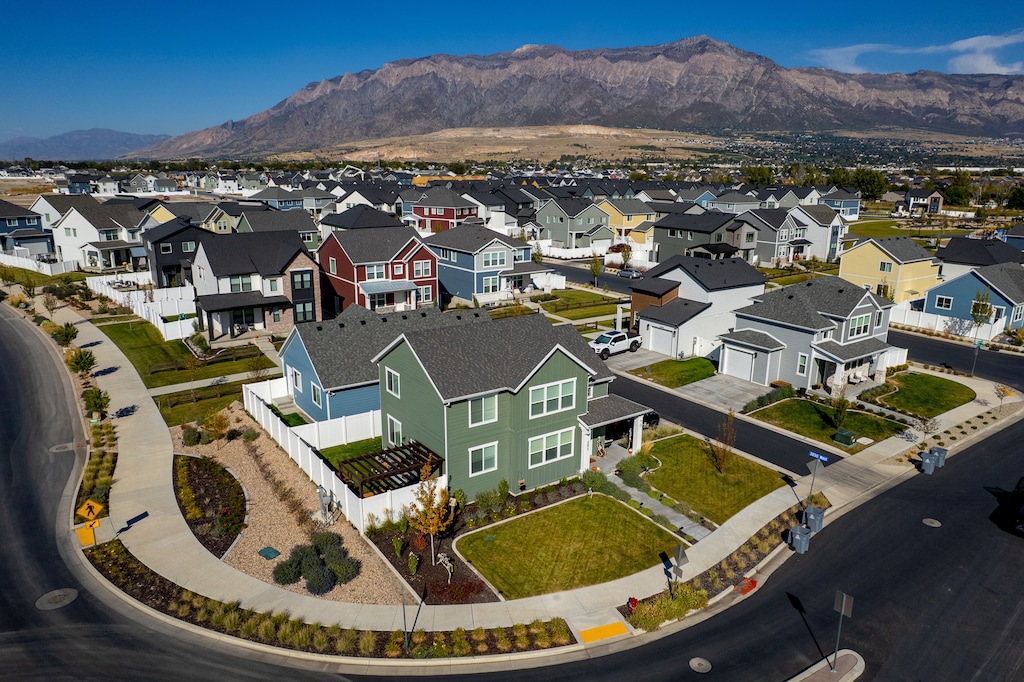
The home is one of 275 starter homes at JDC Ranch and a prime example of something that’s become increasingly difficult to pull off in Utah: Making homeownership affordable by building smaller houses on smaller lots.
“That’s what is required to create affordability for working Utahns right now,” said Steve Waldrip, who advises Gov. Spencer Cox on housing strategy and leads the state’s Division of Housing and Community Development.
The challenge, Waldrip said, is that smaller homes generally require more density — something that’s often a hard sell.
‘I want my kids to be able to stay in Utah’
(Trent Nelson | The Salt Lake Tribune) Maggie Wells in Plain City on Tuesday, Oct. 6, 2026.
Jed Nilson owns Nilson Homes, the Utah-based developer that is building the JDC Ranch development.
He started building houses in 1999, when young people could reasonably expect to become homeowners early in their careers.
Today, he said, even two college graduates can struggle to afford a home together.
Utah has some of the highest housing prices in the nation. In September, the typical listing price here was $579,000, according to the Federal Reserve Bank of St. Louis. That’s the ninth highest in the country.
Experts say those prices are largely driven by a shortfall in supply as Utah continues to grow, driving up demand.
To help address that, Gov. Spencer Cox announced an “audacious” goal nearly three years ago of building 35,000 new starter homes before the end of 2028, along with thousands more homes overall.
Nilson began reworking plans for the Plain City community shortly after that announcement, meeting with Waldrip to discuss increasing the development from 725 homes to 1,000.
He’s passionate about making homeownership affordable.
“I’ve lived here for 48 years of my life, minus two, and I love the place, and I have five kids. I have a sixth child on the way,” Nilson said. “I want my kids to be able to stay in Utah.”
(Trent Nelson | The Salt Lake Tribune) Jed Nilson at a new home in the JDC Ranch development in Plain City on Tuesday, Oct. 6, 2026.
Waldrip remembers Nilson being one of the first calls he got in his role as the state’s housing czar.
He was all in, but it wasn’t easy: It took months to convince local officials that adding 275 homes to the plan — all priced below $450,000 — was the right move, Waldrip said.
Looking to the Avenues for inspiration
As land prices skyrocket along the Wasatch Front, it’s made it nearly impossible to build affordable homes on larger, traditional-sized lots.
That means starter homes increasingly require smaller lots and more density – something Waldrip said often draws ire.
What eventually helped convince officials, he said, was the fact that homeownership allows families to build wealth.
For this development, the county was also able to prioritize preferred applicants, like first responders and active-duty military. All get two weeks to secure new homes before houses become available to the general public.
That fights another part of the narrative that Waldrip and Nilson pointed to — the idea that smaller homes attract a certain kind of person.
“These are nurses and teachers, and people who are great neighbors,” Waldrip said.
They’re people like Wells and Kameron Chancellor, a 26-year-old who works for Nilson.
She and her husband started looking for homes after the place they were renting went up for sale, she said. But most were either above their price range or “old and run down.”
(Trent Nelson | The Salt Lake Tribune) Kameron Chancellor in Plain City on Tuesday, Oct. 6, 2026.
In Plain City, though, they found the perfect fit. The smaller, more affordable homes have the same finishes and craftsmanship as the development’s market-rate houses.
They’re also dispersed throughout the development, so they blend into the neighborhood, Nilson said, addressing officials’ concerns about “a wall of garages.”
Nilson said he looked to older Utah neighborhoods, including the Avenues and Sugar House, for inspiration.
City and county officials from elsewhere have taken notice, he said, and several have asked for something similar in their communities.
Buyers ‘just want a home’
Nilson isn’t the only builder pursuing the idea. Oakwood Homes has been experimenting with smaller homes at its Wander development in Saratoga Springs.
Malcolm Thacker, who oversees the Utah market for the Colorado-based builder, said the homes have attracted buyers who previously didn’t think they could afford to become homeowners.
But Thacker said it’s not just about the size of the house.
“That’s not the answer,” he said.
It has to be economic from the get-go, he said, from acquiring land and getting density approved to designing and efficiently building.
(Trent Nelson | The Salt Lake Tribune) Homes at the JDC Ranch development in Plain City on Tuesday, Oct. 6, 2026.
That includes leaving off some features that have become standard in new construction.
“Not everybody needs to have granite or quartz countertops,” Thacker said. “Not everybody needs to have a finished backyard.”
Oakwood Homes asked buyers and would-be buyers what they found important, and it was much simpler.
They “just want a home,” he said, and the opportunity to start building wealth.
‘More accessible than people think’
Homeownership is the biggest vehicle for “having broad wealth spread across a big middle class,” Waldrip said.
Without a broad middle class, he said, there are “risks to the future of our entire structure and society.”
Utah in particular is losing too many of its kids and grandkids to places with more affordable housing, he said.
(Trent Nelson | The Salt Lake Tribune) Homes at the JDC Ranch development in Plain City on Tuesday, Oct. 6, 2026.
To help them stay, more communities need to take a forward-thinking approach, he said. One way to do that? Looking to the past.
Lots of Utahns grew up in a home smaller than 1,500 square feet that didn’t have a garage, he said, and survived.
Nilson’s own father lived in a fourplex after moving out of his family home, then in a roughly 1,000-square-foot house after that.
These days, new starter homes are about 4,000 square feet on a ¼-acre lot.
“Going back to what we used to do is perfectly fine,” Waldrip said.
In Plain City, it’s made homeownership more attainable than Wells and Chancellor expected.
The process can feel intimidating, Wells said, but the right assistance made it possible.
“It’s more accessible than people think,” she said.
Note to readers • This story is part of The Salt Lake Tribune’s ongoing commitment to identify solutions to Utah’s biggest challenges.