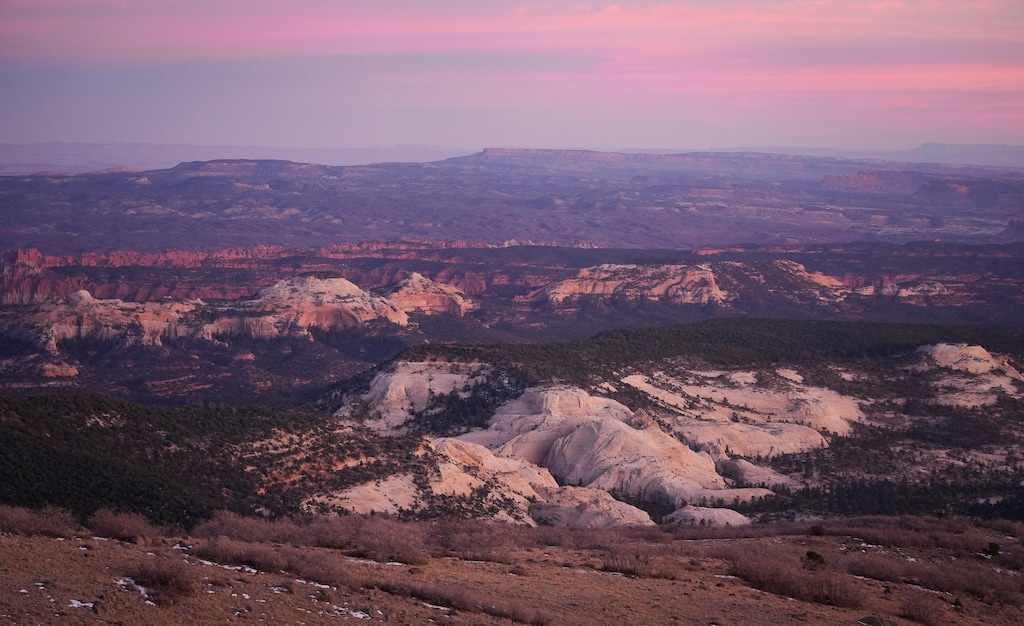
I participated in the Grand Staircase-Escalante planning process as a cooperating-agency representative. So, I was surprised to learn about the current push to use the Congressional Review Act to wipe out the monument’s 2025 resource management plan under the assumption that local governments and stakeholders were not heard.
That claim does not match my experience. Quite the opposite.
The process was long, adversarial and exhausting. It involved counties, the state, tribes, federal staff, consultants, comment periods, repeated drafts and conflict over grazing, recreation, preservation, access and stewardship. Whatever else one says about it, this was not a process in which Utah’s local interests were ignored. If anything, the recurring problem was that some participants seemed unwilling to tolerate the possibility that other voices might matter, too.
One short vignette illustrates this point: At a cooperating-agency meeting, I heard county officials object to the draft management plan’s Alternative D (the “natural processes” alternative), saying it was “too extreme” because it proposed phasing out grazing. That objection misunderstood what alternatives are for. My position was that this alternative needed to be included so that each alternative could be evaluated comparatively. Having four alternatives that are substantially similar ignores this important deliberative step. I was not arguing that grazing should be removed from every alternative. I contended that Alternative D should remain so that preservation and conservation values could be evaluated against more use-oriented alternatives.
What followed was even more revealing than the meeting itself. After I defended retaining Alternative D, Utah Public Lands Policy Coordinating Office officials sent a letter to the Navajo Nation President that carried a condescending tone, as though the real problem was not disagreement within the planning process but the possibility that a tribal representative had spoken in a way the state found inconvenient to its goals. Our response rejected that framing and clarified that my position was consistent with a professional analysis. The letter also objected to a broader pattern of state and county representatives monopolizing meetings and pressuring other cooperating agencies to support what they wanted rather than accept differing perspectives, expertise and strategies.
The correspondence made the real dynamic difficult to ignore. State and county representatives were not being excluded from the process. They were so overrepresented and so accustomed to shaping the terms of the management plan, that when a tribal representative defended a different perspective, the disagreement escalated upward in a way that looked less like dialogue than an attempt to eliminate other perspectives.
I say this as someone who was not fully satisfied with the final plan. Other tribal representatives were also not pleased. We had serious frustrations with parts of the plan, but this is what a compromise looks like, often leaving everyone dissatisfied. To me, this is a sign that the process was functioning as intended. One of the components that survived that process, and that would be lost if the management plan is overturned using the Congressional Review Act, was the tribal co-stewardship section. This was one of the most forward-looking parts of the plan and one of the few places where years of tribal participation produced something concrete.
That matters because the National Environmental Policy Act and National Historic Preservation Act are not arcane bureaucratic rituals, they are among the most pragmatic ways that federal law requires agencies to hear from affected communities. These laws are vital instruments of democracy and public participation. They force deliberation of complex and varied viewpoints.
The Congressional Review Act allows for congressional oversight of agency rules. But using it here as a blunt instrument to discard the product of years of planning, consultation, compromise and public engagement is not democratic repair. It is a way of nullifying the process after the fact. And it is especially cynical when justified by the claim that local voices were ignored, even though many of the same interests now making that claim were deeply involved from the beginning and, in my experience, often overrepresented in the room.
If critics believe parts of the Grand Staircase plan should be changed, they should say which parts and why. They should make that case in public. They should not pretend the process never happened. They should not erase years of work because the final compromise did not tilt far enough in their favor.
This is bigger than one monument plan. Democratic erosion rarely begins with the dramatic abolition of public process. More often, it works by preserving institutional forms while hollowing out the substance: hold the meetings, collect the comments, convene the agencies, and then discard the outcome when the wrong people manage to be heard. That is not efficiency, it is not accountability, and it is not representative democracy.
Grand Staircase and all its communities deserve better.
(Erik Stanfield) Erik Stanfield is a Senior Anthropologist with the Navajo Nation Heritage and Historic Preservation Department.
Erik Stanfield is a Senior Anthropologist with the Navajo Nation Heritage and Historic Preservation Department and participated in the Grand Staircase-Escalante National Monument planning process as a cooperating-agency representative. His work focuses on cultural resources, tribal consultation and federal land-management planning across the Colorado Plateau.
The Salt Lake Tribune is committed to creating a space where Utahns can share ideas, perspectives and solutions that move our state forward. We rely on your insight to do this. Find out how to share your opinion here, and email us at voices@sltrib.com.