 Brooke Larsen
Utah leaders want to overturn the Biden-era plan for a popular southern Utah national monument.
Sen. Mike Lee and Rep. Celeste Maloy on Wednesday introduced a joint resolution of disapproval under the Congressional Review Act that would undo the Grand Staircase-Escalante National Monument’s management plan implemented under President Joe Biden shortly before he left office in January 2025. The resolution is co-sponsored by the remaining Utah congressional delegation.
Congress is exercising its “constitutional responsibility to check executive overreach,” Maloy said in a statement on Wednesday. “And to be clear: this land remains federal land. It remains protected. The CRA is holding the agency accountable to the local people we represent.”
This resolution comes after Maloy wrote a letter to the head of the Government Accountability Office last July requesting an opinion on whether the monument plan counts as a rule under the act. The office deemed the plan a rule, meaning Congress can overturn it.
“The GAO has now confirmed what the law makes clear: this Resource Management Plan is a rule,” Lee said in a statement. “It carries binding consequences. It shapes what can and cannot occur across millions of acres.”
Gov. Spencer Cox said the resolution is “the right move” by Utah’s congressional delegation.
If the resolution passes with a simple majority vote within the next 60 days, Congress will throw out the plan and the Bureau of Land Management cannot replace it with a plan that is substantially the same.
This will mark the first time the Congressional Review Act is used to overturn a national monument plan.
The Utah delegation aims to replace the current plan with the 2020 management plan created during President Donald Trump’s first term after he shrunk the monument by nearly half.
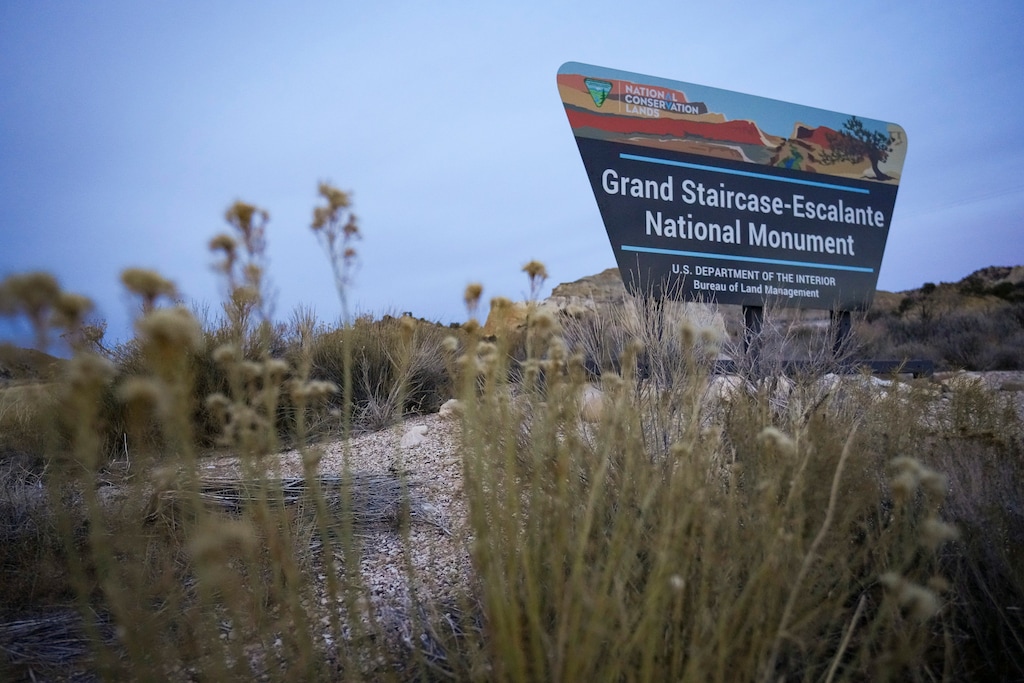
(Bethany Baker | The Salt Lake Tribune) Grand Staircase-Escalante National Monument is seen from the Head of the Rocks Overlook near Escalante on Tuesday, Dec. 17, 2024.
“The 2020 [Grand Staircase] plan was built with local communities, balanced conservation with access, and reflected the realities of life in southern Utah,” Maloy said.
That plan did not integrate Indigenous voices to the same extent as the current plan, though, Autumn Gillard, Southern Paiute Grand Staircase-Escalante Inter-Tribal Coalition member, told The Tribune.
“I am a Southern Paiute woman, and my connection to the landscape is not only cultural, but is theological,” she said. “This monument is a very culturally sensitive area for me in that it is a place that I go to seek refuge, to leave offerings, to make prayers, to engage with nature, to find solitude.”
If the BLM reimplements the 2020 plan, 900,000 acres of the monument would be managed at a “much lower standard,” Steve Bloch, legal director for the Southern Utah Wilderness Alliance, told The Tribune, and could be opened for oil and gas leasing, mining and more off-road vehicle use.
“This is a part of a grander strategy to undo Grand Staircase-Escalante,” Bloch added.
The current monument plan was finalized after over two years of public input and environmental analysis, according to the BLM. This included 13 joint meetings with local, state and tribal governments, as well as attendance at four meetings set by Kane and Garfield Counties, according to the BLM.
Local leaders still felt the plan did not adequately represent them, though. “With Garfield County sitting at the very heart of Grand Staircase–Escalante, the sweeping restrictions contained in the 2025 management plan fall squarely on the backs of our residents and small businesses,” the Garfield County Commission said in a statement. “Our communities live with the day-to-day consequences of decisions made about these lands.”
A recent study from Headwaters Economics, an independent research nonprofit, found that jobs and incomes have nearly doubled in communities around the monument since its designation in 1996.