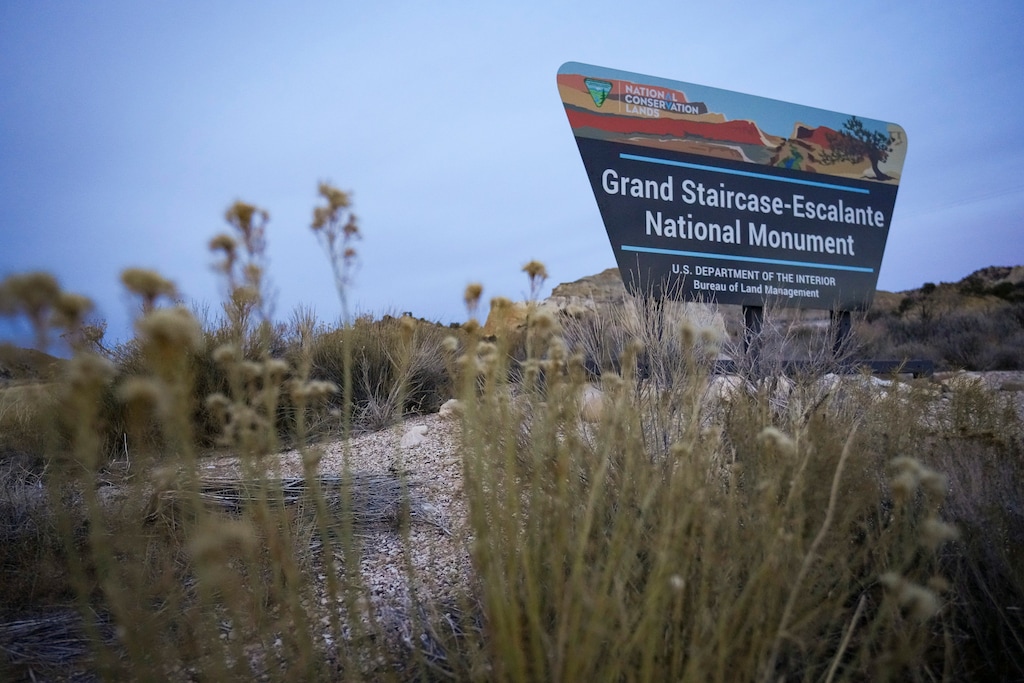
The anti-public lands crusaders in Congress are coming for Grand Staircase-Escalante National Monument.
Last month’s vote to overturn a 20-year mining ban in the headwaters of Minnesota’s Boundary Waters Canoe Area Wilderness proved the Congressional Review Act (CRA) is a weapon that can finally achieve something dreamt of for decades: An express lane to opening public lands to development.
The CRA had already been used to overturn land protections in Alaska, Montana, North Dakota and Wyoming, but the Boundary Waters was a true high-profile test case. And it worked. Minnesota Rep. Pete Stauber managed to manipulate an obscure legal process to open roughly 225,000 acres bordering the most-visited wilderness in the U.S. to a Chilean mine that will turn around and ship what it digs up to China to be sold on the world market.
Now, Utah’s delegation, led by Rep. Celeste Maloy and Sen. Mike Lee — stalwarts of the anti-public lands movement — are hoping members of Congress that voted to strip protections in Minnesota will fall in line and do the same to Grand Staircase-Escalante in southern Utah.
Using the CRA on Grand Staircase-Escalante will not overturn its national monument designation, but it will revert its management plan to an earlier version that sets the stage for mining, oil and gas drilling, and clearcutting.
I lived in Utah for 20 years. I can say with confidence its public lands are second to none. Grand Staircase-Escalante, specifically, is irreplaceable: There are ample opportunities for hiking, canyoneering and rock climbing. With sweeping vistas of red rock and narrow slot canyons, it is also home to hundreds of bird species, black bears and mountain lions that roam forested mountains.
Do not be fooled by the self-congratulation for retaining monument designation and the claims this is about course correction. Rep. Maloy and Sen. Lee know from experience selling public lands is a losing argument. Seventy-four percent of Utahns support Grand Staircase-Escalante’s designation, and 85% of Utahns see funding cuts to public lands as a serious problem. Using the CRA is an attempt to open the area to exploitation without having to explicitly say so.
Rep. Maloy claims reverting to the earlier plan is vital because the current one was created “without the people it affects most having any real seat at the table,” yet her release has no mention of the Tribal Nations connected to the region who have stewarded the area for time immemorial. At a time when 86% of Western voters say Native American tribes should have greater input into how public lands with sacred sites are managed — including many places of cultural and spiritual significance within Grand Staircase-Escalante — it is notable that Rep. Maloy’s announcement includes quotes about energy development and mining, but nothing about Tribal stewardship or the role of Tribal Nations in how the monument is managed.
Her central claim is that using the CRA will restore the monument’s management plan to a version more thought out and community minded. The truth is, it took more than two-and-a-half years to create the plan they are attempting to throw out. The management plan in use today represents deep discussion and analysis with local Tribes and communities, scientists, conservationists, ranchers, outfitters and other businesses who rely on the monument. It considers recreation but also things like grazing rights, dark skies, wildlife and a path forward for Tribal co-stewardship — which would be thrown away if the resolution is passed.
Defeating Rep. Maloy and Sen. Lee’s attempts to upend Grand Staircase-Escalante supports the more-than 75,000 jobs tied to outdoor recreation in Utah and the greater $1.3 trillion industry as a whole. It helps the communities surrounding the monument grow sustainable economies rather than the boom-and-bust that comes with extractive industry employment. Despite what anti-public lands politicians say, protecting Grand Staircase-Escalante is not holding back some golden age of prosperity. From 2001-2022, jobs grew by 51%, and per capita income grew 41% in the surrounding areas. Businesses in Garfield and Kane counties rely on protections of the monument to succeed.
A handful of lawmakers, including Rep. Maloy and Sen. Lee, has lobbied relentlessly to take steps to dismantle the public lands system, and this ill-advised use of the CRA would pry open a crown jewel in Grand Staircase-Escalante. We know public pressure works; it is up to us to apply it.
This may be a once-in-a-lifetime opportunity for the anti-parks and anti-public lands caucus.
The same can be said for those of us who want nothing more than to protect them.
(Ryan Gellert) Ryan Gellert is chief executive officer of Patagonia.
Ryan Gellert is chief executive officer of outdoor apparel and equipment brand Patagonia and an avid climber, snowboarder and lover of nature. He has spent decades exploring Utah’s backcountry.
The Salt Lake Tribune is committed to creating a space where Utahns can share ideas, perspectives and solutions that move our state forward. We rely on your insight to do this. Find out how to share your opinion here, and email us at voices@sltrib.com.