 Samantha Moilanen
 Megan Banta
Community leaders across Utah are fielding a growing number of data center proposals from developers eager to build the energy-hungry projects on pockets of mostly agricultural land.
But as frustrated residents pack meetings demanding answers, how much authority do local planning commissions and elected leaders actually have to stop them?
“You really can’t just zone people out,” said expert Francine Romero, a professor of public administration at the University of Texas at San Antonio. “You can’t zone out certain kinds of people, certain kinds of businesses.”
That leaves local leaders with a narrower path, able to require temporary delays and set limits on issues like size and noise, said Romero, who authored an article explaining why communities can’t “just say no” to data centers.
Grand County, where Moab sits, is one of several Utah communities trying to determine where to draw the line. Officials there are considering whether to prohibit data centers altogether — to the extent that state law allows — or what power they have to rein in their size and scope.
Planning Commissioner Robert O’Brien supports an outright ban. Grand County is one of the driest counties in the country, he said, and residents there have made it clear they don’t want data centers.
In Castle Valley, for example, a community survey conducted by the town council found about 90% of residents oppose the projects, O’Brien said. The planning commission also regularly receives letters from residents urging officials to prohibit them.
(Ryan Galbraith | The Salt Lake Tribune) Castle Valley Drive, the main road through the scenic community of Castle Valley, in Grand County.
“I don’t want them, but it’s a stopgap measure,” O’Brien said. “You can simply say no data centers, and then you can always change that.”
Farther north, Logan is drafting new land-use rules for data centers that would restrict their size, water use and electricity consumption.
There, Logan City Council Chair Mike Johnson said he doesn’t believe the city can legally ban data centers outright, pointing to state law that dictates how local governments regulate land use.
He also said the city can’t just allow one type of data center — such as one that stores public health data, for instance — yet prohibit any that support generative AI.
“You can’t say yes to a Ford dealership and not a Chevy dealership, and you may love one or hate the other,” Johnson said. “But at the end of the day, they’re doing similar things, and so, as long as we write that code in a way that our community [feels] is acceptable, then that’s what will move forward.”
The changes are happening in real time, as residents and local leaders try to understand how these projects can differ — from how much noise they generate to how much water and energy they consume.
What can be done?
(Rick Egan | The Salt Lake Tribune) Protesters demonstrate before a Box Elder County Commission meeting in Tremonton on Tuesday, May 4, 2026.
In Utah, public attention around data centers hit critical mass this spring, after news broke of celebrity “Shark Tank” investor Kevin O’Leary’s massive Stratos project in Box Elder County, said Brandy Grace, CEO of the Utah Association of Counties, a statewide advocacy group.
Since then, counties across Utah have seen a sharp rise in data center proposals, Grace said.
Some were already considering projects before the Box Elder plan, she said, but that project prompted more communities to consider pauses — or moratoriums — on any new data center developments and take a closer look at land-use rules.
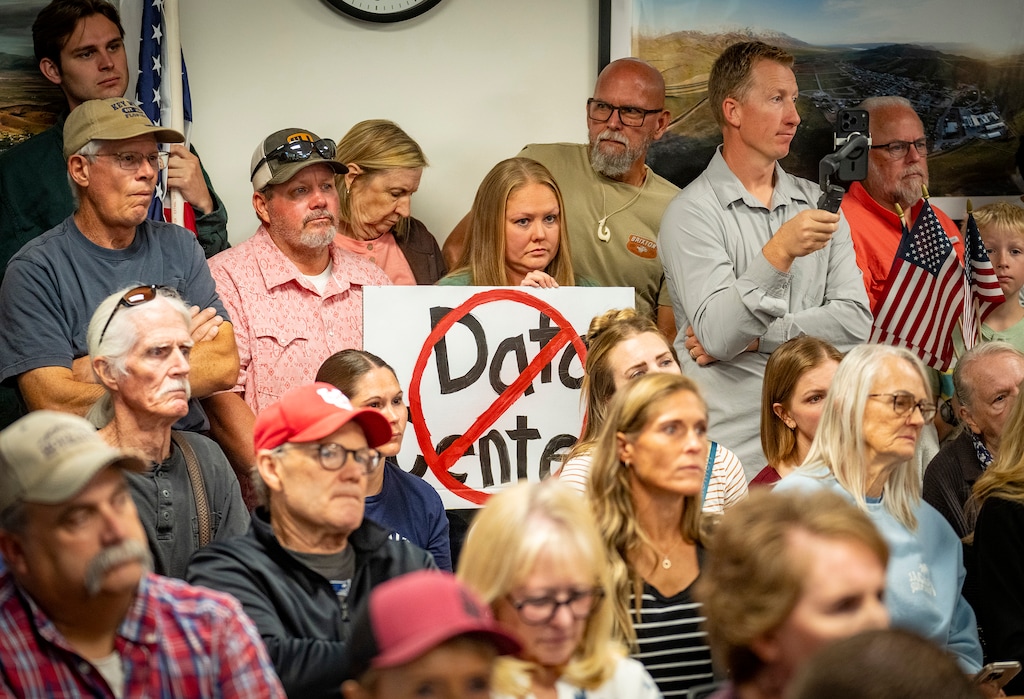
Before that tipping point, public hearings on data center proposals often drew little to no crowds, said Eric Clarke, general counsel for the Utah Association of Counties. Now, he said, Utahns are watching closely and turning out in droves to push back.
But it’s “risky” for local governments to outright prohibit a development simply because they oppose the type of project, he said. It could open them up to lawsuits.
Utah’s state code generally favors private property rights in land-use disputes, he explained — unless it’s impacting the private property rights of others.
(Rick Egan | The Salt Lake Tribune) Members of the crowd react as Box Elder County commissioners vote to greenlight the Stratos data center project during a Box Elder County Commission meeting in Tremonton on Tuesday, May 4, 2026.
“If it’s a big fat unknown against an industry that’s really well-funded,” Clarke said, “the safer thing to do is to come up with reasonable regulations than to try to do an outright ban and roll the dice and see if it holds up in court.”
Romero, the Texas professor who has studied the issue, said this is playing out in communities across the country.
Local officials have to be equitable — a concern that dates back to the late 1800s, when California cities used zoning and local ordinances to target and suppress Chinese-owned laundries.
She said communities are better served if local leaders identify specific concerns, gather reliable information about potential impacts and create new regulations designed to address those problems.
Cities and counties don’t have to rush, either, she said. In some cases, infrastructure needs alone can provide a legitimate basis for delaying a project — allowing utilities and local governments time to study whether the area can handle additional demand.
State lawmakers are currently considering changes to data center regulations that would leave decision-making power in local officials’ hands but improve the process, said Rep. Paul Cutler.
An upcoming bill likely will require local officials to have policies in place for data center zoning, setbacks, noise, heat, vibration and architecture before approving projects, the Centerville Republican said.
“The intent is to ensure, in the process, that consultations happen early in the development process so that people’s questions can be answered,” Cutler said Wednesday during a legislative interim committee hearing.
Does the public actually have a say?
(Rick Egan | The Salt Lake Tribune) Ranch owner Taylor Flake addresses a crowd of residents about a data center proposal near his Mona property during a Juab County Commission meeting on Tuesday, Sept. 8, 2026.
If local leaders introduce new conditions, a developer may decide to agree if it means their project can move forward, Romero said.
But she cautioned that if the process leads to officials effectively rejecting a project because of public opposition, the local government could face a legal challenge — one she believes developers would have a strong chance of winning.
Clarke agreed that planning commissions need to be careful about how they weigh public opposition to individual proposals.
Under Utah’s public clamor doctrine, they can’t deny a development proposal simply because a lot of residents oppose it, he said. Officials have to base decisions on the applicable land-use standards and evidence of how the project could affect neighboring properties.
“If the planning commission takes that into account, and it’s not like actual facts that would hold up in court, then the county can get sued over that,” he said.
(Francisco Kjolseth | The Salt Lake Tribune) The location of a new data center planned in Salt Lake City’s Northpoint neighborhood, pictured Tuesday, Nov. 10, 2026. A Florida company, Qlevr LLC, wants to power it through Utah’s existing electrical grid.
Counties, however, can regulate some impacts, such as noise, lighting, odors and appearance, Clarke said. But by design, their authority over other issues — such as water access, power, air quality and wastewater discharge — is more limited by state and federal regulations, he said.
“The real input for what people want in terms of data center development in their communities is during the code-writing process,” said Johnson, the Logan City Council member, “which for many communities across the state, including Logan, is happening right now.”
Romero recommended that cities think about the process for permitting when writing that code.
She pointed to Chandler, Arizona, which requires developers to notify neighbors of possible data centers and send someone with decision-making authority to two neighborhood meetings to describe the project and sound-mitigation efforts.
Local leaders also could give the public a role through a citizen commission, Romero said, to help them understand the process better.
“People don’t know a lot of the pressures that the elected officials are under with state law and mandates,” she said.