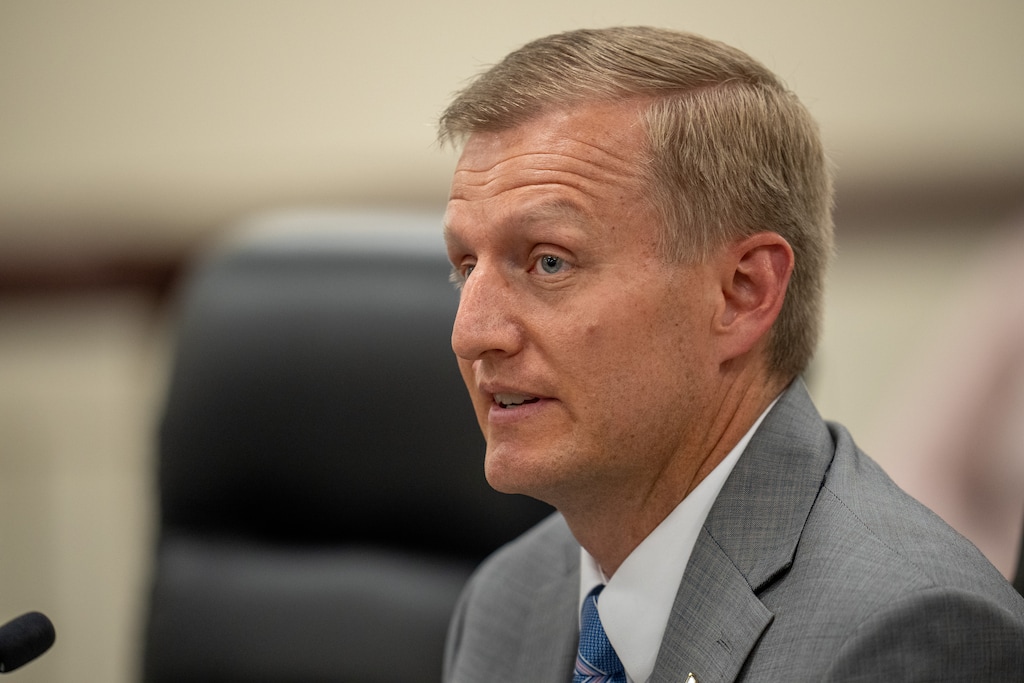
 Robert Gehrke
Plaintiffs in Utah’s gerrymandering lawsuit want Supreme Court Justice Michael Menssen, who signed a petition to repeal Proposition 4’s ban on partisan mapmaking before he was on the court, off their case.
Attorneys for the League of Women Voters and others who have fought to defend Proposition 4 asked in a filing last Friday for Menssen to be removed from a challenge to the Legislature’s creation of three-judge panels to hear challenges to state law.
The question before the Supreme Court is whether the panels made up of three district court judges violate the Utah Constitution.
While it does not deal explicitly with the merits of the Proposition 4 case, attorneys contend the court’s decision will determine where future attempts by Republican lawmakers to overturn Proposition 4’s ban on gerrymandering are heard.
The case was argued before the justices last month, but the plaintiffs now contend that, because records from the lieutenant governor’s office show he signed a petition to repeal Proposition 4 last February, reasonable people could doubt his impartiality on a matter that could directly impact the future of the initiative. That means he should be disqualified, they argue.
“In the present context,” the motion for disqualification contends, “a reasonable person would view Justice Menssen’s petition signature to mean … that he sought to overturn Proposition 4. And a reasonable person would thus question his impartiality to participate in a case about whether Proposition 4 should be overturned.”
(Fox 13 News) A newly-expanded Utah Supreme Court heard legal challenges to the legislature's creation of a special court to hear lawsuits against laws the legislature passes.
A spokesperson for the courts declined to comment on the motion.
If Menssen is disqualified, the normal course of action is for another lower court judge to take his place and participate in deliberations with the remaining justices. The matter would not be argued again.
One justice already recused
Another member of the high court, Justice John Nielsen, already recused himself from the three-judge panel matter. He said he did so because he had filed a brief on behalf of the Utah Republican Party supporting the Legislature’s position in the gerrymandering matter and had coordinated legal strategy with the Legislature.
Nielsen also eventually recused himself in a similar challenge to the three-judge panel brought by Planned Parenthood of Utah because he had filed a brief on behalf of Pro-Life Utah supporting a law passed by Republican lawmakers — still blocked by the courts — that would have banned nearly all abortions in the state.
(Chris Samuels | The Salt Lake Tribune) Utah Supreme Court Justice John Nielsen is recognized during the State of the Judiciary speech at the Capitol in Salt Lake City, Tuesday, Jan. 20, 2026.
Initially, the court said it did not believe that Nielsen should be disqualified from the Planned Parenthood challenge. Nielsen eventually reversed course and recused himself. Second District Judge Joseph Bean filled in for Nielsen in both the Planned Parenthood and League of Women Voters’ challenges.
Long legal battle over redistricting
Proposition 4 has a lengthy history before Utah’s high court.
Passed in 2018, the voter initiative created an independent redistricting commission to draw political boundaries for the state. It also created criteria for the maps, including that they be politically neutral and not favor one party over the other.
The Republican Legislature largely repealed the initiative in 2020 — making the commission merely advisory – and adopted a map that created four seats with a heavy Republican advantage.
The League of Women Voters, Mormon Women for Ethical Government and several voters sued. They argued that if legislators can repeal citizen initiatives, the rights to run ballot initiatives and to change the structure of government — both of which are guaranteed in Utah’s Constitution — are meaningless.
The Supreme Court unanimously agreed.
Republicans were outraged, first filing a series of legal challenges that failed. They tried to amend the Constitution in 2024 to allow the Legislature to repeal initiatives, but the Supreme Court voided the amendment because the ballot language, the court said, would trick voters into voting for it.
Based on the Supreme Court’s earlier ruling, a lower court subsequently reinstated Proposition 4, ruled that the Legislature’s maps violated the ban on gerrymandering, and ordered a new congressional map to be drawn.
Then, the judge ruled that the Legislature’s new map also unfairly favored Republicans and picked a separate map submitted by the plaintiffs that yielded a Democratic-leaning Salt Lake County district.
(Trent Nelson | The Salt Lake Tribune) Elizabeth Rasmussen of Better Boundaries speaks at a news conference in Salt Lake City on Monday, Aug. 25, 2025. A judge earlier ruled that the Legislature will have 30 days to adopt new maps that comply with the 2018 Better Boundaries initiative guidelines.
In response, Republicans launched a ballot initiative of their own to try to repeal Proposition 4. The Republican-backed effort collected enough signatures — including one from Menssen, who signed the petition on Feb. 12 — at first but then failed to make the November ballot after thousands of voters withdrew their signatures.
Earlier this year, the Republican lawmakers, upset at what they considered activist judges infringing on the role of the Legislature, created the three-judge panels of judges to hear challenges to laws lawmakers pass. In the same session, they expanded the Supreme Court from five justices to seven.
Menssen was one of the justices chosen by Gov. Spencer Cox and confirmed by the Senate to fill the high court vacancies.
The League of Women Voters as well as other groups, like Planned Parenthood of Utah, are asking the court to declare the three-judge panels unconstitutional and the justices, including Menssen, heard arguments on the case in October. A ruling in the case is pending.
The attorneys for the plaintiffs pointed to numerous situations where judges in other states recused themselves from cases based on statements they had made before becoming a judge — including a California judge who was disqualified from a case based on having signed an initiative petition related to the matter central to the case.