 Jason Batacao
When Aiden Martin started considering Utah, he had some questions. But not necessarily about the Utah football program.
The Utah commit from San Antonio had heard about The Church of Jesus Christ of Latter-day Saints (but couldn’t tell you much about it) … and the Utah-BYU rivalry … and, well, that’s about it.
“Coming from Texas, my biggest question and concern was what it looks like over there,” the three-star defensive back said.
Fair question. Fair concern.
Utah is unique. Around 60% of Utahns and just about half of Salt Lake County residents are Latter-day Saints. That hasn’t exactly led to the most diverse population.
While Utah has become more diverse over the years, white non-Hispanics still comprise about 73% of the population, according to U.S. Census Bureau data.
While that’s not on every recruit’s mind, Utah cornerbacks coach Sharrieff Shah has answered similar questions and concerns plenty over the years.
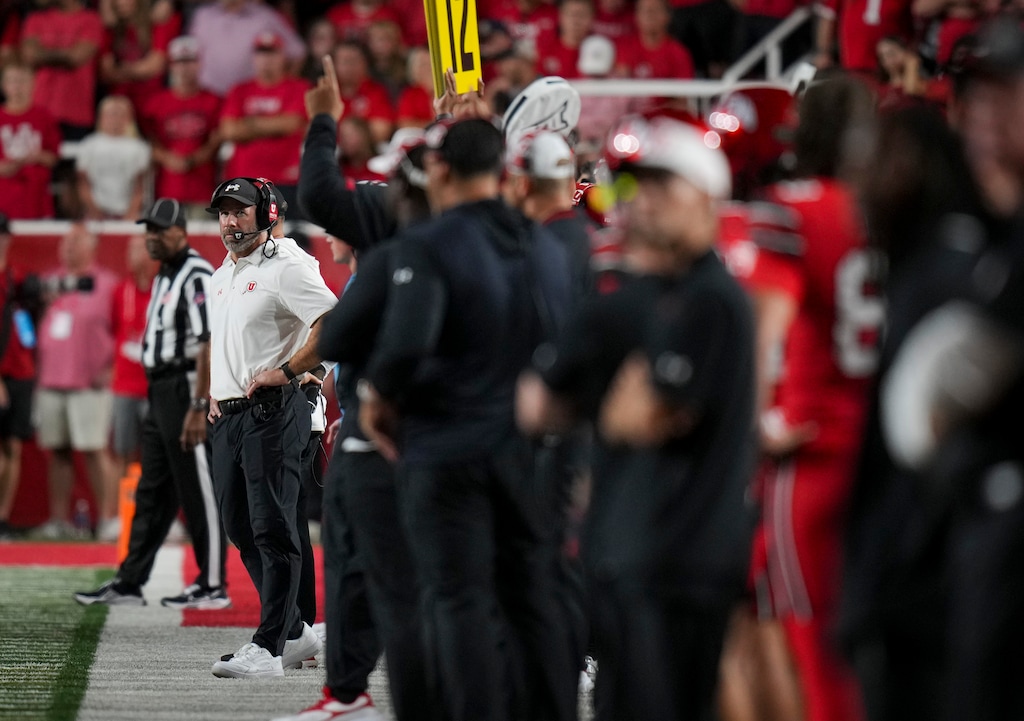
(Trent Nelson | The Salt Lake Tribune) Sharrieff Shah as Utah hosts Houston, NCAA football at Rice-Eccles Stadium in Salt Lake City on Saturday, Oct. 24, 2026.
“Everybody thinks about the LDS religion — they have no idea about it,” Shah said last spring. “Very few people still know much about it. ‘So what’s that all about?’ they’ll ask. Or, ‘Is it some secret, strange, different religion?’ It’s not.
“You have to educate people about the religion. Well, then, if you’re recruiting people who are of different backgrounds and ethnicities — ‘Are there any Black people or Polynesian people?’ Well, yes, there are.”
And when Shah is able to have healthy conversations about Utah’s reality? “People receive us in a way that they probably weren’t expecting to,” Shah said. “There’s actually good people everywhere.”
That’s what Martin saw on his official visit.
“One of the biggest things that my visit showed to me was that I was surrounded by like-minded people,” Martin said. “I know when you go to different places around the world, not every place is like Texas.”
The questions and narratives
When former Utah wide receiver Kenneth Scott first announced he was coming to Utah, the jokes started coming.
The wideout from Fontana, California, heard about how many wives he’d have and how his coaches would soon be trying to baptize him.
“Many people were confused,” Scott said. “They were like, ‘Do you know what’s out there in Utah?’ I was like, ‘What do you mean?’ And then that’s when they brought up religion.”
Soon after, they brought up the lack of diversity in the state.
“I was told culturally that I may be the only person out there as far as my ethnicity goes,” Scott said. “It takes you a long time to get accustomed to people outside of your culture.”
(Trent Nelson | Tribune file photo) Ron McBride celebrates a 13-6 win over BYU in his last game as Utah's coach Saturday, Nov. 23, 2002 at Rice-Eccles Stadium.
Former Utah head coach Ron McBride, who took over the program in 1990, was familiar with that stereotype.
While playing golf at a country club in Florida, McBride mentioned to a woman who worked there that he lived in Utah. Curious, she asked about Latter-day Saints, saying they “were Amish” and wore “weird hats and had no running water.”
His response: “C’mon, lady!”
But she wasn’t alone.
McBride realized that recruits from places as close as California didn’t want to come to the program because of the misconceptions about Latter-day Saints.
So McBride took a different approach — prioritizing a Polynesian recruiting pipeline and a more diverse locker room.
“They needed diversity in the state — it needed different ideas, different thoughts,” said McBride, who isn’t a member of the church. “I wanted it to promote a healthy locker room. Because you had returned missionaries, you had African Americans, Polynesian people, and you had white people.
“The locker room, if you look at it today, it’s the same philosophy.”
Coming from Las Vegas, Stevenson Sylvester tried not to pay attention to the things people told him about the state when he was being recruited. He cared more about the football program. Not necessarily the location.
He cares quite a bit about the place now.
Sylvester, who starred for the Utes from 2006-09, now resides in Utah with his wife and daughter.
“I guess the stereotypes are the questions that you get from other people,” Sylvester said. “It’s all the myths — it’s all the social stuff that people say about Utah, all the stuff that’s untrue, and that’s what you have to deal with, but it’s just all hearsay.”
Martin has encountered that during his recruitment. He said that rival coaches have tried to sway him away from the U. by bringing up the state’s stereotypes.
“The biggest tell was how, like, every school that I was supposed to go to or official visit, they all had to sway me away from going to Utah.
“But to be honest, it made me want to go to Utah more.”
Trent Nelson | The Salt Lake Tribune Utah Utes wide receiver Kenneth Scott (2) scores a touchdown as Utah hosts Fresno State, college football at Rice-Eccles Stadium Saturday September 6, 2014.
Scott understands that feeling. After arriving in Utah in 2010 and spending six years playing for the Utes, he found that those once-unanswered inquiries brought him even closer to his teammates and coaches.
He remembers asking former Utah offensive coordinator — and current BYU OC — Aaron Roderick about Latter-day Saint culture and practices at lunch one day. Scott then reached out to his Latter-day Saint teammates to ask about different scriptures and religious practices.
“It did open up my eyes,” Scott said. “It made me more empathetic to everything. They would be vulnerable and share with me about their religion.
“I honestly had many questions. But I wanted to be educated, because I know people, especially recruits that come in, they’d ask me those same things I had been told.”
Finding a home in Utah
Ever since Darrod Jacobs committed to the U. this summer, he’s heard many stories about the church and the state.
During his official visit, the three-star defensive back asked his hosts — Byrd Ficklin and LaMarcus Bell — a few questions about those stories.
“It was like, ‘I don’t really see much like that, to be honest,’” Jacobs said they told him. “But I just had a question about that for real.”
So what did he see?
“I liked everything about it. It wasn’t a player-and-coach conversation they were having; it was a sons-and-dad conversation.”
McBride used to joke with parents that “90% of his out-of-state players” wanted to return to their home states, only to come right back to Utah.
(Chris Samuels | The Salt Lake Tribune) Former Utah football player Stevenson Sylvester mingles among players at Rice Eccles Stadium after the team was given pickup trucks by the Crimson Collective name, image and likeness organization in Salt Lake City, Wednesday, Oct. 4, 2023.
“I come from Vegas, and I didn’t want to go back to that mess,” Sylvester said. “I understood exactly what I would be going back to versus what I have.
“I have an opportunity to build a family here. … I built a community here; the community embraced me.”
That community is changing. Utah is one of the fastest-growing states, according to the U.S. Census Bureau, and regularly ranks among the states with the best economies in the country.
The NHL also just came to town, and MLB might soon follow, too.
“The best place to do all the things is right here in Utah, not anywhere else,” Sylvester said. “I think that Utah’s continually on the rise, evolving and being more aesthetically pleasing to outside voices.
“It’s probably the best community across the nation as far as what’s projected for the future.”