 Robert Gehrke
Only a few weeks ago, a ballot initiative to restore the Legislature’s ability to gerrymander Utah’s political districts appeared to be a lock for the 2026 ballot.
It didn’t last.
As of Thursday, the Republican-led initiative slipped below the number of signatures required for the measure to go to voters, as thousands of voters statewide and hundreds in one key Senate district withdrew their support.
According to the latest update from the lieutenant governor’s office, 327 more voters removed their support from the repeal effort in the critical Senate District 15. Sen. Kathleen Riebe, a Democrat, represents the district, which includes Cottonwood Heights-area of Salt Lake County.
The removals mean Republican-backed Utahns For Representative Government failed — by 259 signatures — to meet the required threshold in 26 of the state’s 29 Senate districts and it will not qualify for the November ballot.
Rob Axson, chair of the repeal effort and the Utah Republican Party, said in a statement the group has “significant concerns” about the tactics used to get so many voters to remove their signatures, but thanked those who signed the petitions.
“Utahns spoke loudly in the face of an unprecedented onslaught of biased media coverage, outside influence and judicial interference,” Axson said. “Whether now or in the future, by litigation or initiative, we will Repeal Prop 4. This fight is not over, but just beginning.”
UFRG worked for months and spent $4.3 million from an outside group aligned with President Donald Trump to collect the signatures to try to repeal Proposition 4 — the 2018 voter-passed initiative that created an independent redistricting commission and banned partisan gerrymandering.
Trump, Vice President JD Vance, U.S. Sen. Mike Lee, Gov. Spencer Cox and a host of other Republican officeholders joined the fight, urging voters to sign the repeal petitions. UFRG organizers relied on out-of-state paid signature gatherers and volunteers to coordinate the effort.
Along the way, there were allegations that signature gatherers were using deceptive tactics to trick people into signing the petition. UFRG countered that opponents of the repeal effort were resorting to violence and intimidation to derail signature gathering.
Last month, leaders for the group said they had submitted packets containing “well over” 200,000 signatures to county clerks for verification. Close to 30% were deemed invalid, but the group still comfortably surpassed the statewide signature requirement of just under 141,000 — representing 8% of the registered voters in the state.
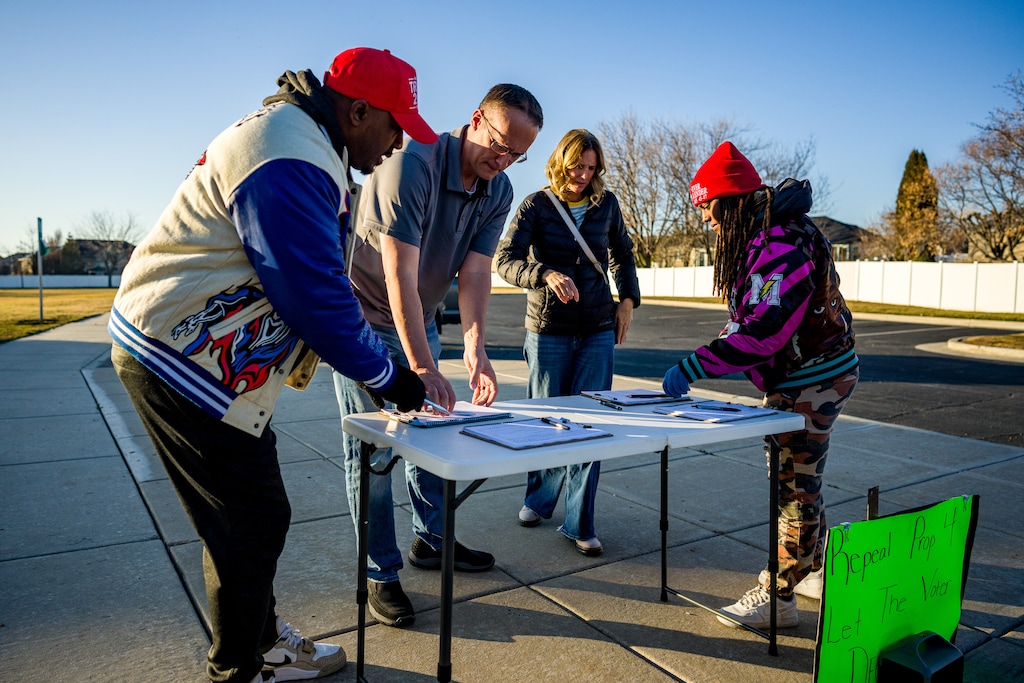
(Robert Gehrke | The Salt Lake Tribune) Utah Republican Party Chair Rob Axson and members of Utahns For Representative Government delivered hundreds of signature packets to Salt Lake County Clerk Lannie Chapman ahead of Sunday's deadline to submit signatures for an initiative to repeal Proposition 4 and remove a prohibition on gerrymandering political districts.
But state law, which puts some of the heaviest burdens in the nation on initiative backers, also requires groups wanting to put a measure on the ballot to get signatures from 8% of the registered voters in at least 26 of the state’s 29 Senate districts.
UFRG passed that threshold with 658 signatures to spare in its most vulnerable district. But opposition groups, taking advantage of a 45-day window in which voters can remove signatures, mobilized. And UFRG’s margin of victory crumbled.
An attempt to make signature removal more difficult by prohibiting groups from paying for postage for the signature removal forms — unveiled and passed in the final hour of the legislative session — didn’t staunch the bleeding.
With four weeks remaining in the removal period, roughly 9,000 voters statewide — and, crucially, nearly 1,000 in Senate District 15 — have withdrawn their support.
(Trent Nelson | The Salt Lake Tribune) Elizabeth Rasmussen of Better Boundaries speaks at a news conference in Salt Lake City on Monday, Aug. 25, 2025. A judge earlier ruled that the Legislature will have 30 days to adopt new maps that comply with the 2018 Better Boundaries initiative guidelines.
Elizabeth Rasmussen, executive director for Better Boundaries, the group that backed Proposition 4, said they will continue pushing for signature removals.
“A well-informed voting population leads to better outcomes for everyone,” she said. “A majority of Utah voters approved Prop 4 in 2018 and we look forward to the day when Utah voters can finally pick their politicians, not the other way around.”
The aim of the UFRG initiative was to repeal Proposition 4 — a 2018 citizen-approved initiative to create an independent redistricting commission and prohibit lawmakers from manipulating districts to benefit one party over the other.
It was done in response to a ruling by the Utah Supreme Court that the Legislature cannot repeal ballot initiatives that reform government without violating citizens’ constitutional right to the initiative process.
Subsequently, a lower court ruled that, with Proposition 4 back in place, the congressional boundaries in place since 2021 were invalid and needed to be redrawn. After the Legislature failed on its second attempt to draw a non-gerrymandered district, the judge imposed a map for 2026 that creates a Democratic-leaning district in Salt Lake County.
Legislative leaders have said they are considering a constitutional amendment that would clarify that legislators can repeal or amend ballot initiatives, but the amendment was not introduced during the recently completed legislative session.
Senate President J. Stuart Adams, R-Layton, said lawmakers may still convene a special session to put the amendment on the 2026 ballot.
Lawmakers tried a similar tactic in 2024, but the Supreme Court invalidated Amendment D on the grounds that the language printed on ballots would have tricked voters by suggesting it would “strengthen” the initiative process, when, a lower court ruled, it was likely to deceive voters.
Note to readers, 4:35 p.m. • This story has been updated to include details about Utah’s Senate District 15.