 Emily R. Anderson
Before opening the floor for questions from reporters Monday at a news conference aired on PBS Utah nearly one week after Election Day, GOP Gov. Spencer Cox began with the obvious.
“Republicans suffered an historic defeat across the country, and while many of us expected a difficult election nationally,” Cox said, “I don’t think anyone, myself included, anticipated the extent to which that wave would reach and impact Utah, particularly in our state legislative races.”
More than a dozen Republican incumbents in the Utah Legislature lost their races, and Democrats won additional contests for open seats previously held by the GOP. The defeats will result in the party losing its dual-chamber supermajority for the first time since 1998.
And although the shift coincides with a stunning repudiation of President Donald Trump’s policies as Republicans lose control of Congress, Cox said his party can’t entirely blame its failures in Utah on voters’ disappointment in the White House.
“Definitely, the national political environment played an enormous role in the outcomes here in Utah — but I think it would be a mistake to stop there,” Cox said.
The governor pointed to elected officials ignoring voters’ input on multiple hot-button issues unique to Utah, starting with the yearslong battle over redistricting.
In 2018, Utahns voted to establish an independent redistricting commission to draw voting maps and ban partisan gerrymandering. But the Legislature repealed the law and drew its own congressional maps, quartering the bluest part of the state in Salt Lake County and creating four solid-Republican districts.
That, Cox said, contributed to Republican lawmakers’ losses.
“You have to be incredibly cautious when there’s a ballot initiative that passes,” he told reporters. “This is what I worried about, and this is what I’ve been warning about for years, is that if you do this too many times, the people will take that authority away from you.”
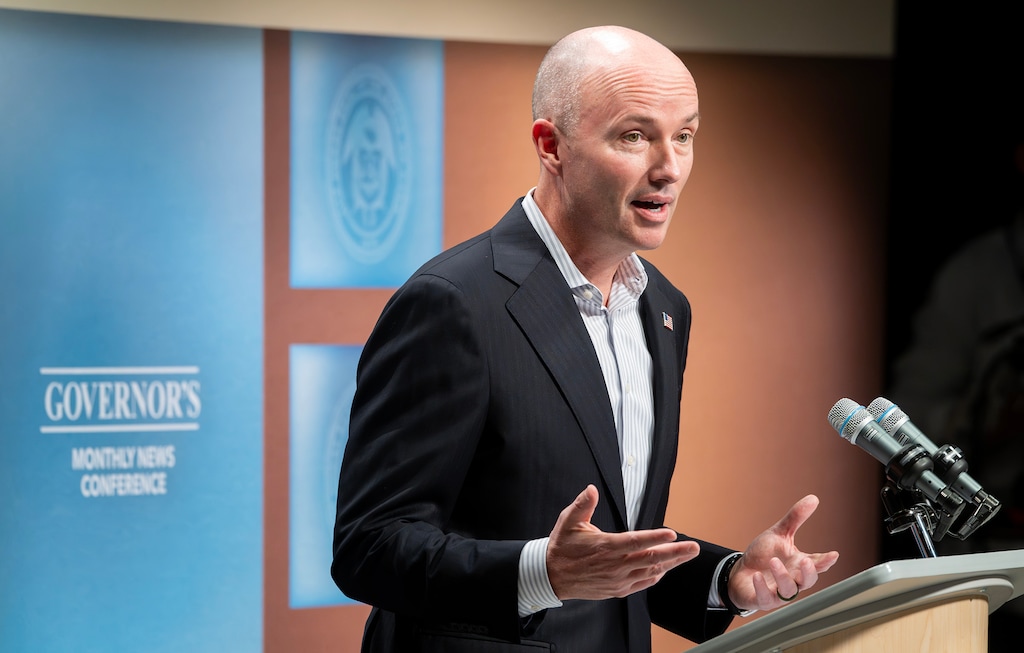
(Scott G. Winterton | Deseret News | Pool) Gov. Spencer J. Cox takes part in the PBS Utah Governor’s Monthly News Conference, broadcast from the Eccles Broadcast Center, at the University of Utah on Monday, Nov. 9, 2026.
Voting rights groups and a handful of Utahns sued, resulting in a new congressional map this election. The lawsuit is ongoing.
The Republican governor maintained Monday that the Utah Constitution gives the Legislature the ultimate authority to draw voting districts, but added that “what I said then, and what I will say now, is just because you can doesn’t mean you should.”
“Drawing boundaries to make it just the perfect map was very dangerous,” Cox said. “You didn’t have to do that.”
Cox said he also heard from voters who had felt dismissed and left in the dark when lawmakers passed policies on data centers and approved new ones.
And the governor raised a third example of Utah voters being disregarded: Lawmakers in 2025 pushed through a law gutting bargaining rights for public employee unions despite its widespread unpopularity.
Labor organizers collected more than a quarter of a million signatures to call a referendum to undo the law, busting Utah signature gathering records.
The Legislature ultimately opted to repeal the law rather than have the referendum appear next to lawmakers’ races on the ballot. Its sponsor Rep. Jordan Teuscher, R-South Jordan, was among the incumbents who lost last week.
“I think those are ... issues where there certainly has been public feedback, but that public feedback was ignored,” Cox said.
The flurry of incumbent losses in the general election followed a primary contest in which a handful of influential Republican state lawmakers were ousted from their roles, including Senate President J. Stuart Adams, of Layton.
Cox said he wants Utahns to know that he sees how they voted, and that “we’re listening.”
Newly elected legislative leadership echoed that sentiment in a Friday news conference.
“The public has lost some trust; I think we have to be real about that. We have to be humble about that and recognize that,” Senate President-elect Evan Vickers, a Republican from Cedar City, told reporters. “We’ve got to do a better job in talking to the public, getting ideas from the public and then responding to their concerns.”
The governor said in the news conference that he hopes the rest of his party — from Trump down to Republicans joining the Legislature in their first political foray — is doing the same.
“I’ve heard frustration about transparency, about trust in government, and about whether the people making decisions are really listening to the people that are affected by them,” Cox said. “These are these are valid concerns, and they deserve real answers.”
This story is developing and will be updated.