facebook-pixel

Utah GOP bid to repeal Prop 4 adds ‘chaos and confusion’ to election process, Lt. Gov. says

Utah Republicans are trying to revoke the Better Boundaries initiative and the state’s new congressional map.
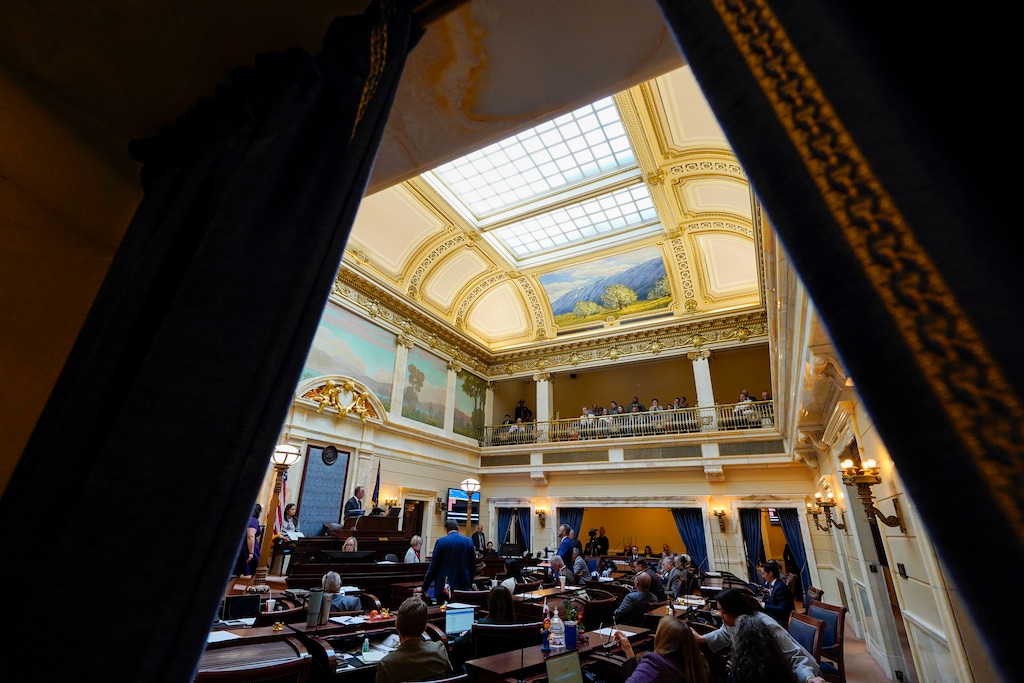
(Chris Samuels | The Salt Lake Tribune) Lawmakers on the Senate floor during a special session at the Capitol in Salt Lake City, Monday, Oct. 6, 2025.

The Utah Republican Party launched a bid this week to use the state’s initiative and referendum laws to void a new congressional map adopted 10 days ago — at the party’s urging — by the Utah Legislature.

Already, Lt. Gov. Deidre Henderson says, the effort is creating an “unprecedented” level of chaos ahead of Utah’s 2026 U.S. House of Representatives elections.

And the plaintiffs defending Proposition 4 — the 2018 Better Boundaries initiative that sought to ban partisan gerrymandering — responded Wednesday night with a court filing challenging the party’s initiative push, alleging it is the latest unconstitutional attempt to circumvent the will of the voters.

On Tuesday, Republican officials, including Attorney General Derek Brown and former U.S. Rep. Rob Bishop, filed paperwork with the lieutenant governor’s office to kick off a referendum effort to repeal the map legislators adopted under protest on Oct. 6 in order to comply with a court ruling.

They also filed documents launching an “indirect initiative” that seeks to compel a vote by the Legislature to repeal Proposition 4.

Meantime, Henderson, a Republican, is sounding alarms about the potential impact of the Republican Party’s proposed referendum and initiative push, saying it would add a new level of mayhem in an already chaotic situation.

“Just with the new map, it was already a tight and chaotic process,” Henderson said in an interview. “This is injecting a level of chaos and confusion into this process that is completely unprecedented.”

Utah Republican Party Chair Rob Axson blames that chaos on the court.

“Tell me, has there been clarity to this process over the last two months?” he said. “We didn’t start this. We didn’t start conflicts around maps around the tail end of when you had time to do anything about it.”

‘Not condemning’ GOP lawmakers

(Bethany Baker | The Salt Lake Tribune) Lt. Gov. Deidre Henderson answers questions during a press conference on the last day of the legislative session at the Utah Capitol in Salt Lake City on Friday, March 7, 2025.

Last year, the Utah Supreme Court ruled that citizens have a constitutional right to make laws via the ballot initiative process and the Legislature violated that right by essentially repealing Proposition 4’s ban on gerrymandering.

Judge Dianna Gibson ruled in August that, based on the high court’s decision, Utah’s current congressional boundaries do not comply with Proposition 4, are void and cannot be used in the upcoming 2026 election, forcing the Legislature to adopt a new map that complies with the initiative.

The Republican-dominated Legislature, under protest, adopted that new map on Oct. 6 — the same map favored by the Utah Republican Party. But now the party is attempting to use the state’s referendum and initiative process to get that map repealed and go back to the current map that has been in place since 2021.

“This is not condemning the action of the Legislature,” Axson said in an interview. “They were forced to do this and to comply by the courts. This is just the avenue where we as Utahns can articulate our displeasure with the situation and … the fact the Legislature was even put into this [situation] in what we feel was a blurring of the separation of powers.”

In response to the Republican Party’s actions this week, the plaintiffs from the original lawsuit — the League of Women Voters, Mormon Women for Ethical Government and several individuals who say they were deprived fair representation by the current map — filed a new complaint Wednesday night, arguing the attempt to use the indirect initiative to repeal Proposition 4 is the latest in a long line of unconstitutional attempts to defy the will of voters.

The indirect initiative — which, it appears, has never been used in the state’s history — allows groups to gather just over 70,000 signatures from registered voters and force the Legislature to vote on a specific measure.

In this case, the Republican Party wants to compel the Legislature to vote on a repeal of Proposition 4. While the Supreme Court previously ruled that the Legislature’s repeal of the initiative was unconstitutional, the party’s belief is that a second initiative — albeit indirect — would trump the first and make the repeal valid.

But, the plaintiffs argued in their filing late Wednesday, the indirect initiative does not exist in the Utah Constitution and is based on a law passed by the Legislature. Therefore, they say, lawmakers cannot contravene the public’s fundamental constitutional right to enact laws, like Proposition 4.

“A small minority of voters cannot permit the Legislature, using a statutory mechanism, to violate the constitutional rights of a majority of Utah voters who enacted Proposition 4,” lawyers for the plaintiffs argued in their brief.

They contend that, because the proposed law is unconstitutional, Henderson should disqualify the initiative attempting to repeal Proposition 4 and not allow the signature-gathering to proceed.

Muddying election deadlines

(Bethany Baker | The Salt Lake Tribune) Utah Republican state party chair incumbent candidate Rob Axson speaks with an attendee during the State Organizing Convention for the Utah Republican Party at Utah Valley University in Orem on Saturday, May 17, 2025.

Henderson’s office, which oversees Utah’s election, has told the court that it needs a congressional map in place no later than Nov. 10 in order to be ready for the 2026 election and the candidate filing period, starting Jan. 2, 2026.

But either the referendum or the initiative — or both — could throw a massive wrench into the works.

Because of statutory requirements for public hearings and timeframes for clerks to verify signatures and for voters to be able to remove their names from petitions, it could be January or early February before the Republican’s initiative and referendum fight runs its course.

In order for the referendum seeking to repeal the Legislature’s new map to qualify for the 2026 ballot, the Republican Party has 30 days from the time they begin collecting signatures to get 8% of registered voters statewide to sign on — 140,748 in all. Additionally, they must meet the same 8% threshold in at least 15 of the state’s 29 state Senate districts.

Once the signatures are submitted, the county clerks have three weeks to verify the signatures. In addition, voters have a 45-day window to remove their signatures from the petitions. That could push the certification of the referendum for the ballot as far back as late December.

If the referendum does qualify, the lieutenant governor would put the map on hold until after the 2026 election.

But then what map is used in next year’s midterm elections?

(Christopher Cherrington | The Salt Lake Tribune)

The new map passed by Republican legislators last week would be off the table, and the court has barred the current 2021 boundaries from being used in 2026.

Candidates would be filing to run for the seats starting Jan. 2, within days of the certification, without any map in place.

And if the referendum to repeal the legislative map happened to fail on the 2026 ballot, the legislative map — which may not entail the districts the candidates filed to run to represent — nobody knows what would happen.

It so happens that the Legislature’s map would have passed with a supermajority and not been eligible for repeal through a referendum if two Republicans — Sens. Heidi Balderee and Dan McCay — had not cast protest votes against the map. and two others — Sens. John Johnson and Chris Wilson — been absent. It received 18 votes in the Senate and would have needed 20 to be safe from repeal.

McCay said he was not aware the party intended to run a referendum to repeal the map when he voted against it.

The entire fight points to the high-stakes national effort by Republicans to protect their majority in the U.S. House. They currently hold a six-seat majority in the U.S. House, with one recently elected Democrat waiting to be sworn in, cutting the margin to five.

Republicans have redrawn maps in Texas to create five new safe Republican seats, although that is being challenged in court. California Democrats are trying to retaliate by drawing that state’s boundaries and others could join the fray.

An indirect initiative

The uncertainty in Utah could be resolved if the indirect initiative is successful. It has easier hurdles for the party to clear, but it also has an even more convoluted timeline — and is now being challenged in court.

If Republicans gather 70,374 valid signatures by Nov. 15, the Legislature would have to have an up-or-down vote on whether to repeal Proposition 4.

Presumably, the Republican-dominated Legislature would vote for the repeal and, thanks to a line added to the legislation adopting the new map passed earlier this month, once Proposition 4 is repealed, the map returns to the current congressional boundaries.

But there are certain statutory deadlines that will create headaches for the lieutenant governor’s office and the county clerks.

Before the party can begin gathering signatures, the Legislative Fiscal Analyst’s office must complete an analysis of the estimated cost of the proposed initiative. It has 25 days to do so, but could finish it sooner.

The party also has to hold a series of seven public town halls around the state and must provide 10 days of public notice before the hearings. The party can’t start collecting signatures until three days after the hearings are complete.

In a best-case scenario, that leaves the party with a narrow window — likely a few weeks — to gather the required signatures.

Once the petitions are returned, the county clerks have three weeks to verify the signatures and voters who signed the packets will have 90 days in which they can rescind their signature. If it clears the threshold easily, the lieutenant governor could forward it to the Legislature for the vote to repeal Proposition 4 before the end of those schedules.

But if it is close, the vote could have to wait until sometime in late January or early February — well after the lieutenant governor’s Nov. 10 deadline and after candidates would have had to file to run for the seats.

“No matter what your opinion is about Prop 4 or the judge’s ruling or any of the maps, I think everybody can agree that candidates and voters deserve some certainty and some fairness when it comes to knowing who their constituents are that they’ve got to court and who the candidates are that they want to vote for,” Henderson said.

“
And if I’m a candidate, I want to be kind of laying the groundwork as soon as possible, as soon as you know what the districts look like. and you won’t know what the districts are gonna look like until possibly January,” she said.

Then, there are lawsuits that are almost guaranteed to come as a result.

In a statement Tuesday, Elizabeth Rasmussen, executive director of Better Boundaries, the group that pushed for the passage of Proposition 4, said the group “will use every tool available — in court, in the public square, and at the ballot box — to defend Prop 4, protect fair maps and uphold the rule of law.”

Legislative leaders have said they still intend to appeal Gibson’s August ruling to the Utah Supreme Court and potentially the U.S. Supreme Court.

And there is the potential that candidates could sue if the boundaries abruptly change mid-process or if they lack certainty about what the maps will look like.

Axson said he has faith that the county clerks and the state elections office can figure it out.

“If realities change it may truncate some of that time, but election officials and government offices are sometimes in an unenviable position to make adjustments based on current realities,” he said. “The things that are in my control right now are getting the signatures and turning in the signatures on the referendum and initiative. After that, a handful of things happen that others will have to decide.”

To alleviate the pressure, the Legislature could change the candidate filing deadline, which previously had been in March but was moved to the first week in January starting in 2024, but that would require convening a special legislative session to make the adjustment.

In an effort to gather those signatures, Patriot Grassroots, a conservative political consulting firm, began texting Republican activists Wednesday, looking to hire signature gatherers. The work promises $40 an hour per six-hour work day, with an expectation gatherers will get four signatures an hour.

“The country and PRESIDENT TRUMP need your help to SAVE Utah,” the solicitation says.

It promises a $500 bonus for those who work an average of six hours a day, every day, between Oct. 24 and Nov. 15.

“It is a Herculean task and we have tighter timeframes than have ever been accomplished, so I don’t want to make it sound like it’s going to be easy or a sure thing. We’re in an uphill battle to meet those expectations,” Axson said. “But just because something is difficult doesn’t mean it’s not the right thing to do.”