 Robert Gehrke
Every Utahn feels what the data shows: Stuff is expensive.
Gas prices are up by $1.40 since last year. Utah has one of the least affordable housing markets in the country. Nine out of 10 renters can’t afford to buy a home. Healthcare premiums are climbing. Grocery prices are way up.
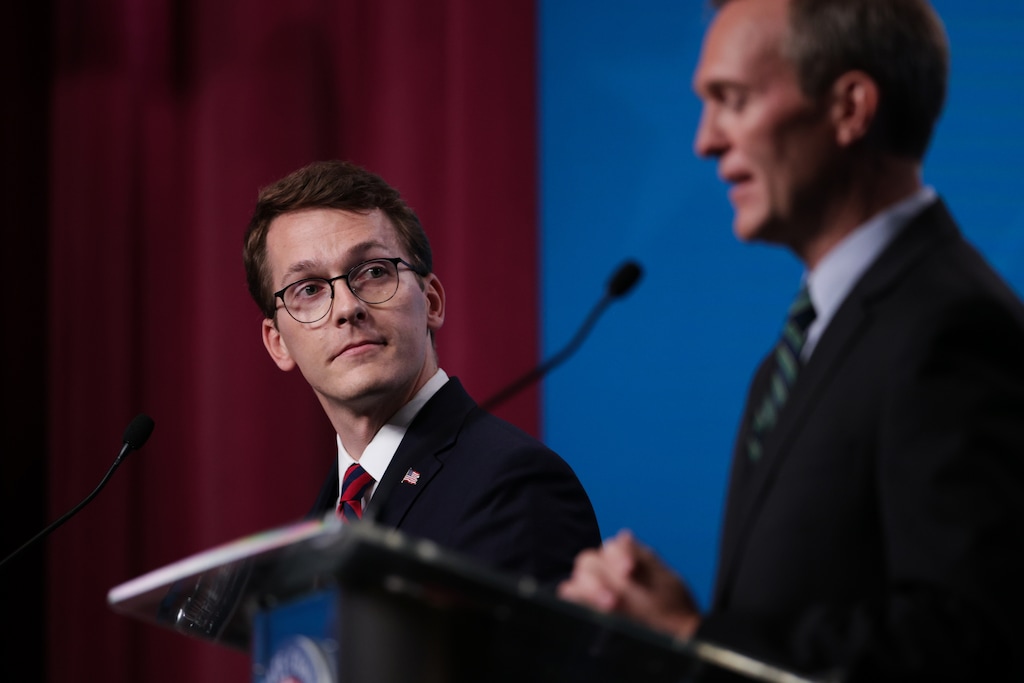
The candidates running for Utah’s 1st Congressional District – Democrat Ben Adams and Republican Riley Owen – say they’ve heard from potential voters for months about the strain those costs are putting on pocketbooks.
Voters across the state say they are looking for candidates who will deliver results to ease that stress.
McAdams is a former U.S. House member, Salt Lake County Mayor and state senator. Owen is a naval reserve intelligence officer who runs a wildlife foundation.
Here is what they say they’ll do about economic pressure points if they’re elected to Congress.
Housing
Owen is a renter who recently got engaged and said he and his fiancée are trying to figure out their future.
“I’m dealing with this personally,” he said. “How do we do this? What can we do to make housing more affordable?”
Local governments should control zoning so they can dictate how and where homes are built, he said. There’s still room for Congress to help, Owen said, like creating incentives and grants to encourage building more homes on smaller lots, allowing alternative dwelling units or zoning for multifamily homes.
“Those are just common sense things that I think would resolve a lot of the supply side issue,” he said.
Owen said he also would support expansion of low-income housing tax credits targeted at states like Utah that have seen a recent population influx. “That program, I think, would be really helpful in creating more affordable housing for people and young families like the one that I’m trying to start myself,” he said.
McAdams has been holding roundtables with stakeholders — housing advocates, home builders and renters — in recent weeks to formulate an approach to bringing down prices and said he would develop a full plan after the election.
But since leaving Congress in 2021, he has studied potential housing solutions as a fellow at the Brookings and currently serves on the National Housing Crisis Task Force, along with Gov. Spencer Cox.
He has co-authored two policy papers as a fellow at the Brookings Institution that have been turned into legislation. One is the Build HUBS Act, which aims to streamline the permitting process for housing developments built near transit hubs. The other proposes redeveloping vacant U.S. Postal Service land to build affordable housing. Both bills are co-sponsored by Sen. John Curtis.
Citing a recent report that said a household needs to earn $147,000 a year — about $50,000 higher than the state’s average household income — in order to afford a typical Utah home, McAdams said that “is essentially a lockout.”
“I’m not interested in a plan that just chips away … and that might pay off in 10 or 20 years,” he said. “I want renters to see relief now. I want first-time homebuyers that are earning an average salary to have a pathway to home ownership, not hedge funds that can outbid them every time before the listing’s even public.”
Both candidates want to see limits on institutional housing investors — corporations buying up homes as rental properties.
Gas and diesel
The first thing that needs to happen, McAdams says, is that Congress needs to stop the war with Iran.
“Trump started a trade war and an illegal war in Iran,” McAdams told reporters recently. “Gas prices went up 50% because of it. And people in Utah, people in this district, are paying for both wars every time they buy the essentials.
Owen — a naval reserve intelligence officer who emphasized he does not speak for the Defense Department — said that “most every American knows when we talk about gas prices, it’s a euphemism for geopolitics and what’s going on in the world. So let’s talk about Iran.”
He said he wants to see Congress exercise its constitutional authority to put a check on the president’s military powers. He also would like to see fewer taxpayer dollars spent on “overseas engagements” so they can be put to use domestically.
Caring for families
“Congress put healthcare coverage for 180,000 Utahns on the chopping block to fund a tax break for billionaires and corporations,” McAdams said, referencing an end to COVID-era Affordable Care Act subsidies that passed last year.
He said he would vote to reverse the Trump tax cut and restore the funding to healthcare and food assistance.
At the debate between the two candidates last month, Owen said he supports the requirement in the Trump budget bill that requires individuals receiving Medicaid to work 80 hours a month or be in school, volunteering or a job training program.
“I don’t find this unreasonable, and the Democratic Party used to stand for this. I don’t know what changed,” Owen said.
Owens said he would also like to provide tax credits to companies that provide paid maternity leave.
“The U.S. is one of only eight countries in the world that doesn’t have some form of federal paid maternity leave,” he said. “At the very least, I think we can expand business tax credits to those businesses taking care of their hardworking mothers, because families should never have to choose between having another kid or a paycheck.”
Saving Social Security
McAdams supports the “Scrap The Cap” proposal promoted by former President Joe Biden, among others. Currently, Americans do not have to pay Social Security taxes on any income over $184,500. The proposal would not tax income between $184,500 and $350,000, but would trigger payments on income above that level.
The additional revenue, McAdams said, would keep Social Security solvent through 2091.
“We have to save it, but I also think it’s not that hard,” he said. “The cap proposal is one that is out there that feels pretty painless.”
Owen said at the debate that he supports investing Social Security funds in the stock market. “There is more risk,” he said, “but over time there’s far more growth.”
Regulating Congress
Both candidates said they believe Congress should be looking out for their constituents, first and foremost. To achieve that, they agree that members of Congress should not be allowed to trade stocks or otherwise profit from their positions.
“I’m tired of career politicians who have been in Washington for decades and make money on insider trading and book deals and all sorts of things,” Owen said, “while average Americans are really just struggling to even buy a home and to have that feeling of I have something that’s mine.”
McAdams said he also wants to ban members of Congress from trading stock. “Either they know something that we don’t, or they’re remarkably good at betting blind and winning every time,” he said. “If you’re writing the rules, you don’t get to bet on them too. That ends.”
Owen further supports term limits for members of Congress, as well as overturning the Supreme Court’s decision in Citizens United that did away with many of the campaign finance limits. He criticized McAdams, who was backed in his primary by a political action committee run by executives from artificial intelligence companies who spent more than $1 million supporting him. .
“I haven’t taken corporate PAC money or outside spending that way, because I think our politicians should be supported by voters, not corporations,” Owen said.
At the debate, McAdams said that, because the donations were independent expenditures, he had no role in how the PAC spent its money and it would not influence how he approaches the AI issue.