 Robert Gehrke
 Jessica Schreifels
Two weeks after Hasan Al Ogaili signed a plea deal, he asked a judge to let him take it back. He felt coerced to plead guilty, he said.
But the judge wouldn’t let him, and in December 2024, he sent Al Ogaili to prison for raping two girls he had met on Snapchat. A few weeks later, Al Ogaili told the court he wanted to appeal, a step that put him in line to get a public defender to help him.
“I’ve been waiting ever since,” Al Ogaili wrote in a letter to The Salt Lake Tribune.
The public defender office handling his case has repeatedly asked for extensions of the deadline to file his appeal. The current total of delays: 20.
It’s Al Ogaili’s constitutional right to have the appeals court take another look at his case — and it’s also his right that he have a public defender represent him in that appeal. But he’s one of 70 Utahns who have been convicted in rural areas who are waiting for the Utah Indigent Appellate Defense Division to argue their cases.
The office has a long list of inmates to help, and the Legislature hasn’t earmarked adequate funding for it to hire enough lawyers to take on all those cases.
Al Ogaili wrote that he’d spoken to his attorney for the first time earlier this summer — more than a year after he was sentenced to prison.
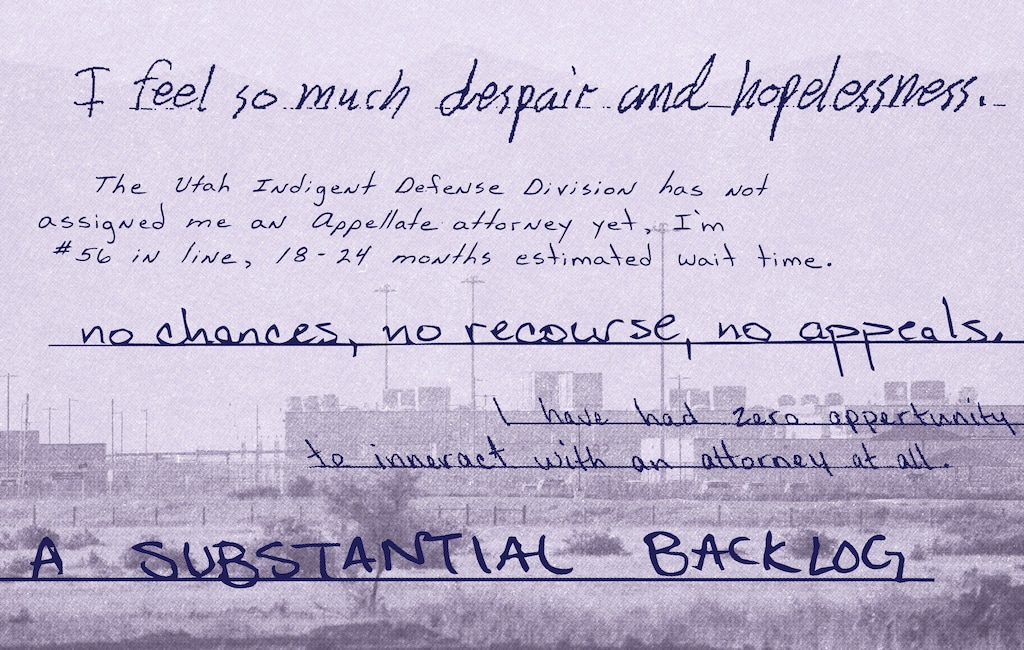
“Waiting with no idea what’s going on,” he wrote, has affected him greatly. “Like I constantly feel anxious. I feel so much despair and hopelessness.”
The backlog’s effects reach beyond those convicted: Victims are left waiting for finality, prosecutors worry that evidence will grow stale and memories will fade, and taxpayers could face the cost of another lawsuit over Utah’s public defender system.
Tribune reporters wrote to more than a dozen prisoners who are on this waitlist, and asked them to share how the delays have affected them.
“I have had zero opportunity to interact with an attorney at all,” wrote one man, who requested an appeal a year ago.
“My case was 29th in line” to get an attorney, even after months of waiting, said another.
Another prisoner, Amanda Bachman, wants to withdraw her Alford plea, a type of resolution which allows her to plead guilty while maintaining her innocence. In her case, Vernal prosecutors had accused her and others of executing a plan to kidnap her friend’s child from the father who had legal custody. She’s serving up to 15 years in prison.
“I know the average person believes that if they follow the law, something like this will never happen to them,” Bachman wrote to The Tribune. “And if there is a mistake there’s always an appeal.”
“Well, I am the average person,” she continued. “I’ve never even had a speeding ticket. This happened to me, and I have been given no chances, no recourse, no appeals.”
The defense division has successfully argued that errors were made in nearly two dozen cases in the past three years.
The long delays before cases make it to a ruling affect more people than those convicted, said Matthew Barraza, who is the executive director of the Indigent Defense Commission, which houses the appellate division.
(Francisco Kjolseth | The Salt Lake Tribune) Matt Barraza, executive director of the Indigent Defense Commission, posses for a portrait on Wednesday, Oct. 14, 2026.
“There’s a real cost to those people who are waiting for their appeals to be heard,” he said. “But then if there’s a victim in the case, there’s uncertainty there. You know that the case has been appealed and there might be a reversal of the conviction, so then they’re going to be anxiously waiting to have some finality.”
“There’s some strains and impact on a lot of different people because of this,” he added.
‘It’s crushing’
In most other states in the country, the cost of public defenders for people accused of crimes who can’t afford their own attorney is funded at the state level.
But Utah has largely passed those costs down to counties, which has created a patchwork system. And for a long time, rural counties often gave flat-rate contracts to a lawyer to defend all of their criminal cases — both at trial and any appeal afterward.
“They would hire the lowest bidder, no matter what, and if whoever they hired made the prosecutors work too hard, then the prosecutor, who doubled as the county attorney, would go to the county commission and say, ‘Don’t hire this guy or gal,’” said Sen. Todd Weiler, R-Woods Cross.
On top of that, there wasn’t any incentive for the lawyer with the defense contract to vigorously pursue appeals, because they didn’t get paid anything additional for the appellate work.
“So the odds are you’re not going to do the appeal, talking them out of it or whatever, or you’ll do as little as possible to file some crappy appeal because you’re out of your element,” Weiler said. “And the odds of you taking money out of your own pocket to hire an appellate attorney are probably zero.”
(Bethany Baker | The Salt Lake Tribune) Sen. Todd Weiler, R-Woods Cross, speaks during a January committee hearing.
The public defender system became so anemic that the American Civil Liberties Union of Utah sued the state in 2016, alleging the process in place was inadequate, underfunded and unfair to poor Utahns accused of crimes who rely on public defenders.
The legal action came just after Weiler had championed legislation to address the shortcomings, creating the Indigent Defense Commission. That commission awards grants to predominantly rural counties to help pay for public defenders.
Then, in 2020, lawmakers created a new division within that office to specifically handle criminal appeals in rural counties, establishing the state-funded Indigent Appellate Defense Division to handle those cases.
But the Legislature’s funding has not nearly kept up with the demand: The number of appeals the division is responsible for handling has shot up, from about 20 criminal appeals when it was created to nearly 100 in the last fiscal year.
Barraza said they need twice as many attorneys as they have now to keep up with the caseload — but the only way they can get there is if the Legislature bolsters their $2 million budget. Now, four full-time staff attorneys are each expected to file a new appeal every month, Barraza said, as the prior months’ appeals are making their way through the system.
Ideally, it should take an appellate attorney 60 to 90 days to file an opening brief, said Ben Miller, who worked as the deputy chief of the appellate division for five years. But attorneys in the office are taking up to two years to file that initial argument, as they ask for 20 or more extensions to cope with the backlog, he said.
Before this role, Miller said he had never asked for more than three extensions on an appeal at any other job.
“It’s crushing,” he said. “It weighs on you, and then it weighs on you because every client you meet has been waiting. … By the time we get there, they’re distrustful. They’re upset. They’re angry. And rightfully so.”
One man has been waiting so long, he expects to be paroled from prison before his appeal is even argued. He told The Tribune that he was sentenced to prison last year for a third-degree felony, and filed an appeal last July. He has yet to meet with an attorney.
“I don’t understand why there is a constitutional right to an appeal in all criminal cases if we’re never going to get to actually have a meaningful chance at doing the appeal,” wrote the man, who said he has a daughter who was born while he’s been behind bars. “Something has to change.”
Funding for the state, but not the defense
While funding for the defense side has been relatively flat in the last few years, the appellate office in the attorney general’s office got a recent budget increase after they, too, said they were overworked and strapped for resources.
Appellate lawyers in the attorney general’s office have historically also asked for repeated extensions to file briefs. It got to the point in 2024 that the state Court of Appeals put the state attorneys on notice that it wouldn’t be so generous in granting delays in the future.
While the court acknowledged the demands on the government lawyers, “the people of Utah can rightly expect that their justice system will seek to decide cases, including appeals, within a reasonable period of time.”
The court suggested that the attorney general can shift more attorneys to appeals, if the demand was too much, or the Legislature could give the office more money.
Since then, nine new lawyers have joined the attorney general’s criminal appellate division thanks to the Legislature’s recent funding boost, alleviating some of the pressure, the division’s deputy director, William Haines, told lawmakers in June.
The Indigent Defense Commission has similarly asked for more money in recent years — but legislators haven’t given them money to hire more attorneys.
“I’ve been saying for years the Sixth Amendment needs a better lobbyist,” Weiler said, referring to the part of the Constitution which guarantees someone the right to have an attorney represent them if they are facing criminal charges and can’t afford a lawyer.
Increasing budgets on the prosecution side, but not the defense, is akin to building a bicycle with one functioning wheel, said former Utah Supreme Court Justice John Pearce, who served for two years on the Court of Appeals before being appointed to the high court.
“It stands to reason that you need as many people defending an appeal as you do prosecuting it, so adding a number of prosecutors solves half the problem but it leaves half the problem untouched,” he said in an interview.
Pearce said he understands that taxpayers feel there are unfunded needs in Utah, and may not see indigent defense as a priority. But being able to appeal is a guaranteed constitutional right, he stressed.
“I don’t think we want our state to be in the business of prioritizing our constitutional rights based on how fiscally easy it is to respect them,” he said.
‘Delay does not benefit anyone’
The higher number of appellate lawyers in the attorney general’s office has not helped to expedite the state’s filings, court data shows. It still takes nearly eight months, on average, for the attorney general’s office to file its appeal briefs — about the same as it had been before.
From the time one side files a notice that they want to appeal to a court ruling, the average criminal appeal in Utah takes 876 days — 798 days of that time is spent on the two sides filing the necessary briefs.
The attorney general’s office has started to advocate for their defense counterparts to have more state funding. Haines told legislators during the June interim meeting that boosting funding for solely their office doesn’t fix the problem.
“The courts, the prosecution, and the defense all need adequate resources for the system to work,” he said. “The defendants are waiting months, or even years, to get an attorney assigned. And in any of these cases that end up in a reversal … the defendant will have waited much longer than necessary to get that relief.”
And if a case is reversed after years have passed, Haines said, it’s harder to prosecute again.
“Evidence will become stale. Memories may fade,” he said. “So delay does not benefit anyone in a typical appeal.”
‘Mistakes corrected’
Sen. Brady Brammer, R-Pleasant Grove, wondered aloud in that same meeting whether, instead of increasing the defense division’s budget, the laws should be changed to limit what issues could be appealed — which would mean public defenders would need to give less help to people.
Barraza pushed back.
“This is literally the only chance that these folks have to have their case heard and reviewed,” he told legislators. “I would not want to limit some of those arguments.”
Barraza’s office has been winning appeals — something that Weiler said wasn’t happening in rural areas before the division was created.
The indigent defense division has succeeded in 23 appeals in the last three years, according to its data — roughly two-thirds of all the winning criminal appeals statewide, despite handling just 20% of the statewide caseload.
“Some might say, ‘That’s not good, because criminals are being let go,’ or whatever,” Weiler said. “No. It’s very good. Because if someone is wrongly convicted or there’s a mistake at the trial level, it’s good to have those mistakes corrected.”
In one case, a Cedar City judge found a woman guilty of criminal mischief and domestic violence charges after a 10-minute trial without a jury that she didn’t attend.
An attorney with the Indigent Appellate Defense Division later argued that the woman’s defense attorney should have argued that the evidence was too weak for a conviction, but that didn’t happen. The appeals court agreed and vacated her conviction, and a judge dismissed the charges.
In another win, a judge gave a pregnant woman a stiff prison sentence after she was convicted of a series of drug charges. On appeal, her attorney successfully argued the judge should not have handled her case because he had previously prosecuted her, and that her trial attorney should have sought the judge’s disqualification because of the conflict.
The appeals court vacated her prison sentence, and more than two years after her original sentencing, another judge released her from prison after re-sentencing her to time served.
That doesn’t appear to be an isolated issue. Another inmate who wrote to The Tribune said that same judge also prosecuted him before taking the bench. That inmate, who The Tribune agreed not to identify because he feared retaliation in his appeal, wrote that he was told he wouldn’t be able to speak to his appellate attorney for 12 to 18 months.
“Everyone involved in my appeal has failed to provide me information regarding my appeal,” he wrote to a reporter. “I have not received updates … and/or letters from an attorney.”
Miller, the former division chief, left that role a few months ago for a new appellate job. But he still receives notifications from the courts on cases he used to be involved in — which have received their 18th and 20th extension. The new deadline to file a brief in one case is now July 2027.
He told The Tribune that he feels Utah could be at risk for another lawsuit like the one the ACLU filed a decade ago. A prisoner could argue that it violates their constitutional right to effective counsel if they have to wait two years for someone to work on their case, Miller reasons.
“I don’t think we’re far off from that if this isn’t addressed,” he said. “It’s getting close to crisis.”