 Robert Gehrke
Note to readers • Click here to find an interactive map where you can enter your address to see all the races on your ballot that have a voter guide from The Salt Lake Tribune.
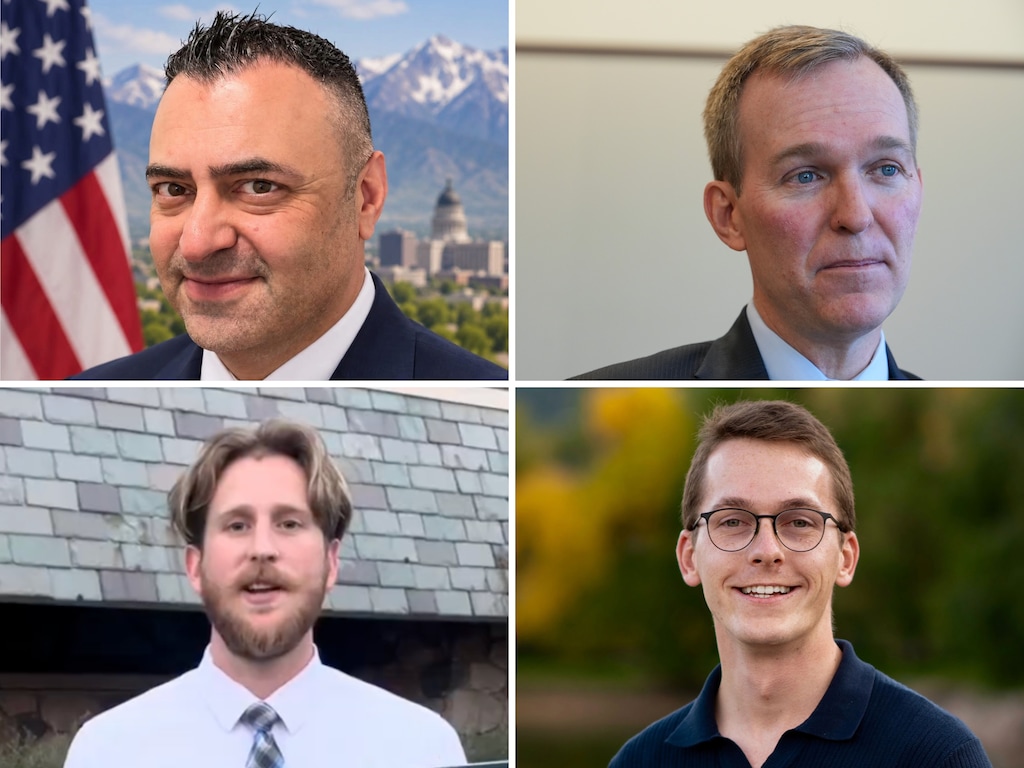
Five candidates are vying for Utah’s newly drawn 1st Congressional District, which covers most of Salt Lake County.
The district is the result of yearslong litigation that resulted in the courts ruling the prior maps were unlawfully gerrymandered and choosing the new configuration. Statistically, the new district favors the Democratic nominee, former U.S. Rep. Ben McAdams, but to return to Congress he will have to beat Republican Riley Owen, Libertarian Jesse West, unaffiliated candidate Elias Montgomery and write-in candidate Bobby Darvish.
McAdams is a former state senator, Salt Lake County mayor and served in the House until 2021. Since leaving Congress he has worked as a consultant on housing and other issues.
Owen is an intelligence officer in the Naval Reserve, served as a policy analyst in the White House during the first Trump presidency and has worked with a drone startup and runs a wildlife conservation foundation.
Darvish’s parents brought him to the United States from Iran in 1974 when he was an infant. According to his website, he worked in information technology, cybersecurity and risk management.
West is an attorney, chair of the Salt Lake City Libertarian Party and avid skier who says on his website that “a vote for me is a vote to ski, not war.”
Montgomery is an unaffiliated candidate who, according to his website, is running to lower prices and ensure government accountability. He did not submit responses to the Tribune’s candidate questionnaire.
The Salt Lake Tribune posed the following questions, based on a reader survey about the issues Utahns felt were most important this election season, to each of the four candidates. Their answers may have been edited slightly for length, style or grammar and are listed in alphabetical order based on the candidates’ last names.
Election Day is Nov. 3. Ballots must be dropped off at a ballot dropbox by 8 p.m. on Election Day or, if returned by mail, must be received by the county clerk by 8 p.m. on Election Day.
Utah voters told us government corruption is their top concern in this year’s election. Why do you think voters feel this way? And why should Utahns trust you to represent them?
Darvish: Utahns feel it because they watch power concentrate. Deals stay hidden and officials answer to parties and donors instead of neighbors. I fled a regime that perfected that model. Decades as a [chief information security officer/governance, risk and compliance] CISO/GRC exec taught me how to demand audit trails, not speeches. I have no machine, no family office and no interest in becoming the next insider. Trust me to represent you because I answer only to Utahns and I’ll put every vote and every dollar in the open.
McAdams: Utahns are tired of a government that works for insiders while everyone else pays the bill. Corruption and the high cost of living are connected: When powerful interests write the rules, families pay more. Utahns can trust me because I’ve already taken hard votes when it mattered. I’ll stand up to anyone from either party who abuses power or rigs the rules for their own benefit and leaves the rest of us to pick up the tab.
Montgomery: No response.
Owen: Americans are tired of working hard and trying to do it the “right way,” yet still struggling to get by just to watch politicians on both sides get richer and abuse power. I’m not a career politician like my opponent. Unlike him, I don’t take corporate PAC money or have millions in Big Tech Super PAC spending behind me. I oppose Citizens United and want big money out of politics. I support term limits for Congress. I support bans on stock trading for members, staffers and federal officials.
West: I believe that voters should feel this way because the corruption is real. This is why I am running for office as a Libertarian. It is time for third parties to become a greater option and for us to hold the Republicans and Democrats accountable.
Utahns told us affordability is their second-highest priority in this election. How would you help Utahns afford housing, groceries, gas and other day-to-day expenses?
Darvish: Government inflated the dollar and stacked rules on housing, energy and food. I will fight reckless federal spending, cut regulations that make homes and groceries cost more to build and ship and back American energy so gas and heat stay cheaper. Utahns need paychecks that buy more, not new programs that hide the bill. Affordability starts when Washington stops making life expensive.
McAdams: Housing is the biggest bill most families pay. I’ve spent five years since Congress working with cities nationwide on housing, writing policy for walkable, affordable homes near transit. I’ll cut needless barriers, put underused public land to work for housing and expand paths to homeownership. I’ll take on the anti-competitive practices that inflate groceries, gas and health care. And I’ll stand up to Trump to end his illegal war in Iran and the tariffs driving up costs for Utah families.
Montgomery: No response.
Owen: I feel this myself as a renter trying to reach my slice of the American Dream. Congress needs to get big investors out of single-family homes and conditionalize federal funds to localities implementing common sense zoning reforms (e.g., reduced minimum lot size requirements, enabling ADUs). We must also lower costs of raising families by expanding business tax credits to those offering paid maternity leave. We should be helping families, not forcing them to choose between a paycheck or a child.
West: Lower taxes. Utahns are paying too much into taxes and not getting enough back. Federal taxes have become a significant burden and in Congress I would vote to cut spending. I would cut spending from bills that are sending funds overseas to other nations to perpetuate war and violence. In cutting this spending and lowering taxes nationwide, people will have more money for day-to-day expenses.
Water resources were also a top concern for voters. What policies would you support as Utah looks to balance growth with preservation of the Great Salt Lake and the Colorado River?
Darvish: Utah must grow without draining the Great Salt Lake or surrendering our Colorado River share. I support state-led storage, reuse, leak repair and conservation incentives, not federal water grabs. Protect senior rights, let markets move water to highest-value use and use technology so farms, cities and the lake can all survive. Manage water as a scarce asset we steward, not a slogan we spend.
McAdams: Politicians talk about saving the Great Salt Lake but still hand tax breaks to developers and water-intensive data centers in the Great Salt Lake watershed. I’ll demand that public subsidies come with accountability, invest in conservation and make sure Utah’s growth doesn’t come at the expense of our future water supply. I’m working on legislation to bring private dollars to help pay for it. The private investment driving Utah’s growth can also help secure the water it depends on.
Montgomery: No response.
Owen: Our planet isn’t partisan. Conservation deserves bipartisan support. We should to invest in removal of water-intensive invasive plants like phragmites, use markets instead of mandates to lease water rights from willing agricultural users tying payment to measured water that actually hits the lake, and make additional growth and development pay for its own water costs. Utah also needs to negotiate from a position of strength with other Colorado basin states to protect its existing water rights.
West: I support protecting Utah’s water rights while expanding voluntary conservation, water banking and infrastructure improvements. Congress should help by removing barriers to businesses and supporting technology development to help ensure better measurement, agricultural efficiency and Great Salt Lake restoration while keeping water allocation decisions with Utah — not Washington. Investing in the future of technology is key to water conservation.
What is another topic you care about and want to address if elected to public office?
Darvish: No response.
McAdams: I want to restore trust in democracy. Voters created this district by demanding fair maps and politicians tried again and again to undo their decision. People should choose their representatives, not the other way around. I’ll also back a ban on stock trading by members of Congress and their families and stop officials from selling access to market-moving government information. Government should answer to the people who pay the bills, not the people who write the biggest checks.
Montgomery: No response.
Owen: Social media is destroying America with addictive algorithms that collect our data, spread misinformation, deepen polarization and stunt healthy child development. We are selling our future for free. As one of the first Gen Z Republican congressional nominees in the country, I was the first generation to have this forced upon us. I want to be the first generation to fix it. We need age-verification on social media at 16+ to protect young people, empower parents and curb Big Tech.
West: Anti-war policy. The United States has become imperialistic and our tax money is going to war efforts and violence that Americans do not agree with. I would run legislation to repeal the War Powers Resolution of 1973 and return war power to Congress and the American people. I would work to cut funding to Israel and end the genocide in Palestine.
How will you vote on Constitutional Amendment A? If passed, the amendment will stop the practice of publishing the full text of amendments and ballot questions by lawmakers in a newspaper for 60 days ahead of an election and instead require that text to be published on two state websites.
Darvish: Against.
McAdams: Against.
Montgomery: No response.
Owen: For.
West: Against.
How will you vote on Constitutional Amendment B? If passed, citizen-proposed laws that increase taxes would need to be approved by 60% of voters, instead of a simple majority.
Darvish: For.
McAdams: Against.
Montgomery: No response.
Owen: For.
West: For.
What’s your favorite book and why?
Darvish: The Bible. After leaving Islam, it showed me Jesus is Lord and that liberty comes from God, not the state. It is why I stand against tyranny, in Tehran or in any government that hides the truth from its people.
McAdams: “The Hobbit.” I loved it as a teen and still think about its warnings about greed and protecting the places we call home. As climate change and frontier technologies reshape our state, we need leaders who will steward what is irreplaceable.
Montgomery: No response.
Owen: “The Count of Monte Cristo.” It’s a riveting adventure that captures the limitless potential of the human spirit and the importance of strong relationships while exploring the corrupting effects of power and the balance between justice and mercy.
West: “Mistborn: The Final Empire,” because it’s immersive, entertaining and has a powerful message of hope.