 Emily Anderson Stern
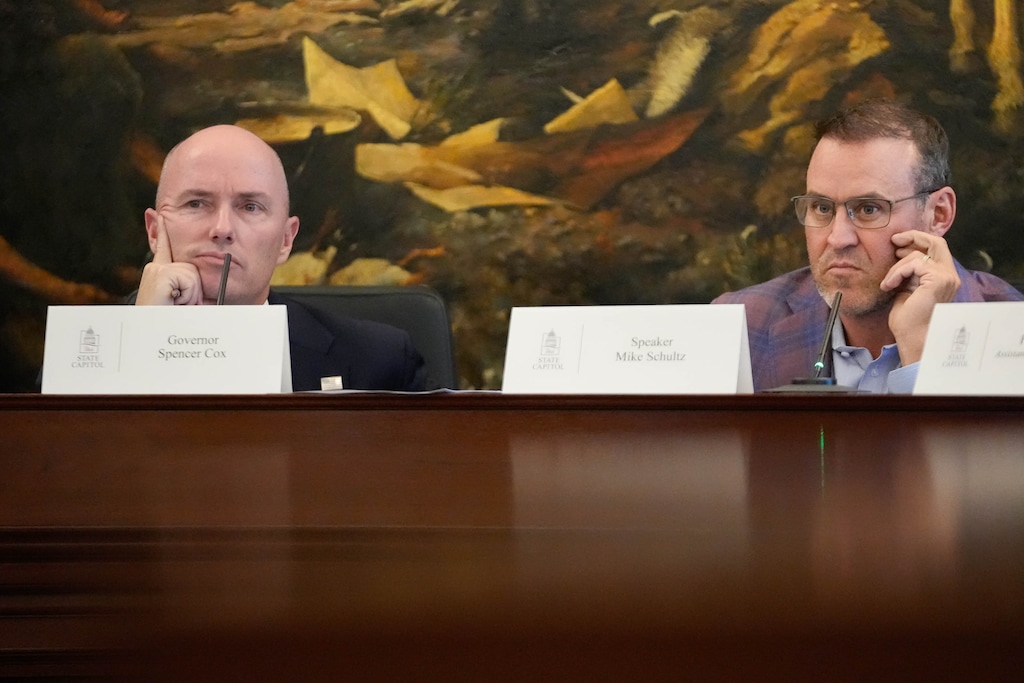
Meeting for the first time since neighborhood pushback led a New York sculptor to withdraw his plans for a “Grand Liberty Arch” at the Utah Capitol, state leaders voted Thursday to move forward with picking a different monument.
The Capitol Preservation Board is asking the public to submit more ideas for a “large commemorative element” — and this time, members discussed adjusting the approval process to give Utahns more chances to participate.
The timeline for that process, however, remains unclear. Board members initially debated whether to postpone beginning the monument search again.
“I think there are really smart people outside of this room that it would be fun to get their thoughts on when the next one should be, as well as what it should be,” said Gov. Spencer Cox, who chairs the board.
He later added, “I think we should absolutely move forward and at least get the ideas. If we don’t see one we like, then of course we can [delay selection].”
In May, the board — without public input — unanimously signed off on sculptor Sabin Howard building his “Grand Liberty Arch” on a grassy state-owned parcel that sits northwest of the Capitol.
(Bethany Baker | The Salt Lake Tribune) A model of the Grand Liberty Arch Monument is on display during a special event honoring America's 250th birthday and introducing Utah's Grand Liberty Arch Monument at the Utah Capitol in Salt Lake City on Monday, July 6, 2026.
Members of the board include 11 of Utah’s top elected leaders, such as Cox, Attorney General Derek Brown, Senate President J. Stuart Adams and House Speaker Mike Schultz.
Howard said he hoped his monument, with its nods to national history, would unify the country and “gives us hope in what the unbridled human spirit can achieve.” Instead, it ignited controversy in the surrounding neighborhood.
Capitol Hill residents indicated in a survey conducted by Rep. Jennifer Dailey-Provost, D-Salt Lake City, who sits on the board, that largely they were displeased with the proposal. Dailey-Provost said respondents told her in comments that the proposed monument felt “oppressive,” and some saw depictions of Native Americans and enslaved Black people as racist.
After a vote, the Capitol Hill Neighborhood Council sent the board a letter in August asking it to put the arch on hold until it collected more community feedback. Howard announced the next week that he had decided to take his arch elsewhere.
Board members agreed Thursday to ask for more ideas for a large monument on Capitol grounds. Under rules previously adopted by the Capitol Preservation Board, large monuments can only be installed once every 100 years.
(Francisco Kjolseth | The Salt Lake Tribune) Outgoing Senate President J. Stuart Adams, R-Layton, remotely attends a meeting of the Capitol Preservation Board at the Utah Capitol on Thursday, Oct. 1, 2026.
The board’s executive director, Dana Jones, said her office has plans to ensure that a call for proposals is distributed more widely, “to make sure that the call is heard far and wide.”
When a subcommittee begins meeting to whittle down monument proposals for a final vote by the board, Dailey-Provost suggested adding meetings that are open to the public and would include time for Utahns to share their perspectives.
“I would like for us to be very, very intentional about the degree to which we have public engagement and public feedback as we start to consider these things,” Dailey-Provost told fellow board members. “I’m really looking forward to learning from the last several months and making sure that this engages as many people as want to be engaged in the conversation.”
“I concur with everything that was just said,” Cox replied before the vote.
Emily is a statewatch reporter at The Salt Lake Tribune, where she has worked since 2022. She received her master's degree in journalism from Northwestern University. There, she worked on investigative projects for The Washington Post and ProPublica. While writing, she's probably spinning something from her ever-expanding shelf of punk records.