 Emily R. Anderson
 Jordan Miller
 Carmen Nesbitt
New York sculptor Sabin Howard wanted to build something that would unify the country and “gives us hope in what the unbridled human spirit can achieve.”
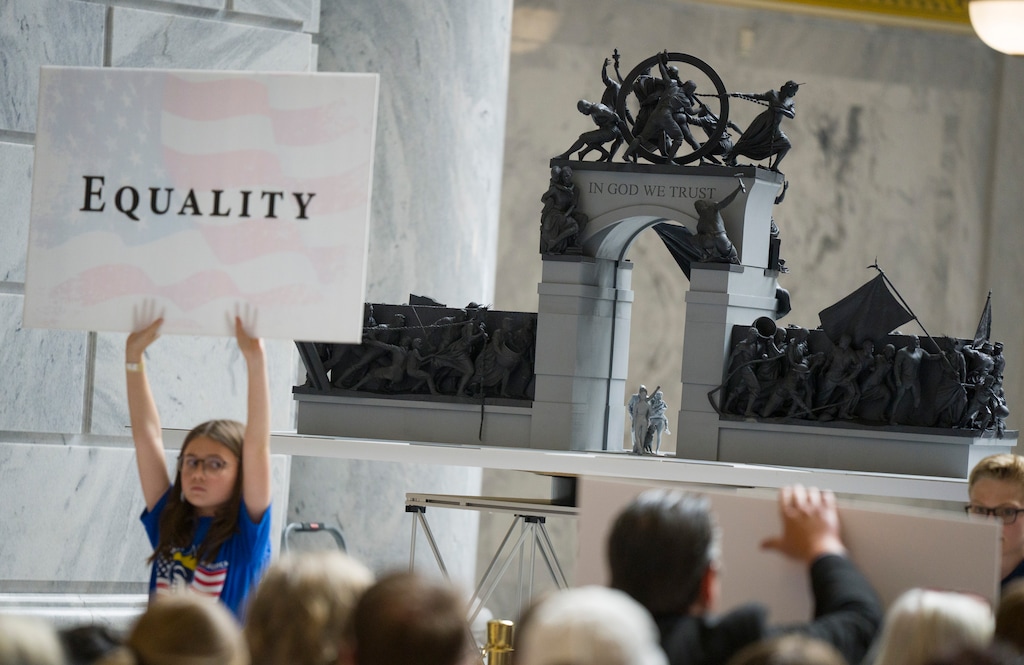
Utah’s values made it “the place” to install his new “Grand Liberty Arch,” he decided, and to avoid what he saw as years of bureaucracy that surrounded his building of the National World War I Memorial in Washington, D.C.
“Utah is the perfect home for this world-class tribute to Lady Liberty,” he said at a Monday ceremony to formally unveil a small-scale model. “Utah, and everything she has become, is one of America’s brightest examples of liberty’s fruit.”
But the state’s prompt approval of Howard’s plan for a 60-foot-long and 38-foot-tall bronze arch — completed without a public hearing about its design — caught Capitol Hill residents by surprise.
There are “a lot of strong feelings” about the selected site, a triangular park northwest of the Capitol, said Jonathan Bruns, chair of the Capitol Hill Neighborhood Council, where many people enjoy the shade trees, relax and play with their dogs.
Residents surveyed by area Rep. Jennifer Dailey-Provost also dislike the scale and design, and some shared concerns that certain depictions of people from history may appear racist, she said. “It is not something they will feel proud of right in the middle of our neighborhood,” Dailey-Provost said.
(Bethany Baker | The Salt Lake Tribune) Sculptor Sabin Howard speaks about his design for the Grand Liberty Arch during a special event introducing the monument and honoring America's 250th birthday at the Capitol in Salt Lake City on Monday, July 6, 2026.
The neighborhood council recently voted to file formal complaints with the Capitol Preservation Board, which approved the sculpture in early May, and to ask Salt Lake City, Salt Lake County and the Utah Department of Transportation to consider the impact the project might have on the community.
The council questions the process, including the lack of public input, and wants the board to “reconsider” its approval, Bruns said.
Dailey-Provost, who sits on the Capitol Preservation Board, said she will share the survey responses at its next meeting.
Howard’s project will cost an estimated $50 million, and he expects to fund it with private donations. At the request of Rep. Jim Dunnigan, R-Taylorsville, the preservation board passed a motion clarifying that it has not endorsed any future state funding for the monument.
The board includes 11 of Utah’s top elected leaders, including Gov. Spencer Cox, Senate President Stuart Adams and House Speaker Mike Schultz, who along with other board members voted unanimously in favor of Howard’s project.
(Bethany Baker | The Salt Lake Tribune) A detail of a small-scale model of the Grand Liberty Arch planned for Salt Lake City is seen during a special event introducing the monument and celebrating America's 250th birthday at the Capitol on Monday, July 6, 2026.
Howard told the neighborhood council later in May that the board’s approval was final. Traci L. Slatton, who was the project manager for Howard’s World War I monument and is his wife, explained that the arch and its 10 panels will be built in stages over eight years, to be fully unveiled for the 2034 Olympics.
The panels depict figures during moments from colonization to the 20th century, showing them “not as a celebration of the past,” Howard said at Monday’s ceremony, “but as a commitment to tell that story and preserve American ideals for generations to come.”
‘Distressed about the process’
The preservation board approves all monuments built on the Capitol campus. In 2021, the board voted to add “large commemorative elements” like Howard’s arch only once every century.
The application period to propose such large projects opened last year, when an application appeared on the board’s website, and closed in September.
A selection committee discussed the submitted ideas in private meetings, and preservation board staff presented only one — Howard’s arch — for members to consider approving as a 2027 project.
(Bethany Baker | The Salt Lake Tribune) A detail of a small-scale model of the Grand Liberty Arch planned for Salt Lake City is seen during a special event introducing the monument and celebrating America's 250th birthday at the Capitol on Monday, July 6, 2026.
Dana Jones, the preservation board’s executive director, initially said the arch wouldn’t be considered as a “large commemorative” idea because it was proposed for the park, not Capitol grounds.
But the board opted to make it the sole large commemorative element it will approve this century. Members decided against pursuing the two ideas that made it to the selection committee’s final round for large elements: one a monument to the 1869 completion in Utah of the first transcontinental railroad, and the second honoring the state’s trailblazing women.
When the board gave its final approval, it did not open the floor to public feedback.
The lack of input from residents is the neighborhood’s main source of frustration, Bruns said.
“There’s a decent resonation within residents [that] they’re not opposed to these kinds of things celebrating our history or anything like that,” Bruns said. “But they are surprised and upset about the process.”
(Rick Egan | The Salt Lake Tribune) Rep. Jennifer Dailey-Provost, D-Salt Lake City, discusses a constitutional amendment over citizen initiatives in the House during a special session in 2024. Dailey-Provost recently said she is “feeling really distressed" about the approval process for the Grand Liberty Arch, a monument planned for a Capitol Hill park.
Monuments built on Capitol grounds are “meant to honor something related to Utah,” added neighborhood resident Glen McBride. “And this statue is just not that.”
To him, the design also seems “overtly political” and patterned after the triumphal arch President Donald Trump wants to build in Washington, D.C., he said. “It’s kind of saying, ‘Oh we love Trump and we want to represent what he thinks is important, the arch symbol, in our own state.”
Dailey-Provost, D-Salt Lake City, is one of two Democratic lawmakers who represent the neighborhood the Capitol sits within — or, in Sen. Jen Plumb’s case, a portion of it, along with Sen. Todd Weiler, R-Woods Cross.
Both Dailey-Provost and Plumb have seats on the preservation board, and both signed off on the arch. But Dailey-Provost said she questions whether the approval procedure was adequately transparent, and said she didn’t understand the vote was a final approval.
“I’m feeling really distressed about the process,” Dailey-Provost said in an interview. “As I’ve explained to my community, I didn’t have clarity on the vote that we were making a final decision on approval of the monument — I thought that we were approving a coming proposal.”
The representative emphasized that her comments aren’t intended as criticism toward other board members. She said she feels the Legislature should consider outlining a more open monument approval process in state law, including a public comment period.
‘Added bonus to the neighborhood’
After Monday’s ceremony, Howard said ultimately, he believes only a small fraction of locals dislike his project.
“Public officials love this piece,” Howard said. “The representative for that neighborhood loves the piece,” referring to Dailey-Provost, who disagrees. “The mayor is on board, loves the piece. I’m scratching my head a little bit, like — why are these people getting so much attention?”
A spokesperson for Salt Lake City Mayor Erin Mendenhall said her office was not involved in discussions about it. Howard clarified in an email Tuesday afternoon that he was told Mendenhall supported the project by one of its key benefactors.
“I look forward to learning more as this project develops,” Mendenhall said in a later statement.
Howard also believes the arch fits well in the neighborhood green space.
“The thing is, I’m not taking away the green space at all,” Howard told The Tribune. “The monument — I think it only fills up something like 20 to 30% of the park, so the green space is maintained. And it’s not like it’s an ugly sculpture, it’s an added bonus to the neighborhood.”
Howard began looking for his next project after he finished work on the National World War I Memorial in Washington, D.C., he recollected to the preservation board in May.
Then, at a ceremony for the memorial, Utah’s Sen. Mike Lee sat next to him. Lee later called the sculptor, told him to get on a plane to Utah, and two days later he was at Temple Square in Salt Lake City, Howard said.
“I had an instant visceral feeling in my gut. It was the most sacred place I’ve been in the United States,” Howard said, continuing, “I picked up my cell phone and I called my wife, and I said, ‘This is the place.’ Little did I know those words were spoken 100 years before me.”
In an interview after Monday’s ceremony, he explained another reason for choosing Utah.
“The big reason I came out here from the East Coast,” Howard said, “is because there’s a lot of restriction. There’s so much blockage bureaucratically, that to come up with something like this, you’d be blocked instantly in government. And here, the values fit what I’m making.”
Emily is a statewatch reporter at The Salt Lake Tribune, where she has worked since 2022. She received her master's degree in journalism from Northwestern University. There, she worked on investigative projects for The Washington Post and ProPublica. While writing, she's probably spinning something from her ever-expanding shelf of punk records.
Jordan is a breaking news reporter at The Tribune. She graduated from the University of Oklahoma and has written for the Houston Chronicle along with the Enid News & Eagle. When she's not reporting, she loves watching football, reading books and painting.