 Emily R. Anderson
 Carmen Nesbitt
As he designed a new monument to national history, sculptor Sabin Howard wanted to include a scene showing Indigenous Americans. He didn’t rely on his own vision, he recently recounted, and instead asked a Native father and son modeling for him how they wanted to be portrayed.
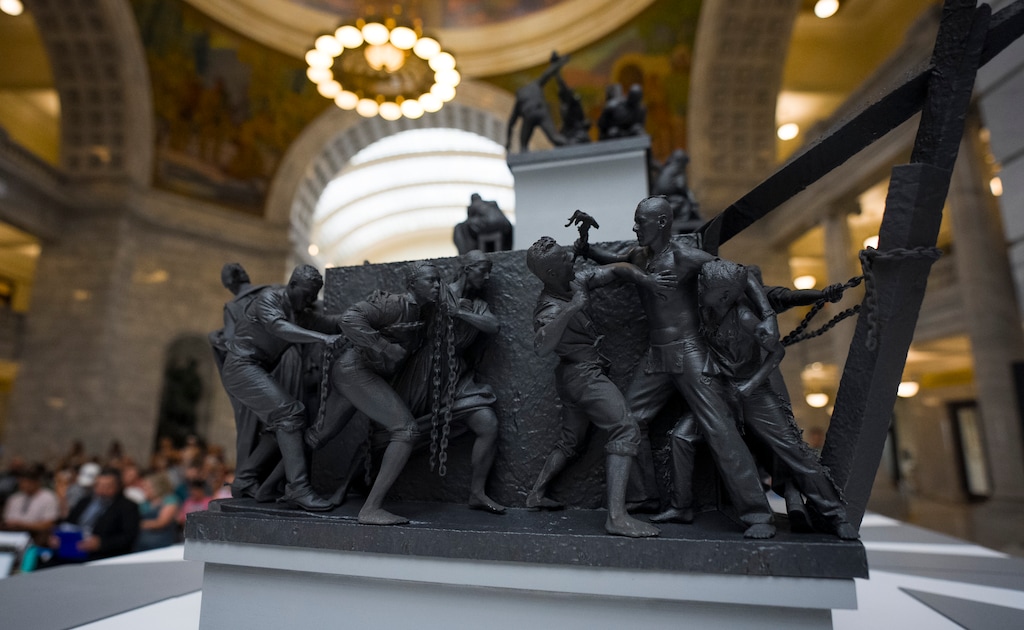
The scene Howard crafted shows a Native man holding up a tomahawk, his other arm around his young son as they face a white settler with one of his fists up. The depiction is not “demeaning,” he said in a recent interview, and is instead “part of their heritage.”
But some neighbors who oppose a state plan to place Howard’s “Grand Liberty Arch” in a Capitol Hill park say they’re concerned by the portrayal.
And a representative of the Haudenosaunee Confederacy, the group of nations that Howard said his artwork represents, said they object to what they described in a written statement as the “tomahawk wielding savage.”
The “real story of liberty,” the statement provided by Rick Hill said, is the “great exchange of ideas about freedom, independence and democracy” in the era of the Founding Fathers — who credited the Haudenosaunee nations with helping to inspire ideas about forming a government in the first Continental Congress.
It’s best practice for artists striving to represent the “full American experience” to consult with and listen to tribal communities during the design process, an anthropologist with the Natural History Museum of Utah said.
“Consultation isn’t just hiring a Native model who poses the way they want to pose,” said Alexandra Greenwald, who is also an assistant professor of anthropology at the University of Utah. “It is conversations with the actual tribal communities you’re depicting.”
The Capitol Hill Neighborhood Council has said it plans to challenge the state’s approval of Howard’s plans. The sculptor has said the decision is final.
(Bethany Baker | The Salt Lake Tribune) Sculptor Sabin Howard speaks about his design for the Grand Liberty Arch during a special event introducing the monument and celebrating America's 250th birthday at the Capitol in Salt Lake City on Monday, July 6, 2026.
“Art is a bigger thing than people understand,” Howard told The Salt Lake Tribune when asked about the Native American figures.
“A lot of the art that’s being done today is very destructive — it’s not about building, it’s about protest,“ he said. ”And it’s very important that people start to look at this like, ‘How can I leave the planet a better place than when I came in?’”
He added, “The whole thing to do is to build things.”
Creating the ‘Native Warrior’
The Capitol Preservation Board selected the project during its May 6 meeting without a public hearing about the design — a move that caught some Capitol Hill residents by surprise. Howard expects to cover the $50 million cost with donations.
The 60-foot-long and 38-foot-tall arch with its accompanying panels will feature dozens of figures that tell “the story of America’s journey through freedom,” according to Howard’s website. Scenes include the Civil War, westward expansion, the signing of the Declaration of Independence and a recurring Lady Liberty.
(Bethany Baker | The Salt Lake Tribune) A model of the Grand Liberty Arch planned for Salt Lake City is seen during a special event introducing the monument and celebrating America's 250th birthday at the Capitol on Monday, July 6, 2026.
One section is called “Emancipation and Encounter Between Native and Settler,” according to Howard’s website.
“The Native Warrior and son block the portal to the West,” the sculptor and Traci L. Slatton, his professional collaborator and wife, wrote in a description. “The scene is tense — a violent fight is imminent as cultures collide.”
“The whole idea” of taking “a tomahawk away from a Native — it’s like, that’s history, that’s part of their heritage,” Howard said in an interview. “And I didn’t depict him in a demeaning fashion.”
At May’s meeting of the Capitol Hill Neighborhood Council, a resident asked Howard if he’d sought input from “the tribes.” The sculptor said he had.
“I actually went and got an Iroquois,” Howard told the community, describing his conversation with his models.
The statement provided by Hill said “Iroquois” was a name the French applied to the ancestors of the Haudenosaunee Confederacy and members of the confederation — which includes the Seneca, Cayuga, Onondaga, Oneida, Mohawk and Tuscarora Nations — who “speak six dialects of Iroquoian languages.”
Rep. Jennifer Dailey-Provost, D-Salt Lake City, who is a member of the Capitol Preservation Board and represents the neighborhood, initially voted for the arch, but said she didn’t understand that the vote was the final action.
Since that vote, Dailey-Provost has surveyed constituents. Of the nearly 100 responses, she said, none are supportive of the project
“Some of the comments have mentioned that while the stated intent is to celebrate America, that it doesn’t feel [like there is] a lot [that is] celebratory about the aesthetic of the proposed monument — that it feels oppressive, and some view many of the depictions to be downright racist,” Dailey-Provost said.
(Bethany Baker | The Salt Lake Tribune) A model of the Grand Liberty Arch planned for Salt Lake City is seen during a special event introducing the monument and celebrating America's 250th birthday at the Capitol on Monday, July 6, 2026.
Founders ‘greatly admired’ the Haudenosaunee
The Haudenosaunee Confederacy’s unification of multiple tribal nations is credited with helping inspire ideas for the founding of the United States.
The confederacy was “intended as a way to unite the nations and create a peaceful means of decision making,” its website states, and it is often described as the “oldest, participatory democracy on Earth.”
The U.S. Senate officially recognized its influence in 1987, passing a resolution acknowledging that the “original framers of the Constitution, including most notably, George Washington and Benjamin Franklin, are known to have greatly admired the concepts, principles and governmental practices of the Six Nations of the Iroquois Confederacy.”
Based on photos of the figures available on Howard’s website, the statement provided by Hill said the nations are concerned that the scene “harkens back to a standard stereotype,” and questioned the authenticity of the clothing and the tomahawk.
“Remember both the tomahawk and hatchet were made by the French, English and Americans for trade with Native Americans,” the statement said, and the clothing may not be accurate, “depending on the era meant to be depicted.”
“Hollywood and the Wild West shows created and perpetuated the image of long, leather, fringed leggings,” it said. “They certainly were not the style of leggings worn by the Haudenosaunee.”
The statement also questioned whether Howard consulted with Utah’s eight federally recognized tribal nations. “How would the Ute people of Utah like to be depicted on this grand memorial? Why were they not asked?” he said.
Utah’s federally recognized tribes are the Northwestern Band of Shoshone Nation, Confederated Tribes of Goshute, Skull Valley Band of Goshute, Ute Indian Tribe, Ute Mountain Ute Tribe, San Juan Southern Paiute Tribe, Paiute Indian Tribe of Utah and the Navajo Nation. No tribes responded to a request to comment.
Asked about the objections, Howard said: “This conversation is, I think, silly to begin with. There are 56 figures here — this is a way to fraction, separate, divide.”
(Bethany Baker | The Salt Lake Tribune) A detail of a small-scale model of the Grand Liberty Arch planned for Salt Lake City is seen during a special event introducing the monument and celebrating America's 250th birthday at the Capitol on Monday, July 6, 2026.
He made an effort to include people of all races among his models, he said. “I don’t feel like anybody’s left out,” the sculptor added. “We have a lot of stories. How do you come up with a story that actually benefits the kids and future generations? That’s what I’m doing — it’s a unifying thing.”
Howard was among a series of speakers on “our civilisational story” at this year’s conference for the right-leaning Alliance for Responsible Citizenship, held in London last month. The group was tasked with answering the question: “How do we recover confidence in the story of the West?”
“The protagonist is you, the everyman, pushing and pulling toward the future on the hero’s journey, led by a powerful recurring symbol of liberty,” Howard said while presenting his arch at the conference, included in a video he posted Wednesday.
Utah’s U.S. Sen. Mike Lee sits on the advisory board for the international consortium, along with other prominent conservative figures.
‘Representative of all members of the state’
While hiring a Native model is a good step, Greenwald, the Utah anthropologist, said, she argues it’s not the same as consultation and collaboration.
Much of her work involves collaborating with Utah’s eight federally recognized tribes to ensure the museum represents their cultures “in the way that they would like visitors to learn about,” she explained.
(Rick Egan | The Salt Lake Tribune) Alexandra Greenwald, an anthropologist at the Natural History Museum of Utah, talks about Native exhibits on Feb. 12, 2024.
Artists have a First Amendment right to freely express their thoughts and opinions, she said, but when “monumental art” is government-sponsored and installed on public land, artists also have a responsibility “to be representative of all members of the state.”
“From my perspective, it really portrays this conflict between indigenous Americans and settlers in a way that favors the settler view: That they are entitled to enter and take ownership of this land, and that Indigenous Americans — the first Americans — are standing in their way,” Greenwald said.
State agencies are required to have policies for “regular and meaningful consultation” with tribes when a proposed state action has “tribal implications,” under a 2014 executive order from then-Gov. Gary Herbert.
The order, however, specifically excluded “independent entities” such as the Capitol Preservation Board, which approves which statues, monuments and displays are approved for the Capitol’s grounds.
The Utah Division of Indian Affairs, which was created to ensure Native Americans have a voice in state government, declined to comment.
Howard’s website pledges that the arch will “redefine the meaning of an enduring artistic and civic legacy.”
The monument could better redefine legacy by representing a different view of American relations with Native Americans, portraying the inspiration provided by the Haudenosaunee Confederacy, the nations’ statement said.
“Sadly,” it said, “the monument chooses to depict the violence between our people.”
Emily is a statewatch reporter at The Salt Lake Tribune, where she has worked since 2022. She received her master's degree in journalism from Northwestern University. There, she worked on investigative projects for The Washington Post and ProPublica. While writing, she's probably spinning something from her ever-expanding shelf of punk records.