 Emily R. Anderson
Historians’ best guess for the location where children found the lynched body of Thomas Coleman, a formerly enslaved Black man who trekked with his enslavers to Utah, is on a shaded stretch of manicured lawn sloping southwest from what is now the state’s Capitol.
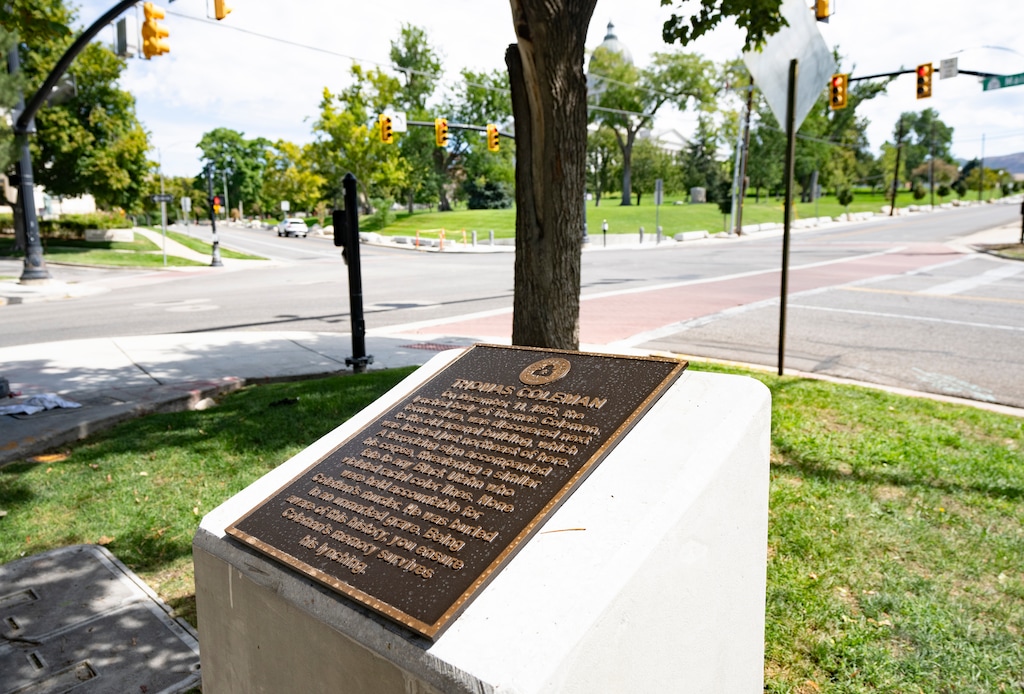
Kitty-corner in a park strip, Salt Lake City quietly unveiled a plaque last week memorializing the 33-year-old hotel worker whose corpse was discovered, it points out, “just northeast of here” nearly 160 years ago.
But that off-site recognition came only after Utah’s top elected leaders twice rejected requests for a marker on Capitol grounds, nearer to where Coleman was likely killed.
With Senate President J. Stuart Adams and House Speaker Mike Schultz most prominently voicing their dissent, Republican officials on the Capitol Preservation Board voted in both 2023 and 2025 to block proposals to install signage educating visitors about Coleman.
In an audio recording of a 2024 meeting in which members were weighing which of three possible small monuments to sign off on, Schultz said he wanted to “find something more uplifting for Capitol grounds.”
Robert Burch, who heads Sema Hadithi African American Heritage and Culture Foundation and presented the group’s pitch, stepped up to a microphone a few minutes later to respond.
“We are absolutely sensitive to the notion that this is going to be a difficult conversation,” Burch said. “We’re also sensitive to the notion that for the African American community, it would mean a lot to feel that we belong in Utah by having that conversation.”
The day before the plaque was revealed and over two years since that testimony, Burch stood above the still-covered plaque and ran his hands over the black shroud still duct-taped over it. The disappointment Burch said he felt at Schultz’s remarks and state leaders’ reception of the request still lingered.
(Chris Samuels | The Salt Lake Tribune) Robert Burch inspects a future memorial for Thomas Coleman, who was lynched near this spot in 1866, by the Utah Capitol in Salt Lake City, Monday, Aug. 24, 2026.
“He is asking us to pretend that those things did not happen. Therefore, unification can never happen. Until we reconcile the things that went wrong, we cannot come together,” Burch told The Salt Lake Tribune.
The Capitol Preservation Board did not respond to a request for comment ahead of this story, nor did Schultz and Adams.
Salt Lake City did not issue a news release for the memorial or hold a formal celebration. A spokesperson for Mayor Erin Mendenhall’s office did not respond to questions about why.
“None were held accountable for Coleman’s murder,” Salt Lake City’s new plaque reads. “He was buried in an unmarked grave. Being aware of this history, you ensure Coleman’s memory survives his lynching.”
The life of Thomas Coleman
University of Utah philosophy professor James Tabery wanted to help his students understand that the United States’ history of racial violence extended beyond the Deep South — so he began looking for Utah examples to inform that discussion.
“That brought me to — I have to admit, to my surprise — these several instances of lynchings that occurred involving Black men in the 1800s and 1900s, and Thomas Coleman was one of them,” Tabery, who has been working on the project as a board member of Sema Hadithi, said in an interview.
Coleman arrived in Utah in 1848 as a slave, entering the Salt Lake Valley alongside his Mormon pioneer enslavers John and Nancy Bankhead of Mississippi, according to the University of Utah’s Century of Black Mormons database.
Newspaper records identify Coleman as having been baptized into The Church of Jesus Christ of Latter-day Saints, and he is the only enslaved man known to have joined the 1856 mission to rescue hundreds of handcart pioneers stranded and dying in heavy snow at Martin’s Cove in Wyoming.
It is unclear how long Coleman was enslaved while he lived in Utah.
His freedom may have come in 1862 when then-President Abraham Lincoln signed a law banning slavery in U.S. territories — a group that included Utah until 1896. But there is no historical record indicating whether that law was enforced.
Coleman might not have attained freedom until the end of 1865 — when states ratified the 13th Amendment abolishing slavery following the Union’s Civil War victory.
That would have left Coleman with only one year as a free man before he was slain. At the time of his death, per the Century of Black Mormons database entry, Coleman worked at the Salt Lake House hotel.
A group of boys playing on what is now Capitol Hill found Coleman dead, lying on his back, near what was known as the arsenal building, where private munitions were stored. According to newspaper accounts, Coleman’s head had been bashed with a rock, and his own knife was used to stab him in the chest and cut his throat.
A sheet of paper attached to the body said: “Notice to all N------! Take warning!! Leave white women alone!!!”
Within hours, newspapers reported that a coroner’s jury concluded the perpetrators were unknown, and determined the menacing note explained his cause of death. Coleman’s remains are in an unmarked grave in a potter’s field in Salt Lake City Cemetery, according to a Utah Division of State History burial database.
“It wasn’t just the murder of a Black man,” Tabery said. “It was a message being sent to the Black community of Utah, basically saying there are racial color lines here that you need to follow, or you can wind up like this.”
(Trent Nelson | The Salt Lake Tribune) University of Utah professor James Tabery at the proposed site of a commemorative marker for Thomas Coleman, in Salt Lake City on Thursday, Aug. 6, 2026.
The National Association for the Advancement of Colored People, which was founded in 1909 to advocate for Black people when lynchings were at an all-time high, defines lynching as the “public killing of an individual who has not received any due process,” pointing out that they … “were violent public acts that white people used to terrorize and control Black people.”
Before the city uncovered its marker last week, the only public acknowledgment of Coleman’s lynching was a jar of soil resting nearly 2,000 miles away at the Equal Justice Initiative’s Legacy Museum in Montgomery, Alabama. Sema Hadithi and other community groups held a ceremony in 2022 to collect handfuls of earth from the Utah Capitol’s shadow.
The Alabama-based nonprofit, in addition to soil collection, urges communities to install historical markers at lynching sites “to confront historical trauma and advance truth-telling at the local level.”
So, that same year, when the Capitol Preservation Board asked the public to pitch ideas for a “small commemorative element,” or a plaque, to “illustrate Utah’s rich history, impactful events, persons and/or cultures of historical significance, and values of the State of Utah,” the opportunity aligned with Sema Hadithi’s next objective.
‘Honestly and truthfully’ addressing the past
At the Capitol Preservation Board’s meeting in 2023, Adams, the Senate president, asked Burch for “any background as to why” Coleman had been killed.
Burch pointed to clues given in the message left on Coleman’s body.
Before Adams’ question, Burch had explained in a presentation that “the conversation around racial lynching is not about the guilt or innocence of a victim — it is whether all citizens of Utah are viewed as worthy to receive the opportunity of due process under the law.”
The board, which has adopted limits on the frequency at which it can approve monuments on Capitol grounds, considered four proposals for two small commemorative elements at that meeting.
(Rick Egan | The Salt Lake Tribune) The Thomas Coleman Memorial on 300 North and Main Street in Salt Lake, on Wednesday, Aug. 26, 2026.
Joining Adams in voting against commemorating Coleman were Schultz; Rep. James Dunnigan, R-Taylorsville; now-retired Sen. Gregg Buxton, R-Roy; and former Attorney General Sean Reyes. Democratic Rep. Jennifer Dailey-Provost, of Salt Lake City, voted for a Coleman marker alongside State Historical Preservation Office Director Chris Merritt.
Members also voted to reject a bronze sculpture of Samuel and Amanda Chambers — two Black, formerly enslaved Latter-day Saint farmers who were early Millcreek residents.
The board ultimately chose monuments honoring Chinese railroad workers, and another celebrating the 250th anniversary of the Declaration of Independence proposed as a donation from the Daughters of the American Revolution. But after the women’s organization withdrew its proposal, Sema Hadithi reapplied.
Tabery stood in front of the board in May 2024 and again urged it to acknowledge the racially motivated murder that happened on the grounds it oversees a century-and-a-half prior.
“It’s an opportunity to take a location that was once desecrated with the blood of an innocent man and remake it into a location that speaks to the transformative power of reckoning with our past,” he said.
(Chris Samuels | The Salt Lake Tribune) Robert Burch inspects a future memorial for Thomas Coleman, who was lynched near this spot in 1866, by the Utah Capitol in Salt Lake City, Monday, Aug. 24, 2026.
Board members opted to delay their vote to weigh the options. But the same leaders who previously objected to a lynching site marker indicated they had not changed their minds.
“In the world that we live in today, there’s so much divisiveness out there, and I want to find ways for the Capitol grounds to come together in this world,” Schultz said. “And I’m not sure the monument of the lynching does that for me right now.”
Early the following year, the Capitol Preservation Board rejected memorializing Coleman again in favor of the Hellenic Cultural Association’s Greeks of Utah plaque.
In that January 2025 meeting, Republican Lt. Gov. Deidre Henderson attempted to create a process by which the elected officials could give permission to place a marker for Coleman, too, but her GOP colleagues blocked all related motions.
“As a historian, as an archeologist, I feel the best history is place-based,” Merritt said before a vote, advocating for Sema Hadithi’s proposal. “And of the three, the Thomas Coleman is the most place-based to the space that is this body and this Capitol.”
Adams and Schultz voted “no,” and state Treasurer Marlo Oaks and Attorney General Derek Brown, both Republicans, voted with them. On the other side were Henderson, Merritt, Dailey-Provost and Sen. Jennifer Plumb, D-Salt Lake City, barely missing the majority threshold.
The board is not scheduled to approve another small commemorative element until 2031.
But — in what Tabery called a “bright path that suddenly appeared in a dark moment,” — Salt Lake City announced around that time that it was accepting submissions for historical markers “to help foster inclusivity and a comprehensive representation of local history.”
To Burch, the plaque’s placement also serves as a reminder that many of the leaders in the white granite building that looms over the new marker were not willing to acknowledge the violent history of the land they’re making laws on.
“They want to create a fantasy, and still that fantasy does not provide for unification, because the stories are not forgotten in the hearts of millions of people — white and Black,” Burch reflected Monday in the halls of the Capitol, before walking to Salt Lake City’s marker.
He continued, “I recognize it’s going to take a lot of time to fix these things, but they never get fixed until we honestly and truthfully address them. ... And right now, most of this country is separated, fighting over lies, not fighting over truth.”
Note to readers, Sept. 1, 12:55 p.m. • This story has been updated to adjust language discussing Thomas Coleman’s enslavement.