 Emily R. Anderson
A group of Utah’s top leaders voted unanimously in May — without public input — to erect a sculpted arch the height of a utility pole and the length of a standard bowling lane in a park that sits northwest of the Capitol.
In a letter delivered to those officials Monday, the Capitol Hill Neighborhood Council called on the Capitol Preservation Board to press pause on the project until it gives the community a chance to weigh in.
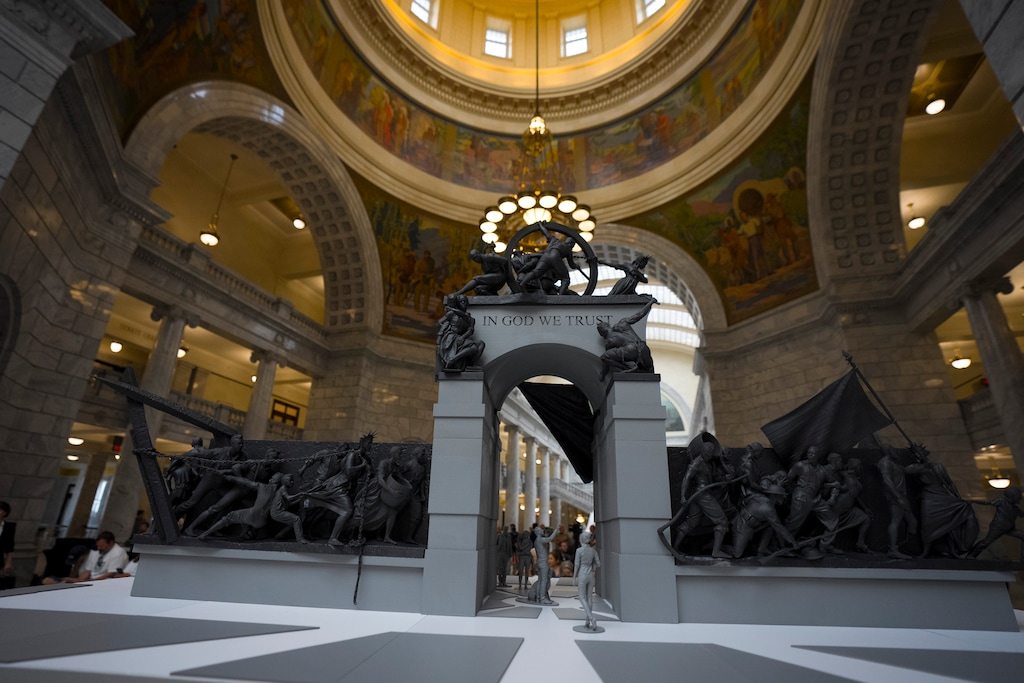
The Grand Liberty Arch monument designed by the sculptor behind the National World War I Memorial in Washington, D.C., Sabin Howard, is scheduled to be completed ahead of the 2034 Winter Olympics in Utah.
It is meant to portray the nation’s history and “gives us hope in what the unbridled human spirit can achieve,” Howard said at a ceremony unveiling a model of the future monument. But some locals have criticized how it portrays Native Americans and enslaved people.
And the neighborhood is lamenting that the park’s mature trees will come down.
“Given the scale and permanence of a monument like the GLAM project, public engagement is an essential component of the planning process,” wrote Jonathan Bruns, who chairs the council.
“Yet,” he continued, “there were no public engagement opportunities or community hearings prior to CPB’s May 6 vote. Since the project’s sudden announcement, the Capitol Hill Neighborhood Council has been inundated with community feedback reflecting near-unanimous opposition.”
The neighborhood council voted unanimously on June 17 to “submit a formal complaint” — an action it is taking through Monday’s letter.
The letter asked that the board, which includes 11 of Utah’s top elected leaders, such as Gov. Spencer Cox, Senate President Stuart Adams and House Speaker Mike Schultz, “restore integrity to this process and appropriately address the overwhelming community opposition.”
To do that, the council urged it to halt the project, open a public comment period — including a hearing specifically for Capitol Hill neighborhood residents — and commit to review all received feedback.
Bruns said he hand-delivered the letter to Dana Jones, the executive director of the Capitol Preservation Board, on Monday.
Jones did not respond Tuesday to a request for comment on the letter. The board’s next meeting is Sept. 30.
The preservation board approves all monuments built on the Capitol campus.
‘A matter that affects all Utahns’
In 2021, the board voted to add “large commemorative elements” like Howard’s arch only once every century. An application period to propose such large projects for 2027 opened last year and closed in September.
Jones initially said in the May meeting that the arch would not be considered a “large commemorative” idea because it was proposed for the park, not Capitol grounds. But the board opted to make it the sole large commemorative element it will approve this century.
Members decided against pursuing the two ideas that made it to the selection committee’s final round for large elements: one a monument to the 1869 completion in Utah of the first transcontinental railroad, and the second honoring the state’s trailblazing women.
When the board gave its final approval to build the arch, it did not open the floor to public feedback.
“CPB cannot simultaneously disclaim the parcel as outside its purview to bypass a competitive process, while also exercising stewardship authority to place a permanent monument upon it,” Bruns wrote.
(Bethany Baker | The Salt Lake Tribune) Sculptor Sabin Howard speaks about his design for the Grand Liberty Arch Monument during a special event honoring America's 250th birthday and introducing UtahÕs Grand Liberty Arch Monument at the Utah Capitol in Salt Lake City on Monday, July 6, 2026.
The arch will cost an estimated $50 million, and Howard expects to fund it with private donations. Board members specifically said during the May vote that no state funds are committed to the project.
But Bruns pointed out the monument, which will be located on state-owned land, will still use public resources, so the decision should be subject to public input.
“Regardless of whether the GLAM project is privately funded, the land is publicly owned, and CPB and its processes are intended to serve the public,” the letter read. “While we represent the residents who will be most proximate to the monument, this is a matter that affects all Utahns and deserves to be treated as such.”
Rep. Jennifer Dailey-Provost, D-Salt Lake City, who is a member of the Capitol Preservation Board and represents the neighborhood, initially voted for the arch. She told The Salt Lake Tribune last month she didn’t understand that the vote was the final action.
Since the May vote, Dailey-Provost has surveyed constituents on the approved monument. Of the nearly 100 responses, she said, none are supportive of the project.
“Some of the comments have mentioned that while the stated intent is to celebrate America, that it doesn’t feel [like there is] a lot [that is] celebratory about the aesthetic of the proposed monument — that it feels oppressive, and some view many of the depictions to be downright racist,” Dailey-Provost said.
The lawmaker said she plans to share the survey responses at the board’s September meeting.