 Robert Gehrke
Gov. Spencer Cox essentially finalized a makeover of the Utah Supreme Court on Friday, appointing Mike Menssen, a civil litigator, and Judge Matthew Bell to fill two vacancies on the high court.
Cox said, like his previous selections, he looked for justices who were originalists and textualists, meaning they adhere to the language of the Constitution and the law.
“This is really common sense, the way it’s been from the beginning of our nation,” Cox said when announcing his nominees. “That’s their job. There is no place for judicial activism in the system. If you want to make laws, then get another job. That’s what the Legislature does.”
Bell has been a judge on the Fifth District Court, covering Beaver, Iron and Washington counties, since being appointed to the bench by Gov. Gary Herbert in 2017. Previously, he worked as an assistant U.S. attorney and a trial attorney at the U.S. Justice Department. Before attending law school, Bell was a St. George police officer. He received his law degree from Brigham Young University.
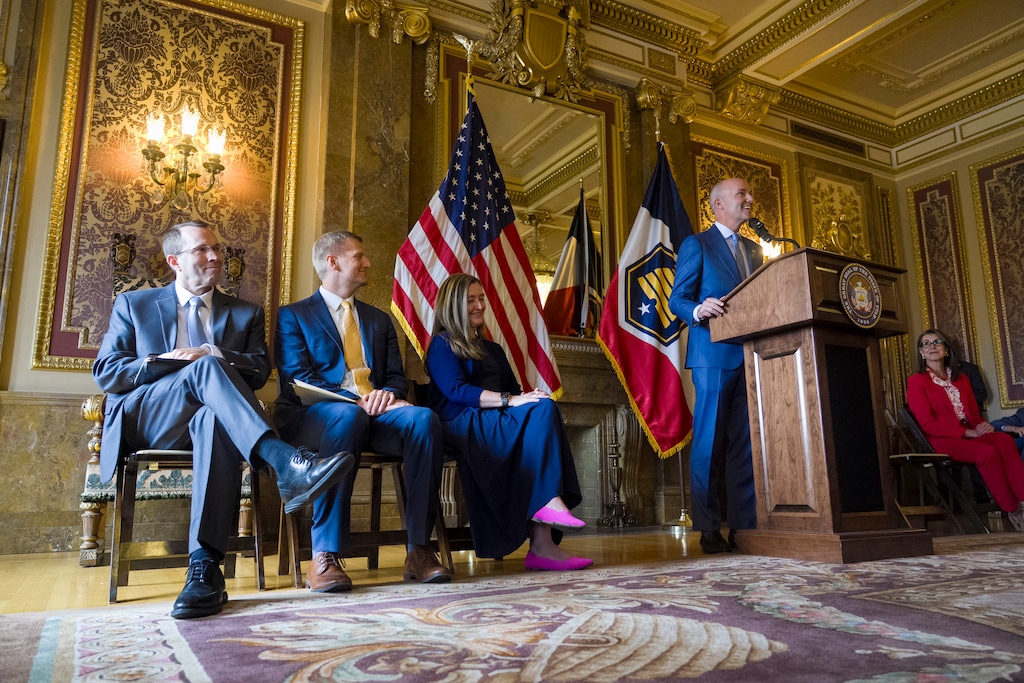
(Bethany Baker | The Salt Lake Tribune) Mike Menssen, left, a civil litigator, and District Judge Matthew Bell speak with family members following a news conference where Gov. Spencer Cox, not pictured, announced them as appointees to the Utah Supreme Court at the Utah Capitol in Salt Lake City on Friday, Aug. 28, 2026.
Cox said that, in his decade on the bench, Bell has received some of the highest scores from the Judicial Performance Evaluation Commission.
“These are better than Yelp reviews,” Cox said. Bell, having worked most of his career in Southern Utah, brings regional diversity to the bench, as well.
Menssen has worked as a civil litigator at Mayer Brown LLP since 2022 and prior to that was a partner at Stowell Reeves. He specializes in complex commercial litigation and employment law.
“This is the piece of his resume that stood out the most to me: He has had leadership roles with legal aid nonprofits and has been recognized for his pro bono work,” Cox said.
Menssen is on the board of directors of the Legal Aid Society of Salt Lake, aiding low-income clients and victims of domestic violence, and is chair of the leadership committee of And Justice For All, a nonprofit that helps provide legal services to disadvantaged individuals.
He is a member of the Federalist Society, a national organization of conservative lawyers, and is a graduate of the University of Virginia law school and did his undergraduate work at BYU-Idaho.
The openings were created by the resignation of Justice Diana Hagen, who quit in the face of an investigation by Cox and legislative leaders into allegations of misconduct, and Justice Matthew Durrant’s retirement amid health issues.
Assuming both selections are confirmed by the Senate — which has never rejected a Supreme Court appointment — Cox will have chosen six of the justices on the court, which Republican lawmakers expanded to seven seats in the wake of a series of defeats before the previous five-member court.
Cox said the aim is not to create a court that will side with him or the Legislature on every issue.
“I’m not interested in having seven people on the court that think exactly like me. That’s not good for the court, it’s not good for the law,” Cox said. “It would be a very terrible court if there were seven Spencer Coxes on it.”
“I hope that they will rule against me and against the Legislature whenever they feel like that is necessary,” he said. “Nothing in this process should make them feel beholden to me for appointing them, beholden to the Senate for confirming them.”
Under another change made by Republican legislators, the governor will also appoint a new chief justice to replace Durrant. Previously, the justices chose their own chief.
Cox said he plans to take his time and consult with each of the seven justices before making the pick within the next six to eight weeks.
“We want to get this right and make sure that everybody gets an opportunity to get seated, to get their feet underneath them and have a chance for their colleagues to get to know them, as well,” the governor said.
Earlier this year, Cox appointed Jay Jorgensen and Stephen Dent to fill the two newly created seats on the court. Jorgensen was previously an attorney for Walmart and then The Church of Jesus Christ of Latter-day Saints. Dent was a federal prosecutor in southern Utah. Both were overwhelmingly confirmed.
Until the field of 12 finalists for the last two vacancies was chosen, all 19 of the previous finalists forwarded to Cox by the Appellate Nomination Commission had been men.
His last five appointments have all been men.
(Bethany Baker | The Salt Lake Tribune) Gov. Spencer Cox listens as 5th District Judge Matthew Bell speaks after Cox announced Bell as one of the Utah Supreme Court appointees during a news conference at the Utah Capitol in Salt Lake City on Friday, Aug. 28, 2026.
Critics decried the expansion of the court from five justices to seven as court packing. Republicans’ expansion came on after the justices dealt a series of defeats to the Legislature’s attempts to redraw congressional districts, undo ballot initiatives and ban nearly all abortions in the state.
Proponents of the expansion said it was needed to keep pace with the state’s growth and an increased burden on the court — although the chief justice told lawmakers the court wasn’t overloaded and data shows the number of filings with the Supreme Court increased from 253 to 270 over the past 15 years.
Note to readers, 7:55 p.m. • The story has been updated to correct Mike Menssen’s career background and to clarify the vetting process of applicants sent to Gov. Spencer Cox.