 Robert Gehrke
Two new justices will join the Utah Supreme Court, filling a pair of seats officially expanding the court from five to seven justices, after the Senate voted Wednesday to approve Gov. Spencer Cox’s nominees Jay Jorgensen and Stephen Dent.
Senate Democrats were critical that neither of the two nominees had been a lower court judge previously.
Sen. Jen Plumb, D-Salt Lake City, said she and her constituents were opposed to the expansion of the court, but, as a doctor, she also could not picture having someone perform surgery without having done it before.
Sen. Brady Brammer, R-Pleasant Grove, pushed back, noting other justices have served on the court without having had lower court experience and said he hopes “we can measure these people for what they do bring, as opposed to a made-up qualification that is helpful, but not essential, to this job.”
Of the two, Jorgensen faced the toughest questioning during his Senate confirmation hearing over whether he met the constitutional requirement that justices be “Utah residents for five years preceding selection” — although Jorgensen mistakenly told Sen. Stephanie Pitcher, D-Salt Lake City, that preceding was not in the constitution.
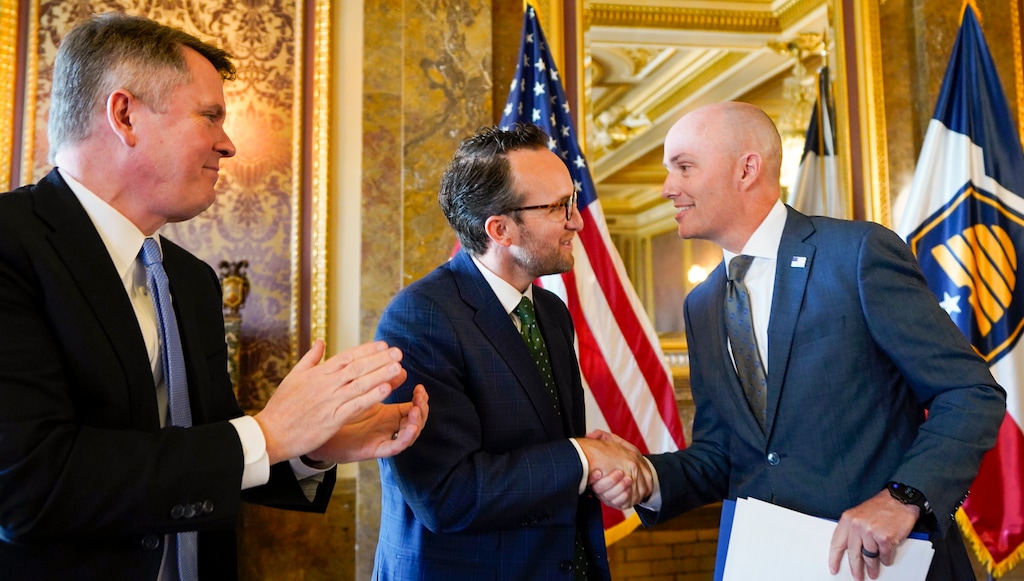
(Trent Nelson | The Salt Lake Tribune) Stephen Dent and Sen. Brady Brammer, R-Highland, at the Utah Capitol after a Senate Judicial Confirmation Committee hearing on Gov. Spencer Cox's two nominees to the Supreme Court — Dent and Jay Jorgensen, in Salt Lake City on Friday, June 12, 2026.
Jorgensen was born in Utah and attended law school at Brigham Young University and then spent 23 years living in Washington, D.C., Arkansas and South Korea before moving back to Utah in early 2021. Shortly after returning to Utah, he was called on a mission for The Church of Jesus Christ of Latter-day Saints in Chile, but Jorgensen said he remained a resident of Utah during that time because he owned a home in Provo and planned to return to the state.
Jorgensen is currently senior counsel for the LDS Church, handling BYU’s international educational program for impoverished nations.
(Trent Nelson | The Salt Lake Tribune) Jay Jorgensen speaks to the Senate Judicial Confirmation Committee during a hearing on two of Gov. Spencer Cox's nominees to the Supreme Court — Jorgensen and Stephen Dent, in Salt Lake City on Friday, June 12, 2026.
Ultimately, all six Democrats and Sen. Emily Buss of the Forward Utah Party voted against Jorgensen’s confirmation. Dent, who is a federal prosecutor in southern Utah, received five votes against his confirmation, all of them from Democrats. Republicans voted unanimously for both candidates.
“There are times in life that leave you awed,” Dent told senators after the vote. “Times when you experience a deep feeling of respect, veneration and reverence. .. I’ve experienced a feeling of awe during this process.”
The two vacancies on the court result from the Republican-dominated Legislature’s move to expand the court from five justices to seven — a move critics decried as court-packing on the heels of a series of rulings on redistricting, ballot initiatives and abortion that went against GOP lawmakers.
Proponents of the expansion said it was needed to keep pace with the state’s growth and an increased burden on the court — although the chief justice told lawmakers the court wasn’t overloaded and data shows the number of filings with the Supreme Court increased from 253 to 270 over the past 15 years.
Sen. Nate Blouin, D-Salt Lake City, who is running for the Democratic nomination in the new 1st Congressional District race, blasted his colleagues for the expansion of the court, and said it was “not good faith reform.
“It’s picking a new referee in the middle of the game because you don’t like the score,” Blouin said.
Cox still has two additional slots to fill on the court after now-former Justice Diana Hagen resigned amid Republican leaders launching an investigation into alleged misconduct and Chief Justice Matthew Durrant announced his retirement effective in August.
One of the first marquee disputes on the newly formed court’s docket will be a series of challenges to the GOP Legislature’s creation of a special three-judge panel designated to hear constitutional challenges to laws passed by the Legislature. The court is scheduled to hear arguments in the case in September.