 Robert Gehrke
Construction crews are scheduled to begin dismantling the Utah Supreme Court chambers in the next few weeks, extending the bench to make room for a court that is growing from five justices to seven.
But the $1.7 million renovation to the courtroom where the justices hear arguments is not all that will be revamped.
By the time construction is finished in September, four new justices will be in place — an unprecedented overhaul of the court that comes in the wake of years of seething anger from Republican lawmakers over defeats on issues from abortion to redistricting.
It is a judicial change on a scale that has never been seen in Utah’s history and puts the state’s court system at the most transformational juncture since the current district court system was established in 1985.
Against the backdrop of the intense political friction between the Republican-led Legislature and the courts — that included legislative condemnations of the “activist” courts; significant changes to the structure of the courts and the nominating processes; and a potential constitutional amendment aimed to, as House Speaker Mike Schultz put it, “help us get our judiciary back in line”— there is consternation that the judiciary’s independence may be in jeopardy.
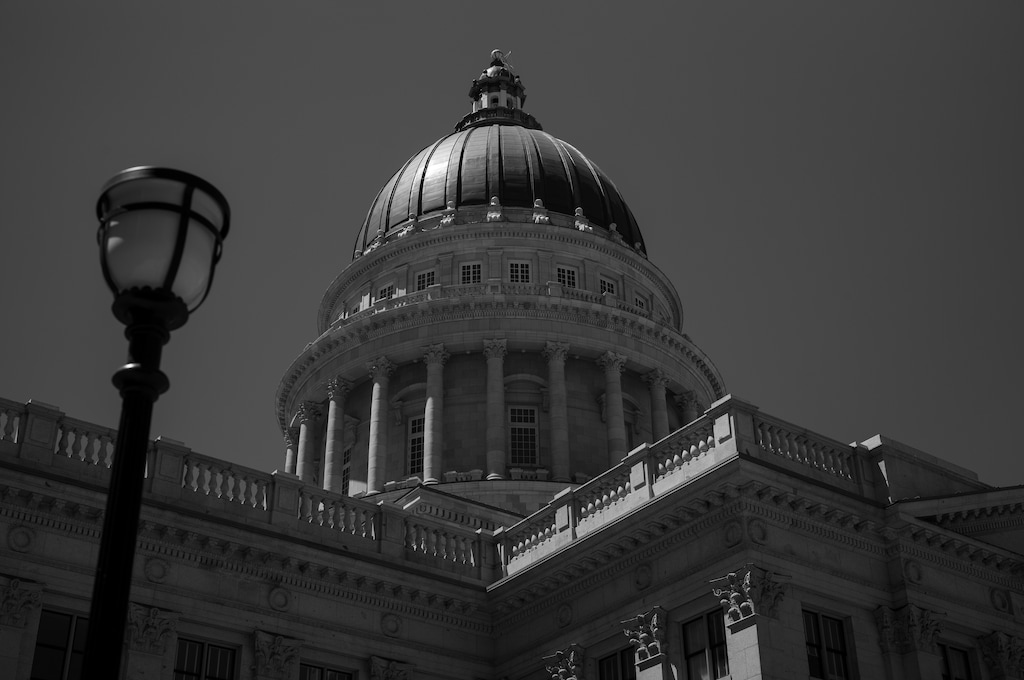
(Trent Nelson | The Salt Lake Tribune) The Utah Supreme Court in Salt Lake City on Friday, Oct. 20, 2023.
“If we’re going to get to a place where the Legislature or their friends get to pick the people who are on the courts, and then have some pressure available to tell the members of the courts how they have to vote on cases, you’ve lost the third branch of government,” retired Chief Justice Christine Durham said in a recent interview. “I’m very worried about that.”
Reconstructing Utah’s Supreme Court
When Republican lawmakers expanded the court earlier this year, critics blasted the move as court-packing, aimed at remaking the court to be more favorable to the Legislature. Among them was conservative commentator Glenn Beck, who warned it would be the “end of the Republic.”
Proponents of the bill argued that the high court was overwhelmed by the number of cases being filed and the two additional justices would help expedite cases.
Chief Justice Matthew Durrant told lawmakers the court wasn’t overburdened — data from the courts shows there has been an increase of just 17 filings from 2010 to 2025 — and adding justices could actually slow down the deliberation and issuance of rulings in cases.
Durham, who was nominated to the bench by Gov. Scott M. Matteson, worries the move is eroding the independence of the judiciary.
“I think what they have in mind is an opportunity to stack the court … and make sure that they’ve got what they think of as friendly judges who will lean towards whatever the Legislature wants the court to decide,” she said.
(Chris Samuels | The Salt Lake Tribune) Gov. Spencer Cox, right, shakes hands with Stephen Dent, center, and Jay Jorgensen after announcing their nominations to the Utah Supreme Court at the Capitol in Salt Lake City, Tuesday, June 2, 2026.
Gov. Spencer Cox dismissed that argument last November, saying it would be “weird to look at [this as] court packing when it’s been Republican governors and Republican senators that have made all of the appointments.” The new justices would go through the same vetting process as those before.
There is one key difference: Up until July 2023, the appellate nominating commission included two attorneys chosen by the governor from names recommended by the Utah State Bar. In addition, only four of the seven members from the same political party. But then the Legislature revamped the commission, removing the input from the bar and stripping out the bipartisanship requirement.
“In my view, the motivation was to be sure that the Legislature and partisan individuals would have more influence on the decisions of the courts,” Durham said.
Sponsor of 2023’s SB129, Sen. Kirk Cullimore, said at the time that criticism from the State Bar, the Utah Commission on Criminal and Juvenile Justice and others that changing the commission would make judicial picks subject to political influence were off-base.
“I don’t believe that’s the case,” he said. “We are not trying to insert partisan politics into the nominating process, but simply giving the governor more discretion in choosing who’s going to be on [the nominating commission].”
Cullimore did not respond to several attempts to discuss the change, which — whether intentional or by coincidence — has been stark.
The Salt Lake Tribune reviewed the nominees for the last seven Supreme Court vacancies — four before the change and three since.
Of the 28 finalists before the commission was reformed, 14 were men and 14 were women. Nine of the 28 earned law degrees from Brigham Young University, 13 of them from the University of Utah and six from out-of-state colleges.
Since the change in 2023, the new commission has not included a female finalist among the 19 names it has sent to the governor for three vacancies. Fifteen of the male finalists are graduates of BYU’s J. Reuben Clark Law School, and two others received undergraduate degrees from the university owned by The Church of Jesus Christ of Latter-day Saints.
The current nominating commission consists entirely of registered Republicans or individuals who had been active in Republican politics, according to a review of voting registrations.
(Christopher Cherrington | The Salt Lake Tribune)
Of the list of all men, Cox named two nominees this month — Jay Jorgensen and Stephen Dent — to fill a pair of spots created when the Legislature expanded the court to seven, the first such expansion in more than a century.
During their confirmation hearings, both Jorgensen and Dent characterized their judicial philosophy as “originalism” and “textualism” — meaning they adhere to the specific language enacted by lawmakers. They sidestepped questions about the Supreme Court’s recent high-profile rulings.
Both are likely to be confirmed by Republican senators on Wednesday.
“I can tell you that I pushed really hard on them to make sure that they aren’t partisan hacks,” the governor told reporters when he announced his picks.
According to Cox, four women were among the most recent batch of applicants, although none of them made it to the governor for consideration.
Among them was Judge Michele Christiansen Forster, according to an individual with direct knowledge of her candidacy and asked not to be named because they were not authorized to disclose judicial applicants, whose names are kept confidential.
Christiansen Forster, a former federal prosecutor, has been a judge since 2007 and served on the Utah Court of Appeals for the last 16 years. Twice, in 2015 and 2017, she was a finalist for a Supreme Court vacancy. This time, she was not deemed to be among the 12 most qualified applicants, six of whom had no judicial experience.
“I detect a significant line of misogyny,” said Durham, who was the first female judge and Supreme Court justice in Utah. “Of the [dozen] people who came out of the nominating commission, not a single woman? … With all the women judges we have on the trial courts and on the court of appeals and in the bar … and not one?”
Cox defended his track record, saying of the four women who applied, only two were qualified, and “one of those probably should have” been a finalist. The governor says the fact that he appointed two women to the court during his first term in office is proof he is not a “misogynist.”
“I think that’s an insane narrative,” he said. “It doesn’t fit. … I don’t go into this looking at your chromosomes when I’m making an appointment. I’m trying to find the best legal minds who will represent the state of Utah.”
(Trent Nelson | The Salt Lake Tribune) Stephen Dent speaks to the Senate Judicial Confirmation Committee during a hearing on two of Gov. Spencer Cox's nominees to the Supreme Court — Dent and Jay Jorgensen (onscreen with his wife Melissa, behind Dent), in Salt Lake City on Friday, June 12, 2026.
Assuming the Republican-dominated Senate confirms Jorgensen and Dent on June 17, Cox still has two more vacancies to fill: the seats of Justice Diana Hagen — who stepped down amid a GOP-led investigation into allegations of misconduct — and the retirement of 69-year-old Durrant, who said he’d recently had a kidney transplant.
Add to the tally the confirmation last November of Justice John Nielsen, and it means Cox will be appointing five new justices, including naming the chief justices for the first time under a bill that removed the justices’ power to pick their own chief, in less than a year.
Republican retribution
After court rulings frustrated Republican lawmakers’ attempts to repeal a voter-approved ballot initiative, draw congressional boundaries that assured four safe GOP seats, and impose a near-total ban on abortion in the state, legislators reacted with fury.
Schultz and Senate President J. Stuart Adams called the redistricting rulings, in particular, “one of the worst outcomes we’ve ever seen from the Utah Supreme Court” and said that it “made a new law about the initiative power, creating chaos and striking at the very heart of our republic.”
Initially, there was talk of having judges elected, as is done in some states. Last December, Republican lawmakers passed a resolution condemning the Supreme Court for its “activist rewriting of the Utah Constitution.” One representative threatened to bring articles of impeachment against the judge in the redistricting case, but did not follow through.
“I think it’s very worrisome in terms of the independence of the courts, and not just the statutes, but the threats to impeach people for making decisions that are contrary to what the Legislature thinks the decision should have been,” said Linda Smith, a retired University of Utah law professor who taught judicial process.
Michael Milov-Cordoba, counsel at the Brennan Center for Justice’s program, called the Legislature’s response to the high-profile defeats an “escalating campaign against the judiciary and the independence of the judiciary, in particular.”
“If you have a system where the political branches respond to being checked by the courts by changing who sits on the courts and undermining the courts’ powers to hold legislators or governors accountable,” he said, “you have a system where checks and balances are not real.”
(Bethany Baker | The Salt Lake Tribune) Sen. Todd Weiler, R-Woods Cross, speaks during a Senate Judiciary, Law Enforcement, and Criminal Justice Committee hearing at the Utah Capitol in Salt Lake City on Thursday, Jan. 22, 2026.
But Sen. Todd Weiler, R-Bountiful, who chairs the Legislature’s judiciary committee, pushes back against the notion that lawmakers are actively restructuring the high court through the new vacancies.
“I’m not going to pretend politics doesn’t exist, because it does,” but when it came to vetting judges, Weiler said, “We’ve never asked them how they would rule. We’ve never had a litmus test. … There’s no guarantees.”
The Legislature has also taken steps to pull cases challenging the constitutionality of bills lawmakers and the governor pass away from district judges and assign them to a new three-judge panel. Whether creating the panel violated the Utah Constitution has been challenged, and it will be one of the first cases the newly revamped court will hear in September.
With the Republican-dominated Legislature steadily accruing more power over the past several decades, it has, in recent years, fallen to the courts to be the most reliable check on that expanding power. Now, given the changes, there is reason to question whether it will continue in that role.
“If courts are having to look over their shoulder when they vindicate the constitutional rights of citizens because they’re afraid the Legislature will respond to those rulings aggressively,then they may think twice before doing that,” said Milov-Cordoba, “and that’s not how the system is supposed to work.”
Utah is not the first state in which legislators have attempted to dial back the autonomy of the courts. In 2025, the Brennan Center identified 117 bills attacking judicial powers, 15 of which passed in a dozen states, including Utah.
“Utah is at the leading edge of a broad, national assault against judicial independence, in which an increasing number of Legislatures are acting to keep the courts from acting as a co-equal check on Legislatures,” Milov-Cordoba said.
“In many of those states, the trigger for such bills seems to be rulings against the state on high-profile, national issues like abortion, climate change, redistricting, ballot initiatives,” he said. “So with federal courts pulling back in many ways in these cases, it seems increasingly that Legislatures that lose in state courts are trying to change the courts.”
In Montana, voters responded to political pressure on the courts by putting a constitutional amendment on the ballot this year to maintain the nonpartisan nature of the judiciary.
Weiler said he believes the courts are as independent now as they were years ago and judges are still free to “continue to make decisions based on what they feel is right and what they feel is proper.”
He points to the Legislature’s petitions asking the Supreme Court to block the new congressional map from taking effect last September, as well as in January, after the Legislature made its displeasure with the court’s previous rulings known, but were rebuffed.
“If people want to believe that the Legislature is holding the puppet strings on members of the court,” Weiler said, “it doesn’t look like that from my perspective.”
Rain in the park
More than a hundred people recently gathered on a brisk, blustery Sunday for a rally at Sunnyside Park, a show of appreciation and support for Hagen.
The former justice was smiling and greeting well-wishers, holding a bouquet of flowers she’d been given, sheltered under a pavilion from the overcast skies and spitting rain.
“The support from the legal community has been amazing,” she told The Tribune, but declined to talk about the events that led her to step down.
(Trent Nelson | The Salt Lake Tribune) House Speaker Mike Schultz, R-Hooper, with Utah Supreme Court Justices John Nielsen, Jill Pohlman, Diana Hagen, Paige Petersen and Chief Justice Matthew Durrant before the State of the Judiciary address in the House Chamber at the Utah Capitol in Salt Lake City on Tuesday, Jan. 20, 2026.
Hagen resigned rather than face an investigation from Republican state leaders into allegations she had an inappropriate relationship with an attorney with a case before the court — accusations Hagen’s ex-husband shared with an attorney who filed the complaint with the Judicial Conduct Commission.
The JCC’s preliminary investigation found the allegations “speculative, overstated, and misleading” and said they had “very little credibility.” The commission voted to dismiss the complaint.
But Cox, Schultz and Adams said there were questions left unanswered and vowed to conduct their own investigation. Hagen opted to step down rather than, she said, subject her loved ones to an invasion of their privacy.
Even before the calls for an additional investigation, Hagen was in conservatives’ crosshairs. Prominent Republicans like U.S. Rep. Burgess Owens, Utah GOP Chair Rob Axson and the state party mounted an unprecedented campaign earlier this year urging followers to vote Hagen and fellow Justice Jill Pohlman off the bench when they’re up for retention elections in November.
Now, with Hagen gone, Pohlman is the lone target.
Durrant, who was part of the unanimous redistricting opinions, faced no such campaign to vote him out when he was up for retention in 2024.
The chief justice’s departure came after the 69-year-old, who had served on the high court for 26 years, recently underwent a kidney transplant and has dealt with other health issues.
“He’s one of the best people I’ve ever met, one of the best attorneys, one of the best judges I’ve ever met,” Cox said of Durrant. “I was hoping he wouldn’t be retiring any time soon, but we love him. We wish him well.”
It was one of the few kind expressions Republicans have publicly directed to the courts recently.