 Robert Gehrke
Gov. Spencer Cox selected Jay Jorgensen and Stephen Dent to fill two new vacancies on the Utah Supreme Court. The men will face Senate confirmation amid an unprecedented overhaul of the state’s high court by the Legislature.
“I feel just incredibly blessed that we had such amazing, qualified people who care deeply and were interested in this position — and that the two of them rose to the top,” Cox said of the nominees at a news conference announcing his selections Tuesday morning.
Jorgensen is currently senior counsel for The Church of Jesus Christ of Latter-day Saints, where he has worked since 2025, when he returned from three years as a mission president in Chile. Before that, he was executive vice president, global chief ethics and compliance officer for Wal-Mart, Inc. from 2000 to 2019, which he left to become chief compliance officer for Coupang, a South Korean e-commerce company.
(Chris Samuels | The Salt Lake Tribune) Jay Jorgensen gives remarks as he is nominated to the Utah Supreme Court at the Capitol in Salt Lake City, Tuesday, June 2, 2026.
In 2002, Jorgensen ran for the Republican nomination for Congress. He was a partner at Sidley Austin, LLP, clerked for former Chief Justice William Rehnquist and for Samuel Alito while the now-justice sat on the U.S. 3rd Circuit Court of Appeals. He received his law degree from Brigham Young University.
Dent is an assistant U.S. attorney who has prosecuted drug, immigration and murder cases, and is a graduate of the University of Utah. He worked at the Washington, D.C., firm of Gibson Dunn before joining the Department of Justice as a federal prosecutor. Dent clerked for U.S. District Judge Robert Shelby in Utah and Judge Scott Matheson on the 10th U.S. Circuit Court of Appeals.
(Chris Samuels | The Salt Lake Tribune) Stephen Dent gives remarks as he is nominated to the Utah Supreme Court at the Capitol in Salt Lake City, Tuesday, June 2, 2026.
Both nominees described their judicial philosophy as “originalists” and “textualists.” Jorgensen said he has modeled his approach on that of Rehnquist and Alito — two justices nominated by Republican presidents.
Cox said he had no qualms with nominating Jorgensen, who works for the church, a powerful entity in Utah.
“I don’t care who they work for. I care about their legal mind and their legal scholarship,” he said. “He’s only worked for them for a short amount of time. I care a lot more about their ability to deliver justice in an unbiased way.”
Sen. Todd Weiler, R-Bountiful, the chair of the Senate Judicial Confirmation Committee, said there will be two public hearings for the nominees before a confirmation vote expected for June 17.
The two appointments resulted from legislation earlier this year that expanded the court from five justices to seven — a move critics denounced as court packing — and marks an unprecedented reshaping of the state’s high court.
The group Co-Equal Utah, a nonpartisan group of lawyers created to protect the independence of the judiciary, said it was concerned that neither of the nominees had any judicial experience.
“The Utah Supreme Court is not an entry-level position,” the group said in a statement. “It is the court of last resort for every Utahn. The governor has bypassed sitting judges with years of trial and appellate experience to place two individuals with no judicial record directly on the state’s highest court. Utahns deserve to know why.”
A new Utah Supreme Court
(Chris Samuels | The Salt Lake Tribune) Associate Chief Justice Jill Pohlman attends the nomination of Jay Jorgensen and Stephen Dent to the Utah Supreme Court at the Capitol in Salt Lake City, Tuesday, June 2, 2026.
The overhaul of the court comes against the backdrop of the intense political friction between the Republican lawmakers and the courts over rulings on abortion, legislative power to repeal ballot initiatives and redistricting that checked the Legislature’s sweeping power.
In recent years, lawmakers have passed resolutions condemning the “activist” courts; made significant structural changes to the courts and the nominating processes; and are eyeing a potential constitutional amendment aimed to, as House Speaker Mike Schultz put it, “help us get our judiciary back in line.”
“It’s no secret that there has been a rift, a well-publicized rift, between two of the branches of government,” Cox said Tuesday, adding that people can disagree without impugning each other’s integrity or assuming bad intentions.
“I suspect, and I hope, that we will have differences of opinion with these new justices, as well,” Cox said. “I can tell you that I pushed really hard on them to make sure that they aren’t partisan hacks, to make sure that they care deeply about the law … and to make sure that they would, that they would be willing to, rule against me and against the Legislature when we get it wrong.”
In addition to the two justice nominees announced Tuesday, Cox has a pair of vacancies left to fill.
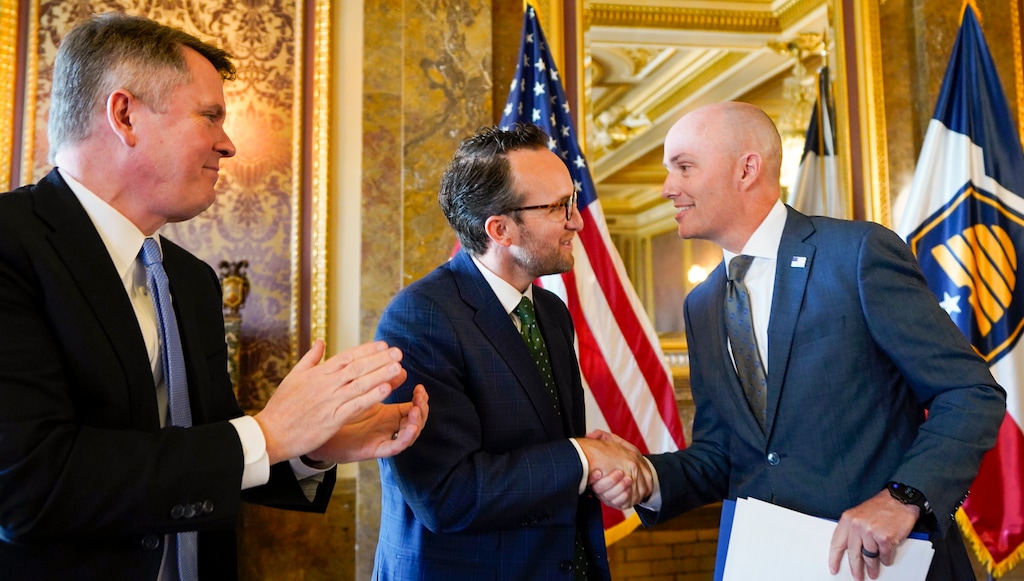
(Chris Samuels | The Salt Lake Tribune) Utah Supreme Court nominees Stephen Dent, left, and Jay Jorgensen exchange phone numbers after their nomination announcement at the Capitol in Salt Lake City, Tuesday, June 2, 2026.
One was created after Justice Diana Hagen stepped down rather than face a Republican-led investigation into allegations she had an improper relationship with an attorney — a complaint the Judicial Conduct Commission called “misleading” and had “very little credibility.”
The other results from Chief Justice Matthew Durrant’s retirement after 26 years on the bench. Durrant, who underwent a kidney transplant recently, will officially leave the court on Aug. 31.
Add to that Cox’s appointment of Justice John Nielsen, who was confirmed last November, and the governor will have appointed five of the seven justices in less than a year — including the chief justice, a power the Legislature stripped from the court last year. That leaves only Justices Paige Petersen and Jill Pohlman from the group that checked the Legislature in recent years.
And Republican leaders are actively campaigning to vote Pohlman out of office when she is up for retention in November — an organized effort that the GOP did not do when Durrant was up for retention in 2024 and has not been done for a justice up for retention in decades.
(Chris Samuels | The Salt Lake Tribune) Gov. Spencer Cox gives remarks at the nomination of Jay Jorgensen and Stephen Dent to the Utah Supreme Court at the Capitol in Salt Lake City, Tuesday, June 2, 2026.
Cox said during the latest round of applicants, of four women who applied, two were not qualified.
Since the governor appointed Hagen and Pohlman in 2022, making women a majority on the court for the first time ever, the last 19 finalists for three vacancies have been men.
“If that makes me a misogynist, I guess I’ll own it, but I think that’s an insane narrative,” he said. “I don’t go into this looking at your chromosomes when I’m making an appointment. I’m trying to find the best legal minds who will represent the state of Utah, and I think that’s all that should matter.”
In Co-Equal Utah’s statement, the group noted that women who they said were more qualified than Jorgensen and Dent applied for the positions and didn’t make the list of finalists. “The governor’s explanation for that pattern deserves scrutiny,” the group said.