 Addy Baird
Lee este artículo en español aquí.
An incumbent member of Congress is facing off against a longtime fixture in Utah politics in the state’s new 3rd Congressional District.
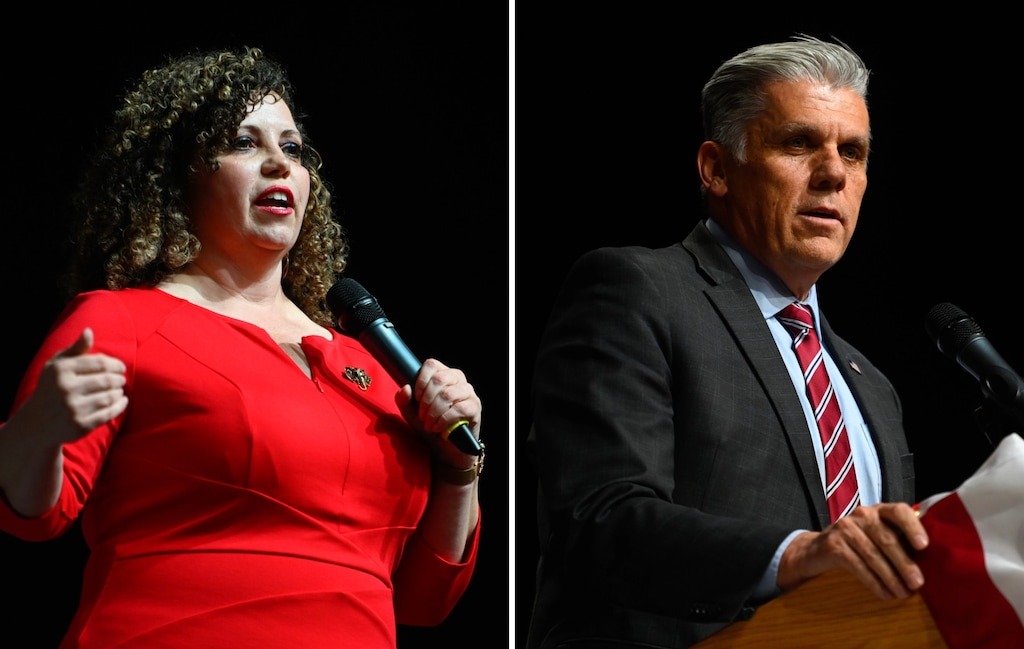
In the southern part of the state, U.S. Rep. Celeste Maloy is running for reelection and facing a primary challenge from former state lawmaker and write-in gubernatorial candidate Phil Lyman.
Lyman argues Maloy is too aligned with the Republican establishment, and Maloy has campaigned on her experience as a member of Congress and, previously, as a congressional staffer.
Whoever wins the Republican primary will face off against Democratic nominee Kent Udell in November’s general election.
The Salt Lake Tribune posed the following questions, based on a reader survey about the issues Utahns felt were most important this election season, to both Republican primary candidates. Their responses may have been edited slightly for length, style or grammar.
A plurality of voters, more than 30%, said elected official corruption is the primary issue driving who they’ll vote for, with another 14% of voters saying it’s their second-highest issue. Why are so many Utah voters concerned about corruption in politics? How will you build trust with Utahns?
Lyman: People instinctively know when they are being lied to. Demanding trust while implementing a “dignity index” is manipulation, especially from those shown to be politically motivated. Trust is earned through transparency. I’ve spent 15 years demanding it: fighting federal land grabs, pushing for election audits and to end the revolving door between lobbyists and campaign managers. Voters are right to be concerned. When the same firms manage campaigns, gather signatures and lobby the legislators they helped elect, accountability disappears. I’ll fight for open government and real oversight.
Maloy: Our political institutions rely on trust and support from the American public and Utahns. Utahns are concerned about corruption because they see Washington failing at its most basic job: budget honestly, control debt, and putting people ahead of politics. Trust is rebuilt by doing the work: returning to regular order, cutting waste, being transparent about tough choices and refusing angry, divisive campaigns that tear down institutions for clicks. I’ll focus on results, accountability and putting Utah first.
After corruption, more than 16% of Utah voters said everyday affordability - like the cost of housing, groceries, gas, etc. - is the first thing on their minds as they vote this year. Another 15% said it is their second-highest issue. What will you do to help make life more affordable for Utahns?
Lyman: Inflation is the largest tax that American families face. The federal government must stop the deficit spending and the fraud, waste and abuse that drives it. Unlocking CD3’s energy resources means better jobs and lower costs for gas and groceries. I support auditing the Federal Reserve and oppose visa programs that undercut Utah wages and pressure our housing markets. I’ll fight regulations that slow development and drive up housing costs. We need representatives who protect Utah families, not the programs that threaten them.
Maloy: Affordability starts with getting Washington’s spending under control. When the government borrows too much, Utah families pay the price through higher inflation, higher interest rates and a weaker economy. I’ll keep pushing Congress to return to regular order, pass responsible budgets, cut waste, protect taxpayers and make long-term reforms that strengthen programs like Social Security instead of waiting for a crisis. We need lower costs, more accountability and a government that lives within its means.
(Alex Goodlett | Special to The Tribune) Third Congressional District GOP candidate Phil Lyman speaks during the 2026 GOP nominating convention at Utah Valley University on Saturday, April, 25 2026 in Orem.
Utah has experienced drought for much of the last two decades. The availability of water is the third-most pressing issue for voters this year. What can elected officials do to ensure Utahns have enough water for the future?
Lyman: We need to capture more of the water that falls on this state. Currently, we only divert 4% to 8% of our precipitation. We need more infrastructure. A healthy forest produces 20% more water than an unhealthy one, yet federal agencies block sensible forest management. The Utah legislature must reestablish the jurisdictional authority granted at statehood. I am not talking about transferring land ownership. I am talking about jurisdiction. Without it, decisions about water are made by people who are not accountable to Utahns.
Maloy: Elected officials need to plan ahead, protect Utah’s water rights and keep decisions close to the people who live here. According to the Utah Constitution, the water in the state belongs to the people of Utah. Unfortunately, federal agencies have a long history of undermining our water laws by requiring co-ownership of water rights as a condition for permit agreements on federal lands. I’m proud to lead my colleagues in sponsoring this bill, which clarifies that states have the power to allocate water rights, and the federal government can’t infringe on that ability.
Should the state continue to pursue nuclear energy, yes or no? What can be done to address Utah’s growing energy needs?
Lyman: Yes. CD3 sits on 77 billion barrels of recoverable oil, world-class uranium deposits and critical minerals. Federal permitting backlogs and monument boundaries are the only obstacles. I’ll push to shorten National Environmental Policy Act timelines, open monument boundaries to responsible energy development and support nuclear as America’s energy future. Utah’s uranium can end our dependence on Russian-aligned producers. The resources are here. We need a congressman who will protect Utah’s right to produce.
Maloy: Yes. Utah needs an all-of-the-above energy strategy that keeps power reliable, affordable, and produced here at home. I believe local communities should have more control over energy generation, transmission, mining, oil and gas, public lands and water. I support greater domestic production of fossil fuels, geothermal, nuclear energy and critical minerals to meet our growing energy needs and strengthen American energy independence. That’s why I introduced the STEAM Act to cut red tape, speed up geothermal development, and clear the way for Utah to produce more energy and jobs.
(Rick Egan | The Salt Lake Tribune) Celeste Maloy makes a comment at the Red Cat ribbon-cutting ceremony on Friday, April 24, 2026.
In 2018, voters narrowly passed the Better Boundaries initiative, creating an independent redistricting commission and prohibiting partisan gerrymandering. The Legislature’s attempts to significantly weaken the Better Boundaries initiative spawned years of litigation, culminating in a court adopting new congressional boundaries. Who should be responsible for drawing Utah’s political boundaries? Why?
Lyman: The Utah Constitution is clear that drawing political boundaries is the purview of the Legislature. The Constitution also grants the people legislative rights equal to the legislature. The Better Boundaries maps, while important for a final determination, were not the product of the people despite the legal opinion of a judge. Rather than fight the ruling, the legislature supported a signature gathering effort to repeal Prop 4, essentially ceding their legislative authority to a politically motivated single member of the judicial branch.
Maloy: Utah’s political boundaries should be drawn by elected representatives who are accountable to the people, not by judges behind closed doors. When unelected judges step in and impose their own maps, it undermines public trust. That’s why I joined Burgess Owens and other elected officials across the state to litigate this decision and return this power where it belongs – with Utahns and their elected representatives.
Is there an imbalance of power between the Legislature and the courts? If so, what should be done about it?
Lyman: Yes. In a republican form of government, that balance of power requires a legislature that is not only vigilant, but is also a guardian of the rights of the people, even if it means opposing the executive or the judicial branch. What we observe is self-interested legislators battling against self-interested activist judges — and the people suffer the fallout. The solution is legislators who respect citizens and understand the Constitution as a governing model that actually works.
Maloy: Yes. There is an imbalance when courts stop interpreting the law and start making political decisions that belong to the Legislature. Judges have an important constitutional role, but they should not be drawing congressional maps or overriding the authority of the people’s elected representatives.
What do you believe is the most pressing issue before voters this year? What can be done to address it?
Lyman: Transparency. Before you can fix a problem, you must identify its source. Those who benefit from bad policy do not want to be seen. They obfuscate, deflect, threaten and gaslight. Our constitutional system was designed to combat and navigate exactly those subversive forces. Federalist No. 10 lays it out plainly. Without transparency, we do not have a government by and for the people. We have an instrument of plunder that says you may not look at me. I will make transparency the foundation of how I serve CD3.
Maloy: Families are doing everything they can to live within their means, but the federal government keeps borrowing, spending and passing the bill to the next generation. What we need is a serious course correction. Congress has to stop treating every dollar as free money and start setting real priorities. That means cutting wasteful spending, reforming the budget process, reducing bureaucracy, growing the economy and putting everything on the table so we can protect taxpayers and rebuild trust.