 Addy Baird
 Emily R. Anderson
Utah Republican delegates voted Saturday to force two of three GOP congressional representatives running for reelection into June primary contests.
Incumbent U.S. Rep. Blake Moore lost a vote of Republican delegates at the party’s nominating convention in Orem, where delegates overwhelmingly voted to endorse Utah House Rep. Karianne Lisonbee of Clearfield over Utah’s only member of congressional leadership.
Moore, who represents the state’s current 1st Congressional District and is running to represent the newly drawn 2nd District, will still appear on the ballot in June after having gathered the necessary 7,000 signatures from voters. But the hotly contested primary signals a split among some of the state’s most involved conservative voters.
And in a second round of voting, U.S. Rep. Celeste Maloy narrowly topped former state lawmaker and gubernatorial candidate Phil Lyman, allowing the latter to secure his spot in the June primary.
The incumbent won by only 18 votes — 50.95%. to 49.04%, according to the party.
Maloy, who currently represents the state’s 2nd District and is running in the newly drawn 3rd District, already collected enough signatures to make the primary ballot without delegates’ endorsement.
The contest was forced to a runoff vote after Maloy garnered an even 50% votes in the initial round, while Lyman received 47.2%.
Earlier in the day, several elected officials spoke to the crowd as delegates gathered in the UCCU arena in Orem, including U.S. Sen. Mike Lee, who is not currently running for reelection. Lee was greeted by cheers and some boos. In his remarks, he railed against the recent redistricting decision that resulted in the redrawing of Utah’s new congressional districts and cheered the convention process.
(Alex Goodlett | Special to The Tribune) U.S. Sen. Mike Lee speaks to delegates during the 2026 GOP nominating convention at Utah Valley University on Saturday, April, 25 2026 in Orem.
Nominating power, he told the delegates, “belongs to you, to we, the people, not the experts, not to paid signature gatherers, but to this convention, these delegates here today.”
Lee argued in favor of the SAVE America Act, a bill he’s sponsoring in the U.S. Senate that would require voters to present proof of citizenship when registering to vote, a measure that experts say would do little to make elections more secure, as there is no evidence of widespread noncitizen voting as Lee claims.
The bill has thus far failed to gain traction in the U.S. Senate, even among some Republicans.
Congressional campaigns
When it came time to consider candidates in congressional races, delegates first heard from the those running in Utah’s newly drawn 1st Congressional District.
Stone Fonua, a retired police officer, took the stage first and sang Latter-day Saint hymn “Love at Home.”
He was followed by Dave Robinson, the former spokesperson for the Salt Lake County Republican Party. Robinson sued dozens of news outlets and elected officials in 2023, including The Salt Lake Tribune, after the outlets reported allegations of harassment against him.
“There’s been a whispering campaign that Dave Robinson is litigious,” he said in remarks to delegates. “No, Dave Robinson likes process and transparency.”
Robinson argued that although there is a big advantage for Democrats in the new 1st District, it is still winnable for the GOP with a “unique candidate.”
But it was U.S. Navy Reserve officer Riley Owen who ultimately won the nomination, garnering votes from 71.2% of the delegates.
“I believe in America, the American dream that has fueled our prosperity for centuries,” Owen said during his remarks to the crowd. “I am not willing to let progressive ideologies dissolve that dream into a mere fantasy, not in America, and especially not in Utah.”
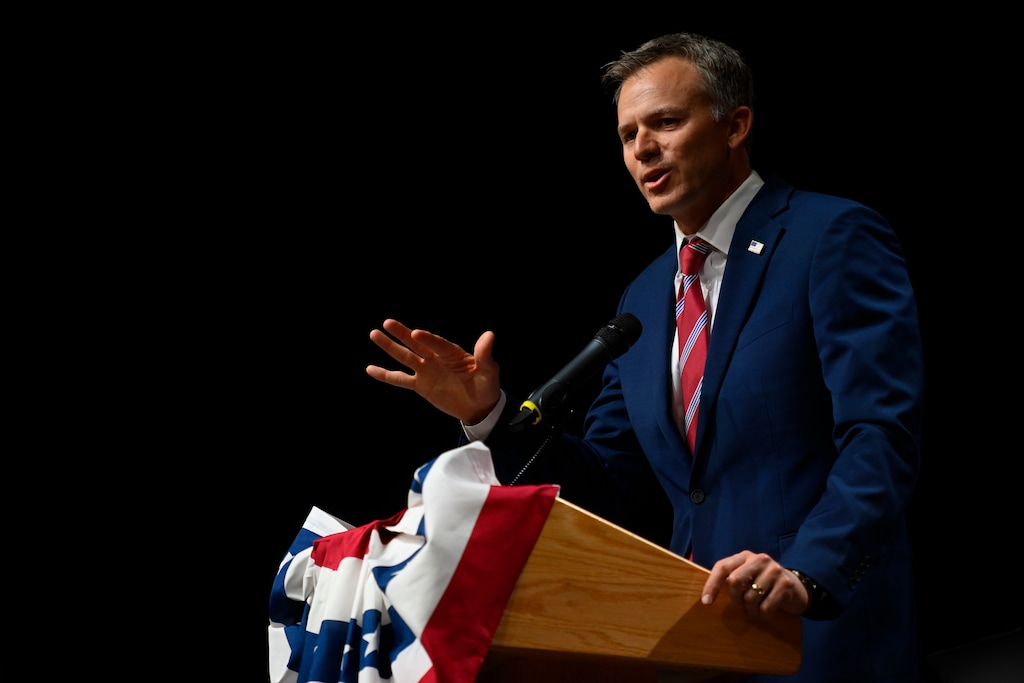
(Alex Goodlett | Special to The Tribune) U.S. Rep. Blake Moore speaks to a crowd during the 2026 GOP nominating convention at Utah Valley University on Saturday, April, 25 2026 in Orem.
Later, Moore took the stage to both applause and scattered boos.
In his remarks, he touted his endorsement from President Donald Trump, his work on the One Big Beautiful Bill last year and leaned into the conservative rhetoric often popular with the GOP delegates.
“Republicans secure borders. Democrats open them,” he said. “We support law enforcement. They refuse to fund ICE and border control. [We support] women playing women in sports. Men do not play women’s sports. We embrace merit over DEI.”
In November, Moore said, voters will be faced with a choice of “common sense versus crazy.”
Colton Hatch, one of Moore’s two Republican primary challengers, focused his remarks on conservative immigration policy before Lisonbee took the stage to huge applause.
Lisonbee took direct aim at Moore in her speech to delegates, hitting Moore for his previous work with anti-gerrymandering group Better Boundaries and for living outside the newly drawn district in which they are both running.
“My opponent worked with Democrats to turn a reliably red Utah congressional seat deep blue,” she said.
(Alex Goodlett | Special to The Tribune) Second Congressional District GOP candidate Karianne Lisonbee speaks during the 2026 GOP nominating convention at Utah Valley University on Saturday, April, 25 2026 in Orem.
It was a message that resonated with delegates, who overwhelmingly voted in favor of Lisonbee. The state lawmaker ultimately garnered 61.5% of the vote, making her the official, party-endorsed nominee in the upcoming primary.
Moore, however, has successfully collected enough signatures from voters to still appear on the ballot in June, despite receiving just 33.7% of the delegates’ votes. Hatch earned 4.8% of the vote.
Saturday wasn’t his first loss at convention. When Moore ran for reelection in 2024, the representative lost 45% to 55% at convention, but went on to handily win that primary with over 70% of votes.
(Alex Goodlett | Special to The Tribune) U.S. Rep. Celeste Maloy speaks during the 2026 GOP nominating convention at Utah Valley University on Saturday, April, 25 2026 in Orem.
And in the race for the new 3rd District, Maloy told the delegates she has been “effective” in the House by “channel[ing] spirit of pilgrims, pioneers and patriots.”
“All I’m asking today is that you give me a chance to keep doing that,” she said.
Lyman took the stage to Muse’s “Supermassive Black Hole” — a song popularized by the 2006 Twilight movie — and huge applause from the delegates. Lyman previously primaried Gov. Spencer Cox in the 2024 gubernatorial race.
In his remarks he called for releasing the Epstein files and “stopping the invasion of America.”
“The only thing more tragic than a rebel without a cause is a righteous cause without a rebel,” Lyman said. “And more powerful than any rebel is the Republican Party that believes in freedom.”
(Alex Goodlett | Special to The Tribune) Third Congressional District GOP candidate Phil Lyman speaks to a crowd during the 2026 GOP nominating convention at Utah Valley University on Saturday, April, 25 2026 in Orem.
Meanwhile, despite facing the largest group of intraparty challengers, freshman U.S. Rep. Mike Kennedy had the largest margin of victory among his colleagues in the federal delegation.
Running for reelection in the 4th Congressional District, Kennedy secured 78.7% of delegates’ votes. And because none of the four Republican candidates running against Kennedy collected signatures to make the primary ballot, Saturday’s results guaranteed the representative’s spot in November.
Legislative races
One closely watched race came early Saturday as delegates considered candidates for Senate District 18. Utah House Rep. Doug Fiefia of Herriman is challenging incumbent Riverton Sen. Dan McCay. Conservative political activist Tracie Halvorsen also made a bid for the seat, but did not make it past the first round of delegate voting, in which Fiefia received just over 44% of the vote and McCay received just over 35%.
In his initial remarks to delegates, Fiefia talked about his parents “chasing the American dream” by immigrating to the United States from Tonga in the 1970s.
“I’m living proof that the American dream is real,” he said.
Fiefia highlighted infrastructure issues in the district and called for lower taxes.
(Alex Goodlett | Special to The Tribune) Utah GOP Chair Robert Axson speaks during the 2026 GOP nominating convention at Utah Valley University on Saturday, April, 25 2026 in Orem.
McCay discussed his mission for The Church of Jesus Christ of Latter-day Saints to India and offered his own vision of the “American dream.”
“I will just say, the American dream for me is if you are willing to work, if you’re willing to sacrifice and you’re willing to apply your talents, you can achieve the American dream — and the Utah dream as well,” he told the delegates.
In a second round of voting, Fiefia garnered just over 58% of the vote, with McCay narrowly holding on to more than 40% of delegates’ support, ensuring both lawmakers will be on the summer primary ballot.
Utah Senate President Stuart Adams will also be joined on the June primary ballot by two other Republicans hoping to unseat the longtime lawmaker and legislative leader. While Adams gathered enough signatures to secure his return to the primary, he also received the highest percentage of delegates through three rounds of voting Saturday morning.
Braden Hess — who didn’t collect signatures and told delegates he believes in the convention process — trailed Adams in each round of voting, but ultimately sustained enough support to be co-nominated with Adams. Stephanie Hollist lost in the second round of voting Saturday, but collected enough signatures of support from Republicans in Senate District 7 to join Adams and Hess on the ballot this June.
Retired longtime Congressman Rob Bishop, who served as Utah House speaker for two years in the 1990s, is poised to return to the Legislature after winning a special election to represent House District 6.
“So Rob Bishop’s name will be given to the governor later today, when I get time to do that, and he will be sent back to represent the same district he represented 20 years ago,” Utah GOP Chair Robert Axson said Saturday afternoon, announcing results.
Bishop, however, actually left the state Capitol more than three decades ago. Delegates also voted to make him their nominee for the seat in November.
Tight security at UVU
(Alex Goodlett | Special to The Tribune) U.S. Sen. John Curtis speaks to a crowd during the 2026 GOP nominating convention at Utah Valley University on Saturday, April, 25 2026 in Orem.
Seven months after conservative commentator Charlie Kirk was shot and killed during a speaking event on Utah Valley University’s campus, security at the UCCU Center for the Republican convention was similar to what is now standard for large concerts and sporting events — no liquids and clear bags only, with metal detectors and law enforcement officers posted around the arena.
Volunteers, offering clear plastic bags to delegates, stood near the center’s entrance and sent scores of backpack-toting delegates back to the parking lot to store their bags in their vehicles.
After the initial breakout voting sessions, Axson spoke to delegates in the arena just before noon and recalled Kirk’s death on the campus last September.
“It is our duty, and I believe it’s our obligation, unfortunate as it may be, that we take and remember the work that Charlie Kirk did here across this country … and honor the responsibility that we have here in Utah carrying forward his message,” Axson told the crowd before calling for a moment of silence to remember the conservative commentator.
The party’s most important work, the party chair said, was “carrying forward his efforts and making sure, again, that the next generation remembers the principles of freedom and liberty. That is our obligation, if nothing else.”