 Brooke Larsen
Any day now, Congress could throw out the management plan for what has been nicknamed Utah’s “science monument.”
Over 150 scientists and scientific groups sent a letter to Congress and the U.S. Department of the Interior on Thursday, defending Grand Staircase-Escalante National Monument as “one of the most important living laboratories in North America.”
The letter asks Congress to vote against a joint resolution introduced by Utah Republican Sen. Mike Lee and Rep. Celeste Maloy to scrap the national monument’s management plan using the Congressional Review Act. If the resolution passes, the Bureau of Land Management would not be able to create a plan that is substantially similar, according to the act.
“Grand Staircase-Escalante National Monument is one of the greatest windows into Earth’s past anywhere on the planet,” Rowan Lockwood, president of the Paleontological Society, said in a statement. “Scientists are making extraordinary discoveries there — from dinosaurs and ancient mammals to entire ecosystems we never knew existed — and those discoveries are only possible because this landscape has remained protected and scientifically managed at a large scale.”
Dismantling the monument’s management plan “sends a deeply troubling message” about how the country values science and public lands, she added.
The federal government emphasized the scientific value of the 1.9 million acres of red rock country when it was established as a national monument in 1996. “The monument presents exemplary opportunities for geologists, paleontologists, archeologists, historians, and biologists,” former President Bill Clinton said in the proclamation.
The federal government has flip-flopped on the monument in recent years, though. President Donald Trump shrunk the monument during his first term in 2017, and former President Joe Biden restored the monument to its original boundaries in 2021.
(Bethany Baker | The Salt Lake Tribune) A sign welcomes visitors to Grand Staircase-Escalante National Monument near Tropic on Monday, Dec. 16, 2024.
Scientists have identified dozens of previously unknown species in the monument since its designation, from an extinct flying reptile to a giant ancestor of the modern Gila monster, according to the letter. Many of the discoveries have been found nowhere else on Earth, the scientists added.
One of those scientists, Jackie Grant, director of Grand Staircase-Escalante Partners, used the monument as a living laboratory when she was formerly a biology professor at Southern Utah University.
Her students examined slime on rocks to test water quality and learned how to catch and identify some of the more than 660 native bee species that live in the monument — comparable to the total number of bee species found east of the Mississippi River.
“We have an incredible amount of biodiversity of bees, and that’s because we have an incredible amount of biodiversity of plants on the monument,” Grant said in an interview. “About a third of all the native plants that can be found in the state of Utah can be found in Grand Staircase-Escalante National Monument.”
Overturning the current management plan may deter scientists from continuing to do research in the monument, she added.
“If they are scared that the monument is going to change, or that the permitting system is going to change, or that their access is going to change, or perhaps a site where they’re studying is going to get run over by OHVs,” Grant said, “then that makes them less likely to choose the Grand Staircase as a place to do their scientific work.”
What’s next for Grand Staircase-Escalante
Congress may make a decision on the future of the monument’s management within the next few weeks.
The Government Accountability Office determined that the monument’s management plan was considered a “rule” under the Congressional Review Act in January after Maloy sent a letter to the office asking for them to review the plan.
Lee entered the GAO decision into the Congressional Record on Feb. 25, starting the clock for a “60-days-of-continuous-session period” during which Congress could vote away the monument plan with a simple majority. Lee and Maloy introduced a joint resolution of disapproval of the monument’s plan on March 4. If voted on within the 60-day period, it cannot be filibustered in the Senate, according to the act.
Based on Congress’s schedule, it will likely hit that 60-day deadline around June 8-10, said Grant Stevens, communications director for the Southern Utah Wilderness Alliance.
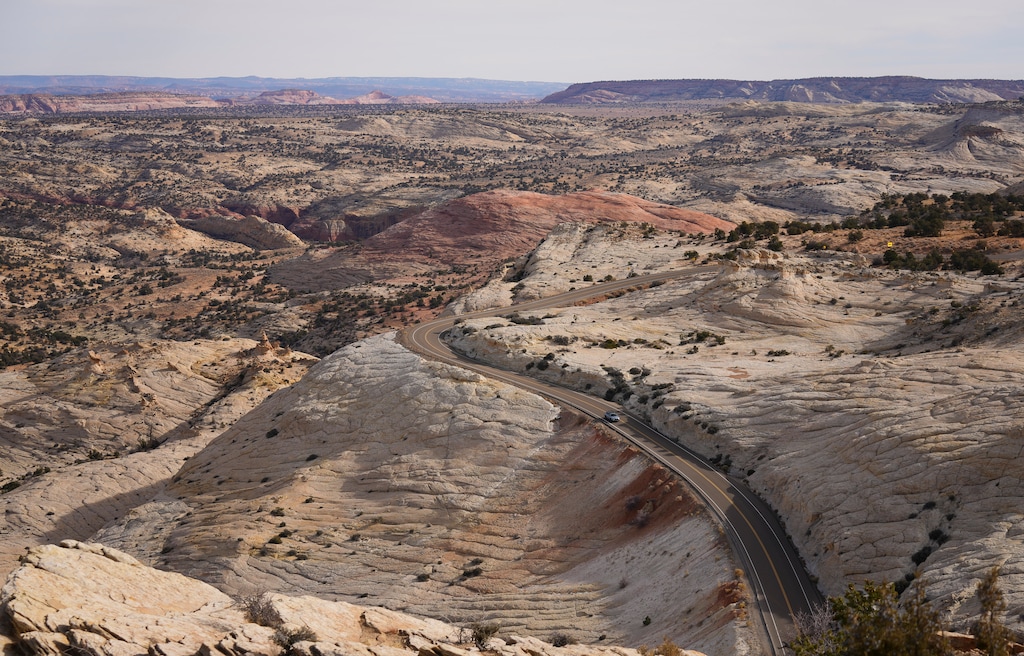
(Bethany Baker | The Salt Lake Tribune) Grand Staircase-Escalante National Monument, seen from Utah Scenic Byway 12 near Boulder on Tuesday, Dec. 17, 2024.
“This resolution uses Congress’s constitutional responsibility to check executive overreach and returns management to a plan that actually listens to the people on the ground,” Maloy said in a statement in March. “And to be clear: this land remains federal land. It remains protected. What changes is that the communities who live here get their voice back.”
Neither Maloy’s nor Lee’s offices responded Thursday to requests for comment on the scientists’ letter.
The 2025 management plan was finalized during the Biden administration after the Bureau of Land Management conducted an environmental analysis, collected public input and met with local, state and tribal governments for over two years, according to the agency.