 Emily R. Anderson
 Robert Gehrke
A power shift in Utah’s Legislature has some veteran politicos wondering something counterintuitive: Could the party’s loss actually be beneficial to Utah’s GOP governor?
The state constitution gives governors the power to kill any bill, or portion of a budget bill, by exercising a veto. The Legislature can override vetoes if two-thirds of the members in both the House of Representatives and Senate vote to do so — and since 1998, the GOP has held an uninterrupted veto-proof supermajority across both chambers.
Now, Republican seats in the House are expected to fall below the two-thirds mark, with a dozen GOP incumbents behind their challengers and Democrats ahead in a handful of open races, according to unofficial returns.
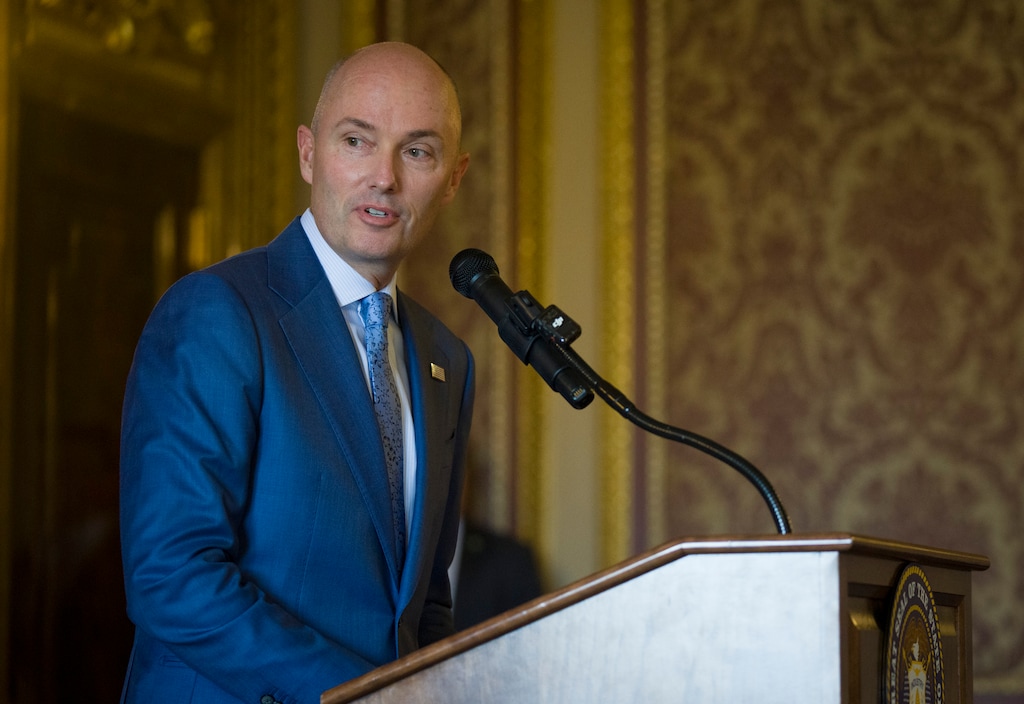
That could help Gov. Spencer Cox secure his preferred policies when he disagrees with legislative leaders.
“You would think that having his own party have more seats could only work to his advantage,” said Adam Brown, a political science professor at Brigham Young University. While the supermajority was an exception to that idea, with its loss, “I’m a little at a loss on what to expect, honestly,” he said, “because you do see the two branches of government butt heads.”
Most recently, in 2022, Gov. Spencer Cox blocked a bill to ban transgender girls from playing on school sports teams that align with their gender identity. The GOP Legislature reconvened and resurrected it with the votes of 56 Republicans in the House and 18 Republicans in the Senate, despite a few members in both respective caucuses voting against the override.
Without a supermajority, Cox’s veto would have stood.
A shift in power
It isn’t that vetoes are common. They are rarely used, and even less frequently overridden. Since taking office in 2021, Cox has vetoed 20 bills out of nearly 3,400 passed, and the sports ban reinstatement in 2022 was the Legislature’s sole reversal.
Utah lawmakers have called only five veto-override sessions in the 28 years since the GOP’s continuous supermajority began, restoring a total of nine bills (plus 10 budget line items rejected in 2018).
But the threat of a veto — and the risk that one would be undone — along with the political fallout that follows can have just as much of an influence on policy outcomes, according to Brown.
“If the governor chose to play hardball with the Legislature in a backroom discussion,” Brown said, “and tell them, ‘If you pass this bill without making these changes, I will veto it,’ they’ve got to take that a little more seriously.”
He added, “It wouldn’t surprise me if you get to the end of the [next legislative] session and the governor feels that maybe his threat of a veto has been a little more fruitful.”
As the Legislature has taken steps to accrue more power in recent years, some of that has come at the expense of the governor, said Derek Miller, who served as former Gov. Gary Herbert’s chief of staff.
“I’ve even heard people say, ‘Well, the Legislature wants to be a super governor.’ They want to be the ones controlling education policy. They want to be the ones making these executive decisions,” Miller said. “To the extent that there’s now an opportunity to restore some of that balance, I think that’s a good thing.”
His ex-boss agreed. In an interview, Herbert said losing a veto-proof supermajority gives legislative leaders more incentive to collaborate with the executive branch “with the goal of developing good policy.”
Herbert attributed the surge in fellow Republicans’ legislative losses to voters having a sense that legislators are passing major laws without transparent and thoughtful deliberation.
“We’ve got people that are good legislators that just got thrown out of office because of what? It’s bad [legislative] process,” Herbert said.
Miller said Cox’s style of governing has differed from Herbert’s, who he said was more inclined to let the legislative process play out and then decide whether to sign or veto the end product.
Cox, as a former legislator himself, is more involved in the dealmaking that goes into refining the bills, Miller said.
“What I am really hopeful will happen is that having more balance in our Legislature will bring more transparency, more accountability and ultimately a better process that leads to better outcomes,” Miller said.
Whether the new makeup of the Legislature makes a difference next year for Cox, who has said he is not running for reelection in 2028, is ultimately situational.
Herbert pointed out that Democrats occasionally joined Republicans in overriding his vetoes. And Brown noted that governors cannot use their veto power to force a policy into law.
“The thing with a veto is it’s only a brake and never a gas pedal,” Brown said.
Another boost for Democrats
Frank Pignanelli, who led House Democrats from 1991 to 1996, remembers awaiting a vote to override a bill vetoed by then-Gov. Norm Bangerter when his phone rang unexpectedly.
It was Bangerter, who was five votes short of sustaining his veto and he needed help, Pignanelli recalled. What was it going to take to deliver five votes?
Pignanelli, unprepared for the request, panicked and asked for a recycling task force.
“And the governor said, ‘Fine. We’re going to do something on recycling. Stop the veto,’” Pignanelli said.
It was the first of many times Bangerter would come to the Democrats for help, Pignanelli said. At the time, the minority party held 31 seats — enough to keep the majority Republicans short of the supermajority needed to impose their will on the body.
“It was a nice feeling,” Pignanelli said, “but the Republicans didn’t like it.”
Beyond gaining seats, Pignanelli said, breaking Republicans’ supermajority can mean Democrats receive more invitations to the bargaining table.
In some cases, they can unite with moderate Republicans to pass legislation opposed by the more extreme members. Or, as was the case with Bangerter, Democrats can provide some additional muscle to a governor’s veto threat.
Current House Minority Leader Angela Romero, who is running to be reelected top Democrat, said she hopes her caucus’s expansion results in both parties and branches of government better collaborating to improve Utahns’ quality of life, leaving behind divisive culture war issues.
And she wants to see Cox use the power he is gained to move policymaking in that direction.
“He wasn’t on the ballot, but I hope he’s looking at these results from election night and taking them seriously,” Romero said. “People are really frustrated.”