 Brooke Larsen
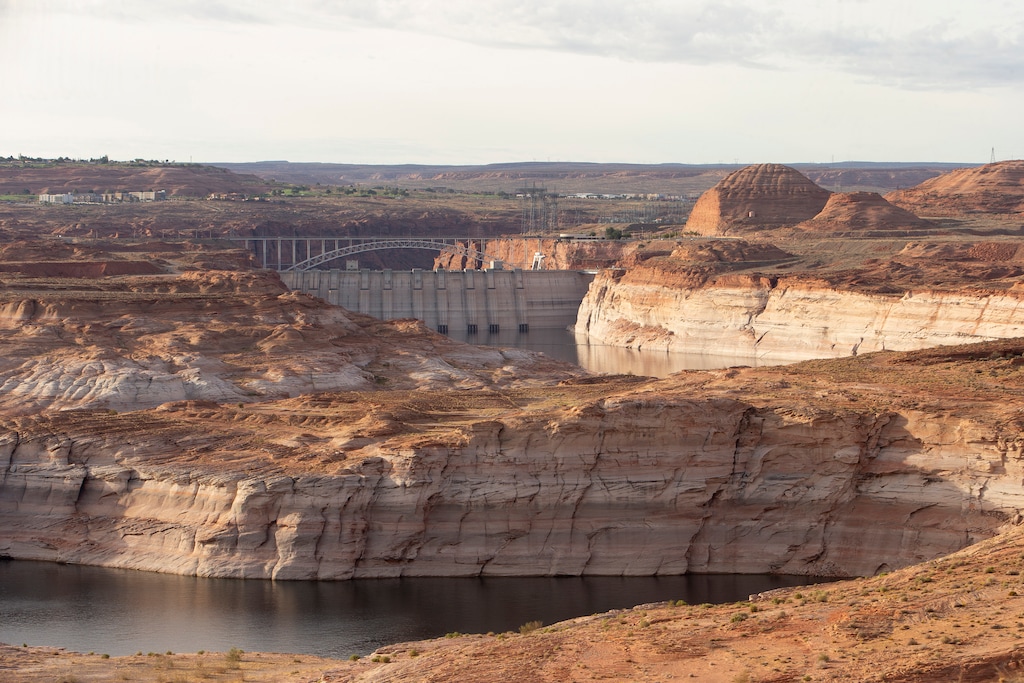
Record rains in the Four Corners region this fall have boosted Lake Powell by over 20 feet and improved the long-term outlook for the Colorado River reservoir.
The Bureau of Reclamation’s latest forecasts show Lake Powell’s elevation staying above 3,500 feet over the next year. That’s the level the federal agency has identified as critical to protect hydropower generation and downstream releases from Glen Canyon Dam.
“However, with all that good news, we’re still four feet below where we were a year ago,” said Gene Shawcroft, Utah’s Colorado River commissioner during a meeting of the Colorado River Authority of Utah on Tuesday. “A six-week wet period certainly doesn’t resolve 25 years of drought.”
The downpours also caused devastating flooding across the Four Corners region, including the southeast corner of Utah. “It’s been quite a ride,” Shawcroft said, “and my heart goes out to many who are impacted … and will continue to be impacted for weeks, if maybe not years.”
Three to five times more rain than usual has dumped across much of Utah this fall, said Elizabeth Cotter, staff engineer with the authority. That rain raised soil moisture levels, but water from snow is still 70% of median levels and temperatures remain above average.
(Courtesy of William L. Rukeyser) Flooding, looking downstream towards the San Juan River, is seen from a bridge in Bluff on Sunday, Nov. 1, 2026.
The uncertainty in the bureau’s forecast grows significantly after April 30 when runoff from the snow-covered peaks begins flowing into the Colorado River Basin.
“It’s all about what happens in snowmelt,” said Jack Schmidt, senior research scientist at Utah State University’s Center for Colorado River Studies.
Reclamation’s latest forecast shows a “middle of the road” scenario closely resembling the 2024 winter, said Schmidt.
“If we hadn’t had this rain, we would have gone over the cliff by April 30th,” he said.
That “cliff” is the point at which Lake Powell’s water levels fall so low that dam operations are jeopardized and the Colorado River system enters a legal quagmire.
“This allowed us to take a half a step back from the edge of the cliff,” he continued. “A big step back from the edge of the cliff is only going to be determined by snowmelt.”
Last year’s November most probable forecast predicted Lake Powell would end September at 3,539 feet. In reality, it dropped to 3,518 feet after a historically dry winter. But thanks to lower releases from Lake Powell and a boost from Flaming Gorge, the reservoir didn’t drop to 3,500 feet, as the November 2025 dry scenario study forecasted.
(Chris Caldwell | Special to The Tribune) The end of the Antelope Point launch ramp on Lake Powell near Page, Ariz., Wednesday, Sept. 23, 2026.
The bureau has released around 540,000 acre-feet of water from Flaming Gorge so far, and the agency estimates it will reach 660,000 acre-feet of releases in December, Shawcroft said.
States and the federal government agreed to release between 660,000 acre-feet and 1 million acre-feet of water from Flaming Gorge from spring 2026 through spring 2027, with the option to revisit that plan if hydrology changed.
Given the “unprecedented” rain and the latest forecast from the bureau, Shawcroft said states and the federal government should reevaluate Flaming Gorge releases.
Colorado River agreements in the works
States and the bureau are also working to finalize a new framework for releases from Flaming Gorge and other Colorado River reservoirs upstream of Lake Powell.
The Upper Colorado River Commission, which includes Colorado, New Mexico, Utah and Wyoming, voted to approve a plan last week. It still needs approval from the federal government, though.
Utah and other Upper Basin states are also ironing out another agreement that will determine how the federal government handles water conserved by Utah’s Colorado River water users.
The federal government awarded Upper Basin states $100 million for voluntary water conservation programs over the next five years. Utah will use its $23 million share to continue its Demand Management Program, which pays farmers and other water users for temporarily and voluntarily sending water downstream rather than using it.
(Brooke Larsen | The Salt Lake Tribune) A sprinkler hangs dry from a pivot system on a fallowed field that was enrolled in the Demand Management Program at Ruby Ranch on Monday, Aug. 10, 2026.
The federal government has indicated its willingness to work on an agreement that will give states credit for the water they conserve.
“That water … would buffer or offset any forced reductions Utah water users would have to take under a curtailment scenario,” said Amy Haas, director of the Colorado River Authority of Utah.
Upper Basin states also want the bureau to consider water they contribute as “operationally neutral” — meaning the bureau does not count it when determining how much to release from Lake Powell.
The bureau said it will not consider operational neutrality without a seven-state agreement, though, Haas said.
Negotiations among the seven states that share the Colorado River, which also includes Arizona, California and Nevada, have stalled.
The Colorado River Authority of Utah voted to move forward with its Demand Management Program and open the application process despite lacking agreements on credit.
“It’s a risk, I think, that the state of Utah is going to take by continuing to commit resources, staffing and time to pursue these activities,” Haas said. “I’m confident that we’ll continue to have this conversation with Reclamation over the coming year, and we’ll get somewhere in terms of credit.”
The authority voted to begin accepting applications for the program no later than Dec. 14.
This article is published through the Colorado River Collaborative, a solutions journalism initiative supported by the Janet Quinney Lawson Institute for Land, Water, and Air at Utah State University. See all of our stories about how Utahns are impacted by the Colorado River at greatsaltlakenews.org/coloradoriver.