 Brooke Larsen
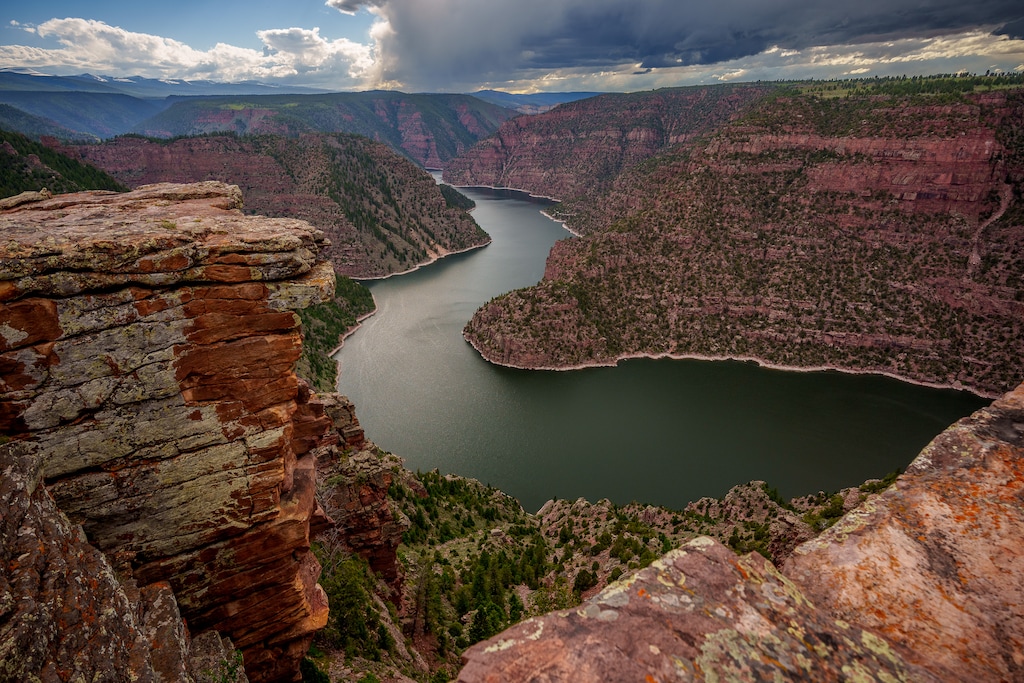
Utah and other Upper Basin states gave their reluctant support for the federal government to release an unprecedented amount of water from Flaming Gorge to bolster Lake Powell, which could fall below hydropower-generating levels as soon as August, forecasts show.
The Upper Colorado River Commission on Tuesday approved a drought response operations agreement with the Bureau of Reclamation that authorizes releasing up to 1 million acre-feet of water from Flaming Gorge, which straddles the Utah and Wyoming border.
“The drought is just absolutely crippling across our entire state and across the West,” Gene Shawcroft, Utah’s Colorado River negotiator, said during a separate meeting of the Colorado River Authority earlier Tuesday.
The approval was not “made lightly,” Brandon Gebhart, Wyoming’s Colorado River negotiator, said. “We recognize that what we are approving today will have significant negative impacts on our water resources, our local economies and recreation, both this year and for years to come.”
The releases from Flaming Gorge will likely make three boat ramps unusable on the Wyoming side of Flaming Gorge, Gebhart added.
On the Utah side, Daggett County’s recreation economy will be particularly affected, Amy Haas, executive director of the Colorado River Authority of Utah, told The Tribune.
“Flaming Gorge is their livelihood,” Haas said.
But the releases from Flaming Gorge could also help outfitters on the Green River that operate below the dam, she added. “You might have positive impacts on the Green. More flow in the river, you’ve got more rafters and potentially some anglers who might like that.”
(Trent Nelson | The Salt Lake Tribune) The Flaming Gorge Dam on Wednesday, June 21, 2023.
Projections shown during the commission meeting show that even a 1 million acre-feet release from Flaming Gorge will not be enough to prevent Powell from dropping below minimum power pool, or 3,490 feet, though.
At that level, Glen Canyon Dam can no longer generate electricity or sustain long-term releases to the Grand Canyon, Lake Mead and downstream states.
“If Glen Canyon Dam declines below 3,490 feet, water releases would be only through the river outlet works, which could cause operational issues, uncertainty for users, downstream impacts, instability in regional power and water supplies, and a reduction in power generation,” the bureau said in a statement last week.
To try to prevent the lake from dipping to that critical elevation, the bureau also plans to reduce releases out of Powell from 7.48 million acre-feet to 6 million acre-feet.
The bureau expects to start both actions this week, possibly as early as Thursday, said Wayne Pullan, the bureau’s regional director.
Based on April forecasts, the bureau expects these two moves will prevent Lake Powell from reaching minimum power pool.
“I wish I could say I was confident in that forecast,” Haas told The Tribune. “I’m not because of the changes that we’ve seen over the last couple of months.”
After a record warm March, the amount of water forecasted to flow into Powell dropped by nearly 1 million acre-feet from the previous month’s projection.
“Runoff is over. Flows are down,” Shawcroft said during the commission meeting. “That just doesn’t affect the small area around Flaming Gorge; it affects the entire state, and it’s a very, very dire situation. … The entire drainage basin is suffering dramatically.”
(Natural Resources Conservation Service) The snow water equivalent, the amount of moisture in snow, peaked early and at a record low this year, according to the latest data from the Natural Resources Conservation Service on Tuesday, April 21, 2026.
Water managers, ranchers and farmers are having to make “heart-wrenching decisions,” he added.
Water managers may have to cut back senior users with rights dating back to 1861, said Dan Larsen, board member of the Colorado River Authority of Utah for Duchesne and Uintah Counties. “It’s going to be tough,” he added.
For the Price and San Rafael River areas, Jay Mark Humphrey, another board member, said he thinks all irrigation will be shut off by August.
Uncertainty for next water year
The Upper Basin approved the emergency drought plan but Chuck Cullom, the commission’s executive director, said they can’t assess its effectiveness beyond September given that most of the drought agreements that govern the reservoir’s operations expire at that time.
The states and federal government will also continue to assess the effectiveness of the drought operations and adjust releases as needed, Haas said.
The new water year at Lake Powell starts on Oct. 1. That’s also when the bureau must have new guidelines in place for operation of the reservoir and the Colorado River system before current plans expire. The federal government has been facilitating discussions with the seven basin states to try to reach a consensus agreement, but those negotiations have so far fallen short.
While releases from Flaming Gorge may help prevent a near term crisis, climate projections show drought continuing in the Colorado River Basin.
“This water can’t be relied upon year after year,” Jenny Dumas, attorney for the Jicarilla Apache Nation, said regarding Flaming Gorge releases during the commission meeting. “It’s going to take time to recover these reservoirs before we can do this again.”
“We really want to emphasize the need for serious and permanent changes in how we use and manage the river to adjust to current and future hydrology,” she added.
This article is published through the Colorado River Collaborative, a solutions journalism initiative supported by the Janet Quinney Lawson Institute for Land, Water, and Air at Utah State University. See all of our stories about how Utahns are impacted by the Colorado River at greatsaltlakenews.org/coloradoriver.