 Brooke Larsen
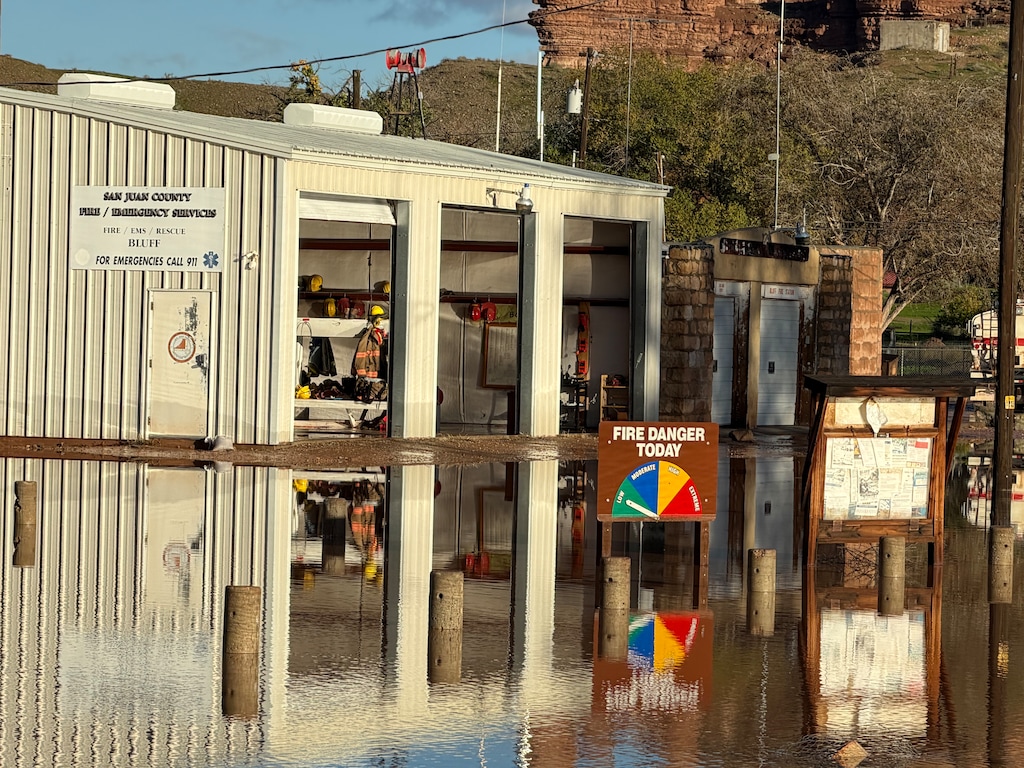
Dark orange water filled the parking lot of the post office and fire station in Bluff on Monday. Dirt roads were washed out and impassable across Navajo Nation chapters in southeastern Utah. And residents’ homes and businesses were flooded yet again after rain poured down on the Four Corners area over the weekend.
The past couple weeks have been like “a one-two punch,” Bluff Mayor Josh Ewing said.
Record rain in the region has produced waves of floods in the San Juan River and creeks, streams and washes across Utah’s typically dry San Juan County. Just as recovery was beginning for communities last week, more rain dumped on the soggy soils over the weekend, prompting the county to declare a local emergency Sunday.
The state of Utah on Monday declared emergency election accommodations, after Lt. Gov. Deidre Henderson visited the county for a second time in the past week. The declaration means affected voters can receive and return their ballots electronically, according to a news release.
Voters who can’t travel to a drop box or polling location will receive an email Tuesday morning if there is an email address on record. Voters who do not receive an email and have not voted yet can call the county clerk before 5 p.m.
“We want every eligible voter in San Juan County to be able to cast a ballot if they have not done so already,” Henderson said in a statement.
As storm clouds unleashed onto the Abajo Mountains north of Bluff on Sunday night, water rushed down Cottonwood Wash, hit the bridge and washed uphill on the highway into popular town businesses, such as the Canyon Smokehouse, and government buildings. Ewing had to evacuate his friends, neighbors and town businesses at 2 a.m. Monday.
(Raini Pachak | Bluff Community Foundation) Flooding in Bluff early on Monday, Nov. 2, 2026.
The latest flood affected nine or 10 businesses and between seven and 10 homes, according to Ewing’s initial estimates, including the building where the Bluff Community Foundation had been storing supplies for families affected by the floods.
The floodwaters damaged some donated clothes, but the foundation was able to salvage most donated goods and move them to the Bluff Community Center on Monday, said Amanda Podmore, Bluff resident and the foundation’s secretary.
The water rose rapidly and dropped quickly in the latest storm, Ewing said, so it didn’t soak and inundate homes quite as dramatically as the last flood.
“But we have some really serious impacts to our local municipal infrastructure,” he added. “Our post office remains underwater. Our fire stations were flooded, and one of our most important historic sites in San Juan County, the Bluff Fort, is underwater.”
(Josh Ewing | Town of Bluff) Heavy rains flooded the Bluff post office and fire station on Monday, Nov. 2, 2026.
(Josh Ewing | Town of Bluff) The Bluff Fort was flooded after heavy rains roared through Cottonwood Wash in Bluff on Monday, Nov. 2, 2026.
The water rushing down Cottonwood Wash also reinundated homes and businesses that the roaring San Juan River flooded last week, including Bluff Gardens Cabins and Cadillac RV Park.
“It was very much insult to injury to folks that had been working hard all week to clean out and then basically have their businesses flood again,” Ewing said.
The San Juan River is expected to peak past flood stage near Bluff again on Thursday, according to the Colorado Basin River Forecast Center, as the precipitation that dumped in Colorado and New Mexico reaches southeast Utah. That could reflood areas such as the Atcitty Camp, which was devastated by the previous surge in the river.
Meanwhile, Navajo Nation chapters in Utah continue to face jurisdictional challenges accessing resources and funding support.
“Anytime emergency resources are deployed, it seems that it ends on the north side of the river,” Martha Saggboy, president of the Mexican Water chapter, said. “Resources never reach us on the south side of the river.”
“Because that’s all reservation” land, she added.
The Navajo Nation chapters in Utah are also on the northern edge of the reservation, leading to gaps in resources from the tribe’s government as well, Saggboy said.
Saggboy sent a letter to the Utah Division of Emergency Management last week asking the state to support the her and other Navajo Nation chapters in Utah with flood recovery.
The state is in conversation with the Navajo Nation about the request, said Joe Dougherty, public information officer for the division.
The state sees the “heartbreaking situation” in the Navajo Nation, he said.
“The land fits within what we call the borders of Utah, but because it’s also in a sovereign nation, the Navajo Nation actually has the ability to decide what it wants to do with its own disaster response,” he added.
Road closures cut off communities
The heavy rains have caused road closures surrounding Bluff, the Navajo Nation communities across southeastern Utah and the greater Four Corners region.
Floods tore a chasm through the bridge over Comb Wash on Highway 163 between Bluff and Monument Valley early Monday morning.
“That’s a really important thoroughfare for folks getting from Bluff to Mexican Hat and to Monument Valley, and so it’s disrupting everything from folks who are trying to get to work to tourism traffic,” Podmore said.
Roads are closed and washed out throughout the Navajo Nation chapters in Utah. “A lot of the dirt roads that they use to get to the highways — to their medical appointments, to get groceries, or even school — are swept away,” said Ryan Benally, a professor in the home and community department at the Utah State University campus in Blanding.
That’s the biggest issue facing the Red Mesa Chapter right now, said Ronalda Joe, the chapter manager.
Red Mesa Road, which connects Red Mesa and Montezuma Creek, has been closed for days. The bypass route, Flat Top Mountain Road, was also completely washed out on Sunday by an orange stream running across it, according to a Facebook post from the Navajo Nation Division of Transportation.
(Navajo Nation Division of Transportation) Heavy rains washed out Flat Top Mountain Road in Red Mesa, forcing a route closure on Sunday, Nov. 1, 2026.
The rain and floods have eroded other dirt roads across the Red Mesa area, and the Navajo Nation Division of Transportation wants to wait to fix them until the ground is less saturated, Joe said. But there are miles of private dirt roads to people’s homes that are not the division’s responsibility to fix, she added.
“How am I supposed to fix their roads when I don’t have the proper equipment?” Joe said. “That’s the biggest issue that I’m facing.”
Saggboy said her chapter also doesn’t have the equipment needed to fix the dirt roads in her corner of the Navajo Nation. “The reservation is so huge, I don’t know if they’ll ever get to us,” she said.
Flooding also forced the closure of Utah highways 262 and 162, making travel in and out of Montezuma Creek “extremely restricted,” Utah Navajo Health Systems said in a Facebook post. The closure on Highway 162 was lifted late Monday evening.
The floods have caused damage to water lines over the past week, leaving some without running water. Some families on the reservation already lacked access to running water before to the storms, and now hauling water has become more difficult, Saggboy and Joe said.
USU in Blanding has been collecting water, food and other supplies to distribute throughout southeast Utah.
“One of the biggest challenges is getting the supplies and finding ATVs and vehicles that can take the supplies to these families that are far off,” said Talia Hansen, one of the coordinators of the donation center and policy analyst for Voices for Utah Children.