 Gordon Monson
Duality and division exist within the innermost realm of the Utah athletic department these days — and outside of it, too. Up with hopes here and down with dopes there; spirits soaring and spirits souring; folks who are pleased with the organizational leadership, folks who are pissed.
Indeed, the moniker “U of U,” at least regarding sports, might as well stand for Undulations of Utah. Even as football is climbing to new heights, there are whispers from various corners that dissent is strong, that discord rules the day.
And the man in the middle of the friction has a name, too.
Mark Harlan.
Over Harlan’s eight years as boss of Utah sports, neither controversy nor a combo-pack of roughed-up feelings and ruffled feathers has been in short supply. There are those connected and/or formerly connected to the department who can’t stand the AD. Others tolerate him, at least some, because they have to in order to stay employed at a school they love. One man seems to adore Harlan, or is willing to put up with him, and that individual, with the title of president, might be the most important name in all of this.
Taylor Randall.
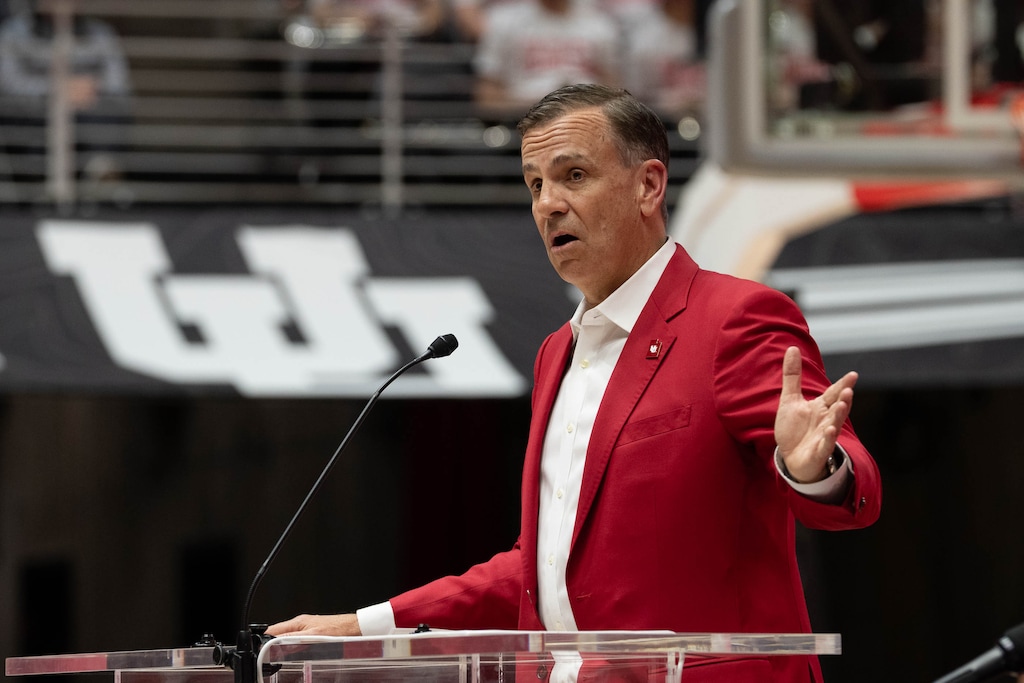
Before we go any further, the intent here isn’t to dress out Harlan as Beelzebub himself. In a recent hourlong meeting with me and head basketball coach Alex Jensen (we’ll get to him), Harlan was a complete professional. And when asked about division in his athletic department, he responded with a mix of bewilderment and wonder.
And, as university leaders point out, the U. has seen success under Harlan, highlighted by the 2022-23 season, when the Utes won Pac-12 titles in football, gymnastics, women’s basketball, softball and men’s tennis (along with a skiing national championship). Utah has set fundraising records, too.
Still, good results don’t always equal a sound process. And my analysis here is based on interviews with around a half dozen trusted sources connected to Utah — people who requested anonymity to protect their standing. Asked about the overall effect Harlan has had at the school, they answered back with their own question: “How does this man still have a job?”
Some of the public stuff is most public.
Harlan made it that way with his behavior, his infamous commandeering of the focus and sound of cameras and microphones, at and after the Utah-BYU football game two seasons back. He danced in protest onto the field after a late holding call went against the Utes, and the AD claimed in a ridiculous postgame session with the media that the refs “stole” the game from Utah and that he wasn’t proud to be a part of the Big 12 Conference.
That scene wasn’t bold, it wasn’t courageous, it was embarrassing for Harlan and, more significantly, for the university. And his tardy apology was tepid, too, all of it drawing a fine of $40,000 from the Big 12.
A lot of people thought Harlan should have been fired for that.
He wasn’t.
Even his wife, Carolyn, gave him the what-for over that debacle. He told me that as critical as I and other outsiders were of him regarding his behavior, none of it matched the disapproval coming from her.
Apologists want to say, hey, that was a long time ago, just let it be. Any administrator committed to a cause, in his weakest moment, might run onto the field waving his arms and screaming his guts out, claiming competitive thievery, while the action is still ongoing. He should be forgiven.
More recently, equally unprofessional and even more ham-fisted was the way Harlan handled Kyle Whittingham’s departure.
Even if Morgan Scalley ends up being a fine head coach, and every early indication is that he will be, you don’t shove an icon out the door after two decades running Utah football, particularly one who just finished a 10-2 season, on top of making winning a habit. That push was clumsy and ugly — and expensive, costing the school some $13 million in departure fees. Money for nothing. And Harlan’s fingerprints were all over that mess.
Divisions remain in the department, despite Scalley’s remarkable success thus far, over the AD’s oversight of that.
Regardless of what happens at Michigan, where Whittingham’s seat is all kinds of hot on account of his initial struggles there, the coach achieved too much for him to be treated the way he was.
Sure, he flip-flopped on his future plans and wasn’t the most helpful when it came to accommodating certain powerful entities at the school. Whittingham most definitely could be difficult at times, and he didn’t kiss up to Harlan, but he won more games at Utah than any coach ever has. He deserves a statue at Utah, not the stigma and stain that resulted, no matter how many players and staff members he took with him to Ann Arbor.
The remnants of that imbroglio, how it was handled or mishandled depending on who you talk to, can still be seen, heard and felt at Utah among big-money boosters, among fans, and throughout the Utes community.
Everyone, though, is happy with the way Utah football is trending at present. It’s like a rose bush growing and blossoming out of a mudslide.
If Harlan deserves credit for that, give it to him.
Utah men’s basketball has been a whole other matter.
Under Harlan, that endeavor has fallen far short of the traditional standard. Let’s repeat: It’s been eight years for him now. Utah is a once-proud basketball school where trips to the NCAA Tournament were a habit. Were. Not only did the Utes often make the tournament, they had a winning record there.
Well.
The AD fired Larry Krystkowiak five years ago, hired Craig Smith, let him fiddle-and-faddle around for a few years, doing nothing special, then fired Smith, then hired Jensen before last season. In the midst of so much mediocrity, it’s been a decade since the Utes made the NCAA Tournament.
Many people believe the hiring of Jensen, a long-ago Ute player, back when Utah was actually good at basketball, back when there were a whole lot more filled seats at the Huntsman Center than empty ones, and later, an NBA assistant coach, was a fine move. The man knows ball inside and out. He’s a Ute icon. He’s a people person, easy to like. He knows what Utah has to do to be successful in this day and age of NIL benefits and quick transfers. The need for resources is greater than ever. And he is fully aware of the shortcomings the program now demonstrates.
Still demonstrates.
In Jensen’s first season, he did not have what he needed to bounce his team forward. The Utes finished 10-22 and won just two conference games.
The plain truth is this: the coach needs more than what he’s gotten from Harlan. John Wooden could be coaching the Utes, and with the relatively limited support available at Utah to date, he would have a losing record.
In our recent conversation with Harlan, Jensen came out and respectfully said he needs more. He wasn’t overly critical. He didn’t bash Harlan. He said things were getting better. Harlan said, in so many words, that things in and around Ute basketball were not where he wants them to be, but that those things would get better.
The Utes recently signed four-star guard Jamaal McKnight Jr., who held offers from Maryland, Georgetown, Tennessee and TCU, among others, and three-star guard Pierce Thompson, who drew interest from California and Mississippi State. Maybe there’s some truth to the idea that things are, indeed, getting better.
But others — including coaches and U. employees in a position to know the inner workings at Utah — say Harlan has not provided Jensen with the support, the communication, the pathway required to win, to grow the program, to get fans back in the seats.
If the only entity Utah fans care about is football, perhaps that matters little. But for those who remember the days when the Huntsman rocked and rolled with great teams with great players with great results with great crowds, that is not sufficient.
Those critics say there have been times when the coach had to go around the athletic director straight to Randall to attempt to make basketball what he intends it to be.
In our meeting, Jensen would not say that, did not say that.
Sources say Jensen at one point secured a large amount of money from a booster for his program and that the coach feared that if he informed Harlan about the gift, Harlan would take it and spend it elsewhere.
Trust, they say, is scarce.
Again, Jensen waved that notion off. And Harlan, in that setting, spoke like an administrator who wants nothing but wonderful things for Jensen and his team.
Other coaches and employees who disapprove of the way Harlan leads his department, from a managerial and personal standpoint, do not wave it off. They say the division and discord are real.
It’s a rough-and-tumble world out there in major college sports these days. Money, even when it’s connected to private equity, has to be channeled here and there, not everywhere. Decisions must be made; sometimes discord arises. But discord can rot a department from the inside out. Whether Harlan is a net positive or a net negative, readers and fans and boosters and top administrators can decide for themselves what they believe.
But at Utah, no matter what side you’re on, division exists.