‘Straight out of the authoritarian playbook’: How the Trump admin may erase history, science at Utah’s national parks
National park staff flagged 37 signs in Utah that may not comply with Trump admin orders.
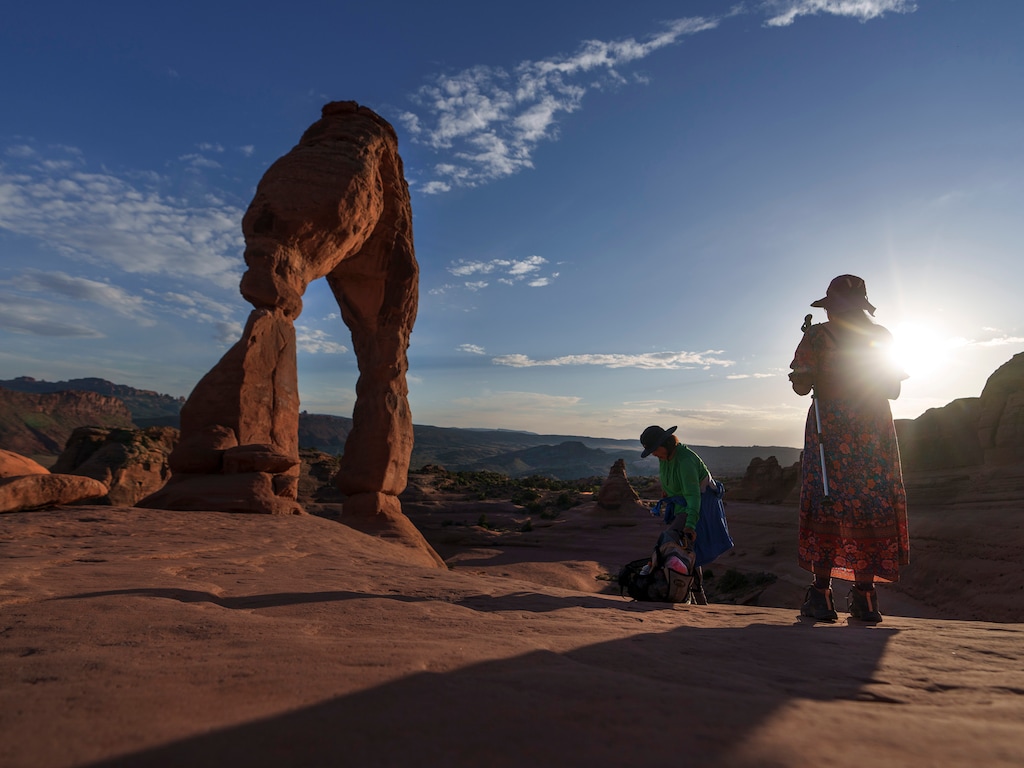
(Leah Hogsten | The Salt Lake Tribune) Delicate Arch in Arches National Park in 2023. From climate change to Indigenous history, dozens of exhibits at Utah’s national parks have been flagged for possible removal under a Trump administration order.
An exhibit that describes what almost drove the California condor to extinction in Bryce Canyon National Park. A sign in Arches that says Indigenous people were forced onto reservations. A wayside that explains how pollinators are in peril in Zion.
These are just some of 37 signs and exhibits that national park staff in Utah have flagged as potentially out of compliance with Trump administration orders to throw out or edit materials that “inappropriately disparages Americans” or talks about any aspect of nature other than its “beauty, abundance, or grandeur.”
The submissions from park staff were leaked by a group that referred to themselves as “civil servants on the front lines” and verified by The Washington Post last week.
“This data belongs to the American people, who need to know what is being done in their name,” the group said.
Democratic senators slammed the Trump administration’s efforts to “erase history” on the U.S. Senate floor Wednesday afternoon.
“We cannot be a better nation or a stronger one if we ignore or hide from our own past,” said Sen. Martin Heinrich (D-N.M.), ranking member of the Senate Committee on Energy and Natural Resources.
“Loving America means embracing our collective effort to learn from our shortcomings, to embrace the collective aspiration to build a better future,” said Sen. Jeff Merkley (D-Ore.).
Get Red Rock Roundup newsletter. Get the Red Rock Roundup, your source for Washington County news every week.
Heinrich and Merkley sent a letter, co-signed by 15 other senators including Ruben Gallego of Arizona and Catherine Cortez Masto of Nevada, to the Interior Department last week demanding information on the park exhibits removed, altered and under consideration.
So far the Interior Department has reviewed more than 2,000 signs and exhibits, Heinrich said, and has ordered the removal or alteration of hundreds.
“We know they aren’t done,” he added.
The park service told The Tribune that no signs have been removed in Zion National Park so far, but did not respond to additional questions about Utah’s other national parks and park service-managed national monuments.
“Staff were asked to identify materials that might warrant clarification,” a park service spokesperson said in an email. “Elevating an item for consideration does not mean it violates the Order, and it does not mean it will be changed. In the vast majority of cases across the system, flagged materials remain unchanged.”
Heinrich called the Trump administration’s orders “straight out of the authoritarian playbook.”
“It should anger every single American listening today,” he said. “When we erase information about who we are, when we silence people’s stories, we promote a narrative that ignores and manipulates what truly happened.”
History that may be erased at Utah’s parks
National park staff flagged signs with potentially disparaging depictions of history at seven parks and national monuments, including Arches, Bryce Canyon, Canyonlands, Dinosaur National Monument, Glen Canyon National Recreation Area, Golden Spike National Historic Park and Zion.
(National Park Service) A panel on Chinese railroad workers at the Golden Spike National Historic Park. The park submitted a section of the sign for review by the Trump administration because of its tone while discussing "discrimination and violence" ethnic minorities face, according to a database leaked on March 2, 2026.
(National Park Service) A section of a panel at Golden Spike National Historic Park on Chinese railroad workers. The park submitted it for review under Trump administration orders “due to modern political sensitivity and tone,” according to a database leaked on March 2, 2026.
(National Park Service) A panel in Bryce Canyon National Park describes how humans almost drove the California Condor to extinction. The park submitted the sign for review under Trump administration orders, according to a database leaked on March 2, 2026.
(National Park Service) A panel in Arches National Park that discusses a historical cabin. The park submitted it for review under Trump administration orders because it references the removal of Indigenous people from the area, according to a database leaked on March 2, 2026.
(National Park Service) An exhibit in Canyonlands National Park was submitted for review by the Trump administration because it describes cattle grazing in "negative terms," according to a database leaked on March 2, 2026.
(National Park Service) An exhibit in Canyonlands National Park was submitted for review by the Trump administration because it describes cattle grazing in "negative terms," according to a database leaked on March 2, 2026.
(National Park Service) A panel in Canyonlands National Park describes the impacts of grazing and mining on native plants. The park submitted it for review for potential removal under Trump administration orders, according to a database leaked on March 2, 2026.
(National Park Service) A sign in Golden Spike National Historic Park describes how the railroad affected Indigenous people. The park submitted it to the Trump administration for review “out of an abundance of caution” because the way it describes the disruption of Native food sources "could be seen as harsh,” according to a database leaked on March 2, 2026.
(National Park Service) A panel in Arches National Park discusses increased tourism. The park submitted it for review under Trump administration orders because it cites Edward Abbey’s book “Desert Solitaire,” according to a database leaked on March 2, 2026.
(National Park Service) A panel on the historic poisoning of Peregrine falcons in Bryce Canyon National Park was submitted for review under Trump administration orders, according to a database leaked on March 2, 2026.
(National Park Service) A panel at an overlook in Canyonlands National Park shows features visible on the landscape. The park submitted it for review under Trump administration orders because it discusses old roads from uranium trucks as “scars,” according to a database leaked on March 2, 2026.
1 / 11
In northern Utah, Golden Spike provided potential revisions for two signs: one that discusses racism and Chinese railroad workers and a second that describes how the military supported killing bison to deprive Indigenous people of food. The sign “could be seen as harsh,” the latter submission said, “but aligns with documented history.”
Arches staff sought guidance on whether or not a sign about Edward Abbey, a deceased writer and former ranger at the park in the 1950s, falls within the scope of the order. The sign currently describes Abbey’s book “Desert Solitaire” that “argued against allowing too many tourists into national parks.” Ironically, the sign adds, his words “inspired even more people to visit Arches.”
Visitation is a contentious issue at Arches, and the park recently canceled its timed-entry system.
At nearby Canyonlands, staff questioned whether signs that discuss the historic impacts of livestock grazing and uranium mining on native plant communities are out of compliance. Two exhibits in the Needles Visitor Center on the “enduring scars from cattle grazing” are slated for removal in winter 2026, according to the submission.
Other historical material up for review include:
A sign in Bryce Canyon National Park that describes how peregrine falcons almost went extinct in the 1970s because of chemical poisoning.
Signs at Lees Ferry in Glen Canyon National Recreation Area that describe John D. Lee, a Mormon pioneer and polygamist who was involved in the Mountain Meadows Massacre.
A film in production that explores both positive and negative impacts of Glen Canyon Dam on tribes.
‘Does not emphasize beauty, abundance, or grandeur’
Several submissions from Utah’s national parks questioned whether signs that describe the natural environment in the parks met the standard of emphasizing “beauty, abundance, or grandeur.”
(National Park Service) A sign on the effects of human-caused climate change visible in Arches National Park. The park submitted it for review for potential removal under Trump administration orders, according to a database leaked on March 2, 2026.
(National Park Service) A sign on floods in Zion National Park that was submitted for review under Trump administration orders because it does not emphasize “beauty abundance, or grandeur,” according to a database leaked on March 2, 2026.
(National Park Service) A panel on biological soil crust in Arches National Park. The park submitted it for review under Trump administration orders because it discusses “negative outcomes associated with the loss of of soil crusts,” according to a database leaked on March 2, 2026.
(National Park Service) A wayside sign on prescribed burns in Zion National Park was submitted for review under Trump administration orders because it does not emphasize “beauty abundance, or grandeur,” according to a database leaked on March 2, 2026.
(National Park Service) A panel that introduces visitors to scientific research at Arches National Park. Because it mentions "climate change," the park submitted it for potential removal or revision under Trump administration orders, according to a database leaked on March 2, 2026.
(National Park Service) A wayside in Zion National Park that discusses the Virgin River. Park staff submitted it for review under Trump administration orders because it does not emphasize “beauty abundance, or grandeur,” according to a database leaked on March 2, 2026.
(National Park Service) A sign that discusses graffiti and invasive species at Arches National Park. The park flagged the sign for review in response to Trump administration orders, according to a database leaked on March 2, 2026.
(National Park Service) A wayside exhibit discusses forest management in Bryce Canyon National Park. The park submitted it for review under Trump administration orders because it emphasizes “matters unrelated to the beauty, abundance, and grandeur” of the forest, according to a database leaked on March 2, 2026.
(National Park Service) A sign describes air quality in Canyonlands National Park, including the effects of power plants, off-road vehicles and grazing. The park submitted it for review for possible removal or revision under Trump administration orders, according to a database leaked on March 2, 2026.
(National Park Service) A panel in Canyonlands National Park discusses biological soil crust. The park submitted it for review under Trump administration orders because it describes negative outcomes associated with losing soil crust, according to a database leaked on March 2, 2026.
(National Park Service) An exhibit on air quality discusses how power plants and wildfires contribute to air pollution in Bryce Canyon National Park. The park submitted it for potential removal under Trump administration orders, according to a database leaked on March 2, 2026.
(National Park Service) A sign on hoodoos in Bryce Canyon National Park. Sentences that discuss how climate change may affect hoodoos was submitted for potential revision under Trump administration orders, according to a database leaked on March 2, 2026.
(National Park Service) A sign on hoodoos in Bryce Canyon National Park discusses how climate change may affect the park’s unique geologic formations. A section of the sign was submitted for review under Trump administration orders, according to a database leaked on March 2, 2026.
(National Park Service) A sign that discusses wilderness in Canyonlands National Park. The park submitted it for review by the Interior Department because it mentions human impacts on air quality and climate, according to a database leaked on March 2, 2026.
1 / 14
Zion National Park submitted eight displays, ranging from the “Leave No Trace” exhibit in the park’s nature center to a “Big Floods” wayside that discusses flooding on the Virgin River.
“I view this as within [the order’s] guidance since flash floods are an awe-inspiring natural feature of the river even though their effects are negative,” park staff wrote about the flood sign.
Other signs that touch on the human impact on the environment that were flagged for review include:
Signs about the negative effects of stepping on soil crusts in Arches and Canyonlands National Parks. “Living soil crusts are as fragile as they are essential,” a sign in Arches says. “One footstep destroys decades of growth.”
Exhibits on haze in parks from power plant pollution, wildfire smoke and dust kicked up by off-road vehicles in Bryce Canyon and Canyonlands National Parks. “You can help keep the air clear,” a sign at Bryce Canyon says. “Conserve energy, use renewable resources, switch to cleaner technologies, and support programs that do the same.”
Signs on climate change and scientific research at the Arches.
A sign that describes how water has receded in Glen Canyon National Recreation Area as climate change-induced drought has plagued the Colorado River Basin.
The offices of Utah Sens. Mike Lee and John Curtis and Reps. Celeste Maloy and Mike Kennedy did not respond to requests for comment.
“We deserve to hear about the science behind climate change, pollution, and other challenges facing our national parks,” Kristen Brengel, vice president for government affairs at the National Parks Conservation Association, said in a statement. “This systematic erasure is deeply unpopular with Americans across the political spectrum.”
Support free news for Utah
sltrib.com is now free to access — no subscription required. We made this decision because we believe access to trustworthy, independent news shouldn’t depend on what you can afford — especially as misinformation and AI-generated content continue to rise.
Free to read doesn’t mean free to produce. Our reporters show up every day to ask hard questions and hold powerful institutions to account. That work takes resources. As a nonprofit newsroom, we rely on support from people who believe it matters. Make a donation today to fund local news that serves Utah communities.
You can help us bring more local news to more communities today.
 Brooke Larsen