facebook-pixel

Tribes and environmental groups sound alarm about fate of one of Utah’s national monuments

Utah’s congressional delegation may try to overturn the management plan for Grand Staircase-Escalante National Monument.
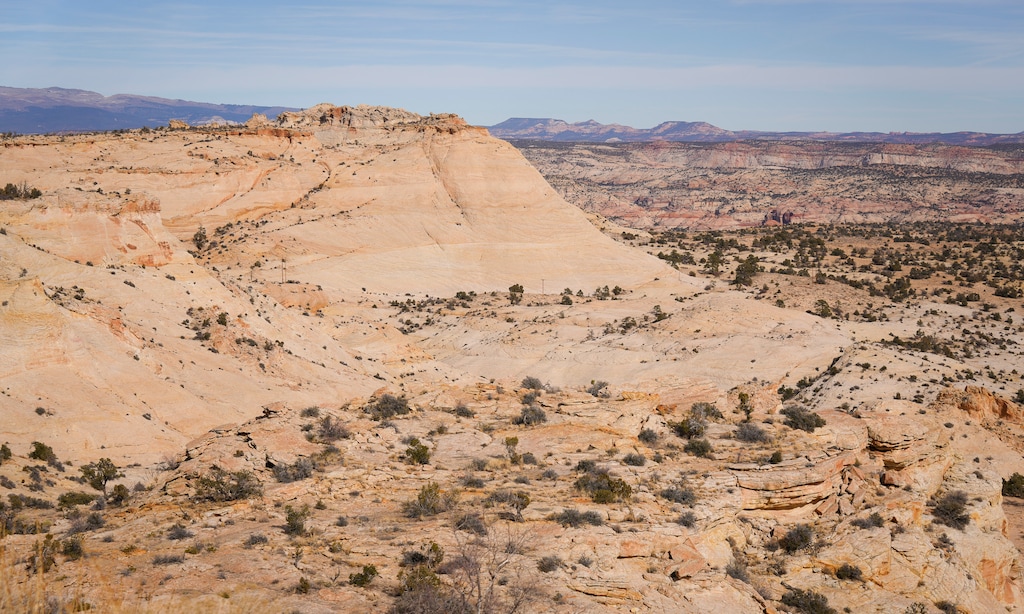
(Bethany Baker | The Salt Lake Tribune) Grand Staircase-Escalante National Monument is seen from the Head of the Rocks Overlook near Escalante on Tuesday, Dec. 17, 2024.

Utah’s congressional delegation may use an obscure federal law to slash the management plan for a popular southern Utah national monument.

The Government Accountability Office issued an opinion last week that said the management plan for Grand Staircase-Escalante National Monument must undergo congressional review.

The opinion came after Rep. Celeste Maloy, R-Utah, asked the comptroller general to determine whether the management plan counts as a rule under the Congressional Review Act in a letter sent in July, according to the GAO.

Environmental groups and the Grand Staircase-Escalante Inter-Tribal Coalition said they expect Utah’s representatives will soon try to overturn the management plan by introducing a “resolution of disapproval” in the U.S. House. If Congress passes the resolution, any future management plan must be substantially different, according to the Congressional Review Act.

This would be the first time Congress uses the Congressional Review Act to overturn a monument management plan, according to the Southern Utah Wilderness Alliance. Congress began using the law to eliminate other federal resource management plans for the first time last year.

“No one ought to mistake this effort as isolated–it’s part of a concerted effort to destroy the Bureau of Land Management’s ability to manage public lands, so that privatizing or industrializing them are the only viable options,” Chris Hill, CEO of the Conservation Lands Foundation, said in a news release Thursday.

The 1.9 million-acre monument in southern Utah, situated in the middle of Utah’s “Mighty Five” national parks, has been caught in political and legal crosshairs for years. President Donald Trump reduced its size by nearly half during his first term in 2017. The Biden administration then restored it to its original boundaries in 2021.

(Bethany Baker | The Salt Lake Tribune) A sign welcomes visitors to Grand Staircase-Escalante National Monument near Tropic on Monday, Dec. 16, 2024.

After the boundaries were restored, the Bureau of Land Management began developing a new management plan for the monument, including consultation with tribes, local governments, stakeholders and the general public, according to the agency.

“This plan reflects years of public input, scientific research, and meaningful Tribal consultation, and dismantling it through procedural shortcuts undermines good governance, responsible land stewardship, and the protection of irreplaceable cultural landscapes,” Autumn Gillard, Southern Paiute and member of the Grand Staircase-Escalante Inter-Tribal Coalition, said in a statement.

In a statement Friday, Maloy said the management plan is “fundamentally incompatible with state and local goals for wildlife management, grazing, recreation, and economic development.”

“I am working to return the monument’s management plan to its previous framework, one that balances conservation with access and reflects the needs and voices of the people who live and work on this land,” she added.

The monument’s previous management plan was finalized in 2020 after Trump shrunk the monument to half its size. The one in place prior to that dates back to 2000.

Utah’s federal delegation has historically been critical of the national monument. In a statement last year, they argued that the latest management plan, released in the final days of the Biden administration, ignored Utah voices and disregarded economic impacts on local communities.

“When the Grand Staircase-Escalante National Monument was created in 1996, it was promised to be friendly to local use and management,” the delegation said. “We will continue to fight to return our land to local control and against future federal overreach.”

A recent study from Headwaters Economics, an independent research nonprofit, found that jobs and incomes have nearly doubled in communities around the monument since its designation in 1996.

The area also includes sacred places and cultural resources for several tribes, according to the Grand Staircase Inter-Tribal Coalition, which includes the Hopi Tribe, Navajo Nation, Kaibab Band of Paiute Indians, Paiute Indian Tribe of Utah, Ute Mountain Ute Tribe and Zuni Tribe.

“Since time immemorial, the Kaibab Band of Paiute Indians lived within and around the entirety of the boundaries of the monument,” Angelita S. Bulletts, interim tribal Administrator with the Kaibab Band of Paiute Indians, said in the release. “This means that any physical impacts through development would irreparably impair the heritage and traditions of the Southern Paiute Nation.”

The inter-tribal coalition said that overturning the management plan would put cultural sites at “greater risk of looting, vandalism, graffiti, and degradation.”

“No matter the complexity of today’s debates,” Cassidy K. Morgan, programs and projects specialist with the Navajo Nation Heritage and Historic Preservation Department, said, “our guiding principle is clear: these places must be protected and honored as part of our shared heritage and as part of the life-giving system of Mother Earth.”

Help The Tribune report the stories others can’t—or won’t.

For over 150 years, The Salt Lake Tribune has been Utah’s independent news source. Our reporters work tirelessly to uncover the stories that matter most to Utahns, from unraveling the complexities of court rulings to allowing tax payers to see where and how their hard earned dollars are being spent. This critical work wouldn’t be possible without people like you—individuals who understand the importance of local, independent journalism.  As a nonprofit newsroom, every subscription and every donation fuels our mission, supporting the in-depth reporting that shines a light on the is sues shaping Utah today.

You can help power this work.